
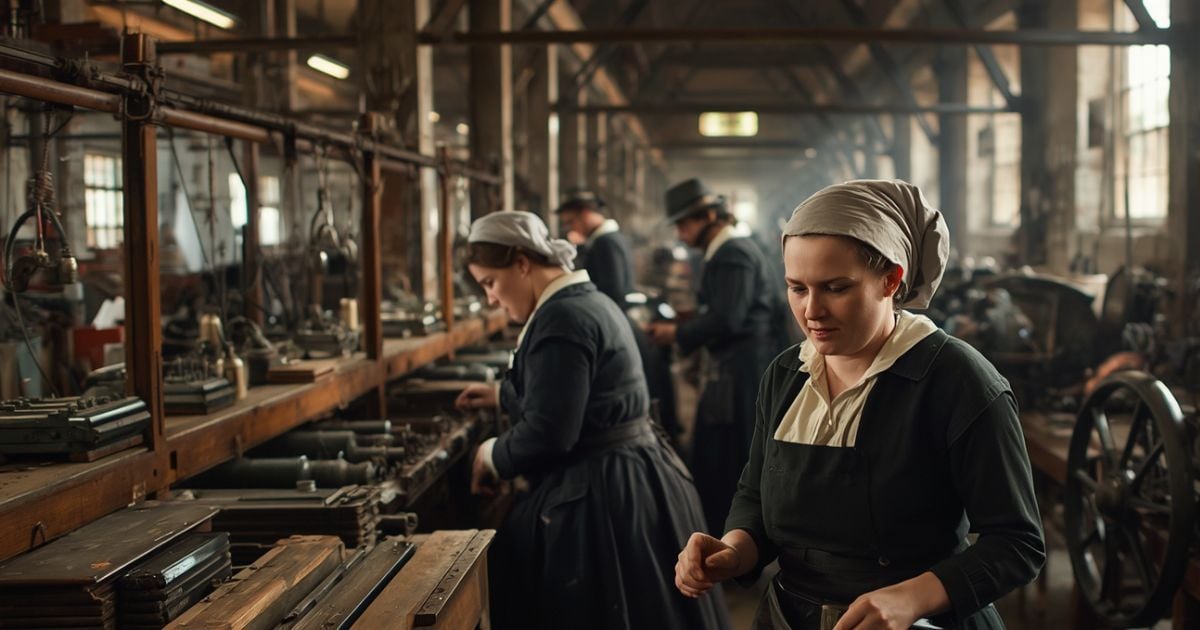
Capitalist production begins when one capital puts many workers together in one place under one master. At first the difference from a guild craftsman is only size: the medieval master's workshop, simply enlarged. Yet numbers still change things. Every worker differs from the average, and Burke claimed that in a platoon as small as five farm labourers the differences cancel out. Twelve men working twelve hours each make a collective day of 144 hours, which counts as average social labour. Give the same twelve men to six small masters and it becomes a matter of chance: one master squeezes more than the average surplus, another less. Shared space helps too. One room for twenty weavers at twenty looms costs less labour than ten rooms for two weavers each, so each product carries less of the value of the buildings and tools, as if the means of production had got cheaper.
Then comes the main point. Like a cavalry squadron or an infantry regiment, workers acting together make a force that is not the sum of their separate forces. Raising a heavy weight or turning a winch is something isolated workers cannot do at all, or only slowly. Mere contact also stirs rivalry and lifts each person's spirits. Marx gives concrete cases. A row of masons passes stones up a ladder from hand to hand, and the stones arrive faster than if each man climbed with his own load. Twelve masons attack a building from different sides at once, as if the body of men had hands and eyes before and behind. In harvest, sheep-shearing or herring fishing, the job must be done in a set time, so a hundred people stretch a twelve-hour day into 1,200 hours. Marx blames the lack of such cooperation for corn wasted in the western United States and cotton wasted in parts of East India where English rule destroyed the old communities.
But the workers cannot arrange this themselves. They must be assembled, and the capitalist must have their wages ready in his pocket before they start. Paying 300 men for one day takes more capital at once than paying a few men week by week for a year. Joint work also needs direction, as a general is needed on the field of battle and a conductor for an orchestra. Capital's direction has a second purpose, squeezing out the most surplus-value, and the workers' resistance grows with their number. So the command turns despotic, and the capitalist hands the daily watching to managers and foremen, the officers and sergeants of an industrial army. Marx turns the usual picture round: a man is not a capitalist because he leads industry, he leads industry because he is a capitalist. Then comes the sale itself. The worker sells only his individual labour-power. The capitalist pays for 100 separate labour-powers but not for the combined power of the hundred. That power appears only inside the labour process, when the workers already belong to capital, and it costs capital nothing, so it looks like a gift of nature to capital.
Marx ends by looking back. The pyramids, temples and giant statues of Egypt and Asia rose because kings and priests commanded the hands of almost the whole non-farming population, and that power has passed to the capitalist. Earlier large-scale cooperation rested mainly on slavery, while capitalist cooperation presupposes the free wage-labourer. Because it grew up against peasants and independent craftsmen, cooperation itself seems to belong only to capitalism. Marx adds that its plain form never goes away: it is still the common form wherever capital works on a large scale with little division of labour or machinery, and it lives on beside the more developed forms.
Marx identified something we experience daily but rarely name: when people work together, they create a kind of magic. A restaurant kitchen during dinner rush becomes more than individual cooks - it becomes a synchronized machine producing meals at impossible speed. A construction crew raising a wall accomplishes what no individual could. A hospital team during a medical emergency saves lives through coordinated precision. This cooperation premium - the extra value that emerges from collective effort - is real and measurable. But here's the question Marx forces us to confront: who owns this magic? The workers create it through their coordination, communication, and mutual support. Yet in most workplaces, the benefits flow upward to owners and managers who organize but don't participate in the actual cooperation. This isn't necessarily evil - coordination does require skill and carries responsibility. But Marx argues we should be honest about what's happening: workers produce individual labor plus collective magic, but they're typically paid only for their individual contribution. The magic gets captured by whoever controls the process. Understanding this pattern doesn't automatically solve it, but it does help us see our workplaces more clearly. When your team accomplishes something extraordinary, ask yourself: where does the value of that collective achievement actually go?
Explore this chapter with AI to uncover deeper meaning and practical takeaways.
AI Discussion