
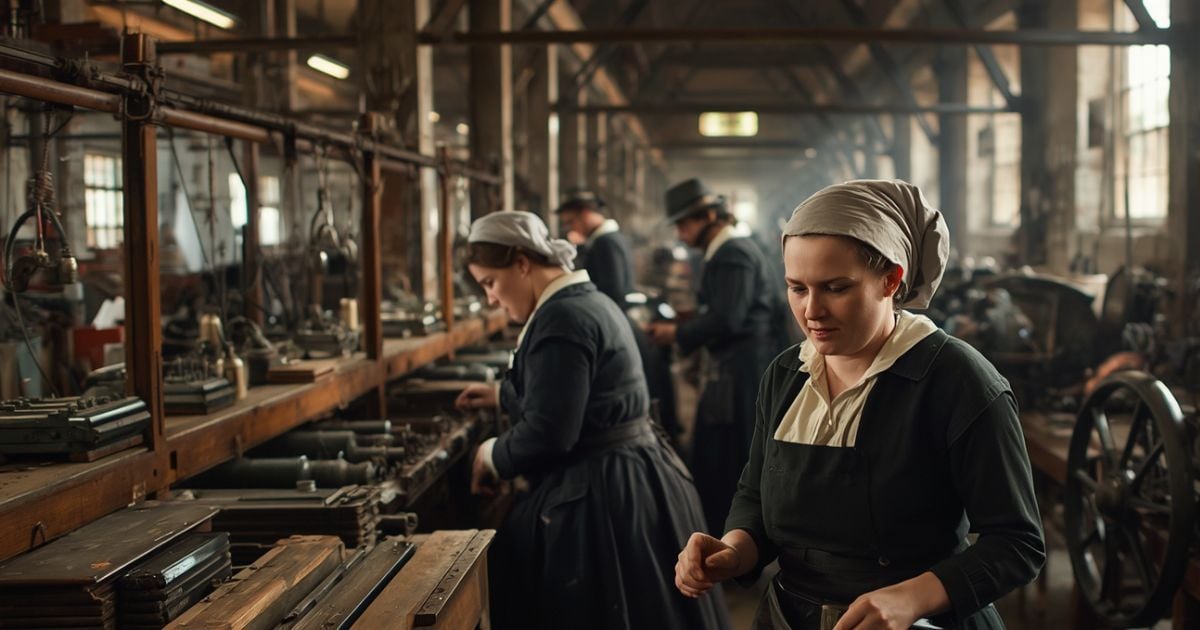
Marx draws a working day as a line. Twelve hours: ten pay for the worker's own keep, two belong to the capitalist. How can the two grow when the line cannot? Only by pushing the dividing point back, so the worker's own time shrinks from ten hours to nine. Paying four shillings and sixpence instead of five would do it, but Marx rules that out. It cuts the wage below the value of labour-power, and he assumes everything sells at its full value. So the value of labour-power itself must fall, which means the same necessaries made in less time. A shoemaker who must turn out two pairs of boots a day instead of one has to change his tools or his way of working. The whole mode of production must be revolutionised. Marx names the prizes: surplus-value from a longer day is absolute, and surplus-value from a shorter necessary labour time is relative.
No single capitalist sets out to do this. Take a factory making twelve articles in twelve hours, each costing a shilling. One capitalist doubles the output to 24, and each of his articles now costs ninepence. That is below the social value of a shilling, so he sells at tenpence, still undercutting the market and keeping a penny extra on each. His worker now needs only seven and a half hours to replace his wage, and the surplus grows from one shilling to three. Then the rivals copy him, the gap closes and the extra vanishes. The same law that lets him undercut forces everyone else to follow.
Spread across the trades that feed the worker, the effect is general. The value of labour-power falls from five shillings to three, surplus-value rises from one shilling to three, and four hours are set free for the capitalist. That answers Quesnay's riddle of why a capitalist who wants exchange-value keeps driving exchange-value down. A shorter day is never the aim. A worker who makes ten times as many articles may still work twelve hours, or fourteen. Marx catches MacCulloch, Ure and Senior praising capital on one page for shortening necessary labour and telling the worker on the next to prove his gratitude by working fifteen hours instead of ten. Every minute taken off the part of the day he works for himself is added to the part he works for nothing. Whether capital can get the same result without cheapening any commodity, Marx leaves to the particular methods he turns to next.
Marx identified something we live with daily: the more productive workers become, the more value employers extract without sharing the gains. This isn't about individual greed—it's systematic. Every business must squeeze more efficiency to stay competitive, so worker productivity gains automatically become profit margins. Consider the modern examples: self-checkout machines didn't reduce prices or create shorter lines—they eliminated cashier jobs while customers do unpaid labor. Nurses handle more patients per shift thanks to electronic records, but hospitals pocket the efficiency savings instead of hiring more staff or raising wages. Fast-food workers operate increasingly complex systems to serve more customers faster, while wages stay near minimum. The cruel irony is that worker innovation often accelerates their own exploitation. The warehouse worker who figures out a faster sorting method trains everyone else, then management uses the new standard to eliminate positions. The office worker who automates their tasks gets their coworker's duties when layoffs hit. This explains why American worker productivity has skyrocketed since the 1970s while wages stagnated—the gains flow upward. Understanding this pattern changes how you approach workplace 'opportunities.' Sometimes the smartest career move is strategic mediocrity until you can negotiate sharing the value you create. The question becomes: how do we recognize when our skills are being harvested, and what do we do about it?
Explore this chapter with AI to uncover deeper meaning and practical takeaways.
AI Discussion