
Marx starts with a plain sum. A worker's labour-power costs three shillings a day, which pays for six hours of necessary labour. If the rate of surplus-value is 100 per cent, that worker also hands over three shillings of surplus-value, or six hours of unpaid work. A capitalist who hires 100 such workers must advance 300 shillings, and he collects 300 shillings of surplus-value. So the mass of surplus-value is the variable capital advanced multiplied by the rate. Two levers move it: how hard each worker is squeezed, and how many workers are squeezed.
The levers can stand in for each other, but only up to a wall. At a rate of 50 per cent, 300 shillings of variable capital yield 150. Halve the capital, double the rate by stretching the day from nine hours to twelve, and the capitalist still collects 150. Yet a day can never reach 24 hours. A capital of 1,500 shillings employing 500 workers for twelve hours at 100 per cent yields 1,500 shillings of surplus-value, but 300 shillings employing 100 workers for an 18-hour day at 200 per cent yields only 600. So capital's urge to employ fewer workers collides with its urge to take the largest possible mass. Constant capital changes nothing here: a thousand spinners need more spindles than a hundred, but that value only reappears in the product. Marx admits the law seems to clash with experience, since a cotton spinner with heavy machinery makes no less profit than a baker who mostly pays wages, and he says the missing steps come later.
The same arithmetic sets a minimum size for a capitalist. A man who owns his tools and lives as a worker needs perhaps eight hours a day. If he forced four more hours from a hired hand, he would need two workers just to live as one worker lives, and eight times the minimum capital to live twice as well and turn half the surplus into new capital. A master who works beside his men is only a hybrid, a "small master". That is why the medieval guilds tried to stop masters turning into capitalists by capping the number of workers each could employ.
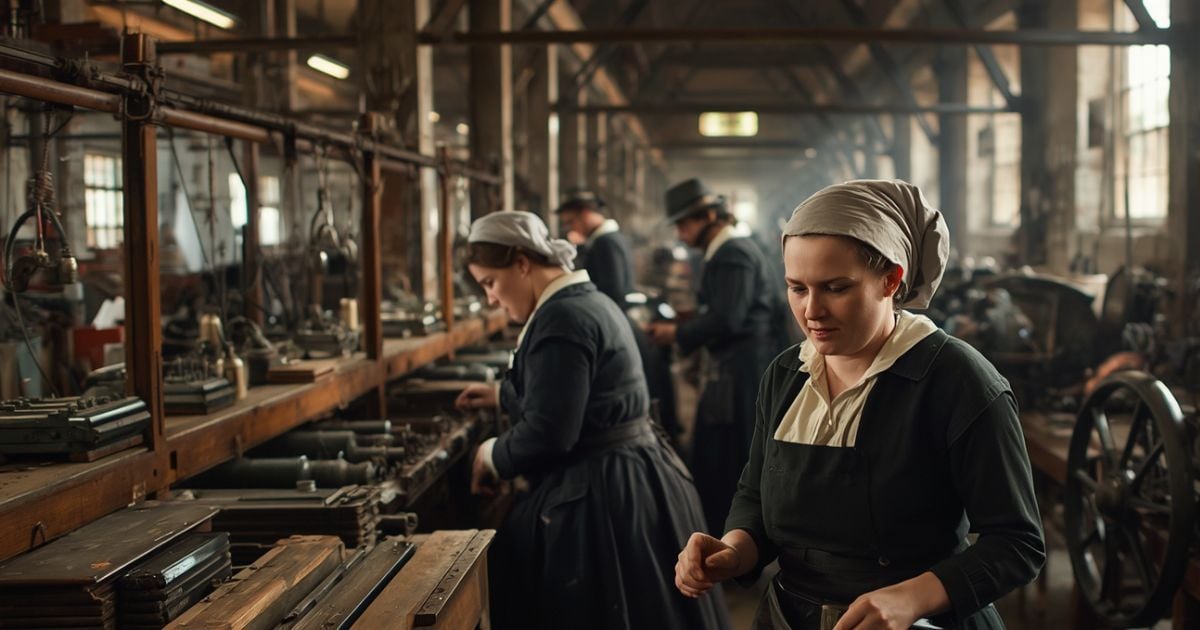
Once the capitalist is free of manual work, he is capital in person, seeing that the worker works regularly and hard enough. The tools turn round on their user: instead of the worker employing the means of production, they employ him, and a furnace that stands idle at night is "a mere loss". Marx closes with Carlile Sons & Co., a linen and cotton thread firm at Paisley. In 1849 its head wrote to the Glasgow Daily Mail against a ten-hour day. Cut the hours from twelve to ten, he warned, and every twelve spindles shrink to ten, so a sixth is wiped off the value of every factory. He seems to believe the spindles will sell with their power to pump out unpaid labour, so that two hours off the day make twelve machines fetch the price of ten.
Marx reveals something chilling about how numbers can make cruelty seem rational. When we convert human relationships into mathematical formulas, we create emotional distance that makes exploitation feel like smart business. A factory owner in 1867 didn't see exhausted workers—he saw 'underutilized machinery.' Today's warehouse manager doesn't see people skipping bathroom breaks—she sees 'improved efficiency metrics.' The math creates a buffer between decision-makers and consequences. This pattern dominates modern working life. Your productivity is tracked by algorithms that don't account for the complexity of your actual work. Healthcare systems measure 'patient throughput' while nurses work impossible caseloads. Schools reduce education to test scores while teachers buy supplies with their own money. Gig economy apps optimize 'driver utilization' while people burn out their cars and bodies. The more sophisticated the metrics, the easier it becomes to ignore human costs. But recognizing this pattern gives us power. When someone presents you with numbers that justify making your life harder, ask the Marx question: whose labor is being extracted, and who's collecting the surplus value? Behind every efficiency improvement, productivity gain, and optimization strategy, there's a human equation being hidden. The numbers aren't neutral—they're tools that either reveal or conceal who really benefits from the system.
Explore this chapter with AI to uncover deeper meaning and practical takeaways.
AI Discussion