
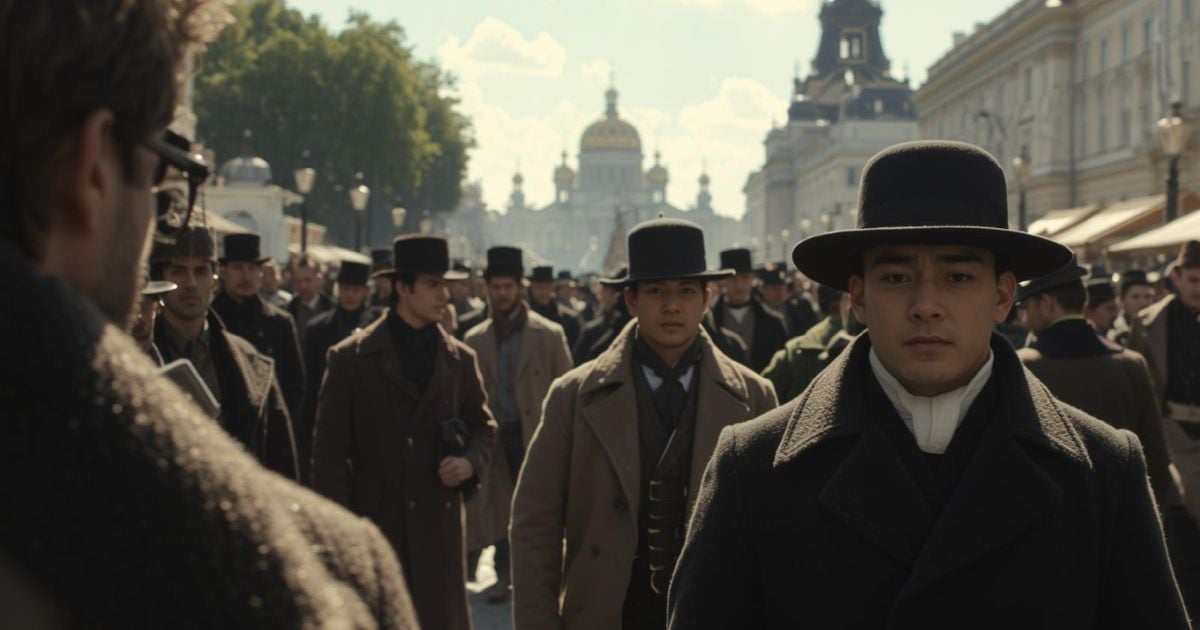
As soon as Nastasya leaves, Raskolnikov dresses in Razumihin's new clothes, pockets the twenty-five roubles and copper change from his mother's money, and slips past the samovar unnoticed. A strange calm replaces delirium: precise movements, one thought only, that all this must end to-day, once for all, though he will not plan how. He breathes the stinking Hay Market air at sunset, gives a copeck to a street singer, chats oddly about organ music, and stops at the corner where Lizaveta once stood with the huckster. He pushes through peasant crowds, listens at a tavern door, and recalls the condemned man who would rather stand on a square yard of space for eternity than die: life, whatever it may be.
At the Palais de Cristal he orders tea and five days of newspapers until he finds the pawnbroker murder. Zametov sits beside him, champagne-flushed, amused that the invalid is out. Raskolnikov mocks his rings, recalls the sock search and Luise Ivanovna, then whispers that he was searching for news of the murder of the old pawnbroker woman. He performs changing false notes, ridicules careless criminals, and when Zametov asks seriously how a murderer would behave, describes lifting a hundredweight stone to hide jewels for years. His lips tremble like the latch on the door; then: what if it was I who murdered the old woman and Lizaveta? He taunts Zametov's belief, waves red and blue notes, cries assez causé, and leaves trembling with hysterical rapture and collapse.
On the steps he runs into Razumihin hunting him under the sofa. Raskolnikov says he is sick of benevolence, repeats let me be with Luzhin-like frenzy, and refuses Potchinkov's house-warming. Razumihin lets him go, then panics and rushes back to question Zametov. Alone, Raskolnikov stands on X Bridge, watches a yellow-faced woman throw herself into the canal, and feels disgust when Afrosinya is pulled out alive: water is not good enough. Complete apathy replaces his morning drive to end everything at last.
He turns toward the police office, detours, and climbs the pawnbroker staircase to the fourth floor, startled to find workmen papering lilac flowers over the old yellow walls. He rings the cracked bell for satisfaction, asks the paperhangers if there is no blood, and tells them the old woman and her sister were murdered here. Porters, a peasant woman, and a man in a long coat argue; a huge porter flings him into the street as a rogue. At the crossroads he stands dead silent, then sees a carriage, talk, shouts, a light in the dusk. He rings the same cracked bell three times for the old fear, then smiles coldly and walks toward the crowd, still meaning to finish it at the police station.
Part II Chapter VI is not redemption; it is exposure without resolution. Raskolnikov leaves in new clothes bought with guilt money, telling himself to-day. He is not healed. He is mobilized. The Hay Market and the square-yard-of-space memory show life clinging where philosophy demanded transcendence. At the Palais de Cristal he does not confess cleanly; he tortures Zametov with hypotheticals until the sentence escapes. Then he shows the notes and flees on hysteria. Razumihin is the conscience he cannot afford. The bridge woman should shock him; instead he feels loathing, because water is too easy an end. The true compulsion is upstairs: lilac paper over blood, workmen who do not know, a bell that still cracks. Is there no blood? is the question of someone who needs the world to acknowledge what happened. Literature teaches that half-confession and crime-scene return are not opposites; they are the same wish to be caught without signing the paper. The carriage crowd at the end is the door to Marmeladov, not clarity.
Explore this chapter with AI to uncover deeper meaning and practical takeaways.
AI Discussion