
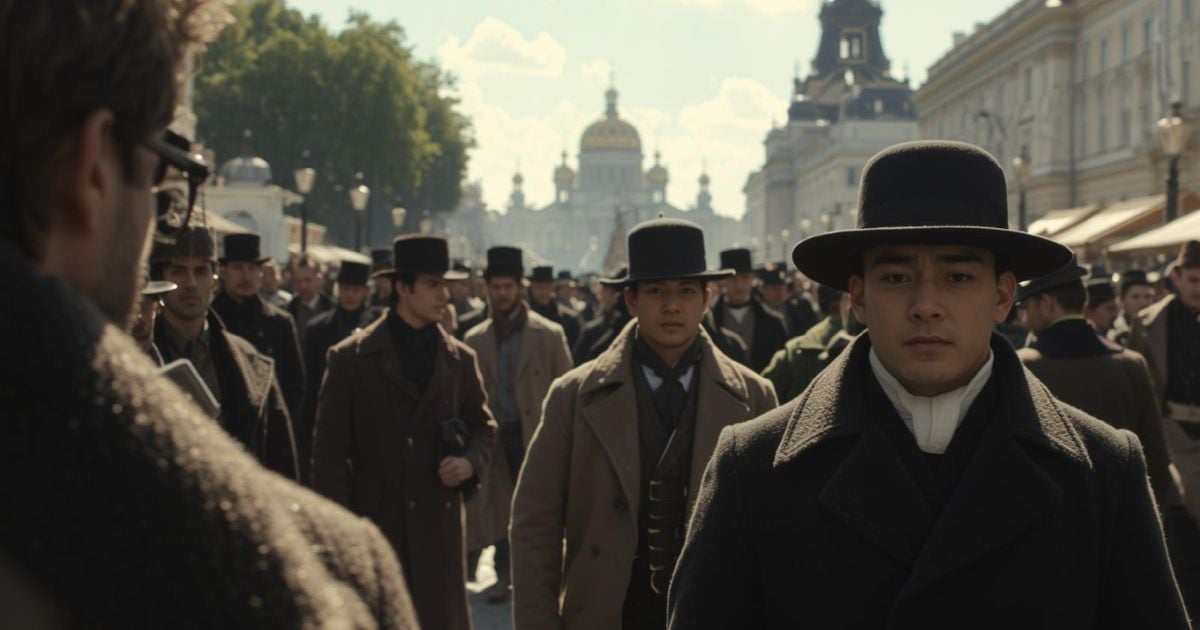
Pyotr Petrovitch Luzhin appears in the doorway of Raskolnikov's cabin: stiff, overdressed, lavender gloves in hand, offended by the poverty he has entered. Razumihin bullies him to a chair while Zossimov yawns through introductions. Luzhin expects gratitude for his mother's letter, lodgings at Bakaleyev's house, and the imminent arrival of mother and sister. Raskolnikov sits up, names him as the fiancé, and turns back to the ceiling with a malignant smile at the new clothes and curled hair.
Luzhin launches a progress sermon: reforms, practicality, science replacing sentiment. Raskolnikov mutters that he has learnt it by heart to show off. Luzhin reframes Christ's command as economics: love yourself before all men, for everything rests on self-interest; whole coats for all when each tends his own purse. Razumihin cuts him off, calling the speech unscrupulous packaging of the progressive cause. Murder talk resumes: Razumihin insists the pawnbroker killer was an inexperienced first-timer, not a cunning genius. Luzhin lingers to add that crime is rising even among educated men.
Raskolnikov turns Luzhin's logic into a blade: carry out the theory and people may be killed. He then exposes the story that Luzhin boasted of wanting a beggar bride for control. Luzhin crimsons; Raskolnikov threatens to send him flying downstairs if he ever mentions mother again, cries that he is not ill, and tells him to go to hell. Luzhin leaves with insult in his spine. Raskolnikov orders everyone away; Zossimov and Razumihin withdraw, noting his fixation on the murder and the shock of the fiancé visit.
Part II Chapter V is not a family reunion; it is a preemptive strike. Luzhin arrives as the future: Bakaleyev rooms, Senate business, lavender gloves, and a lecture that replaces love thy neighbour with love yourself first. Razumihin hates him on sight; Zossimov half-agrees; Raskolnikov does the one thing he can do without confessing. He calls the fiancé by name, mocks the memorized progress speech, and pushes utilitarianism until it touches murder. Then he repeats the beggar-bride story and threatens mother. Go to hell is not delirium; it is border control. He cannot bear mother and sister walking into this room with Luzhin still in it. Afterward, alone, he refuses tea while doctors note that murder is the only topic that makes him vivid. Literature here teaches that ideology in a sickroom is never abstract: it is a claim on your sister, your mother, and your guilt. Clearing Luzhin is Raskolnikov's last defense before the family plot enters the door.
Explore this chapter with AI to uncover deeper meaning and practical takeaways.
AI Discussion