
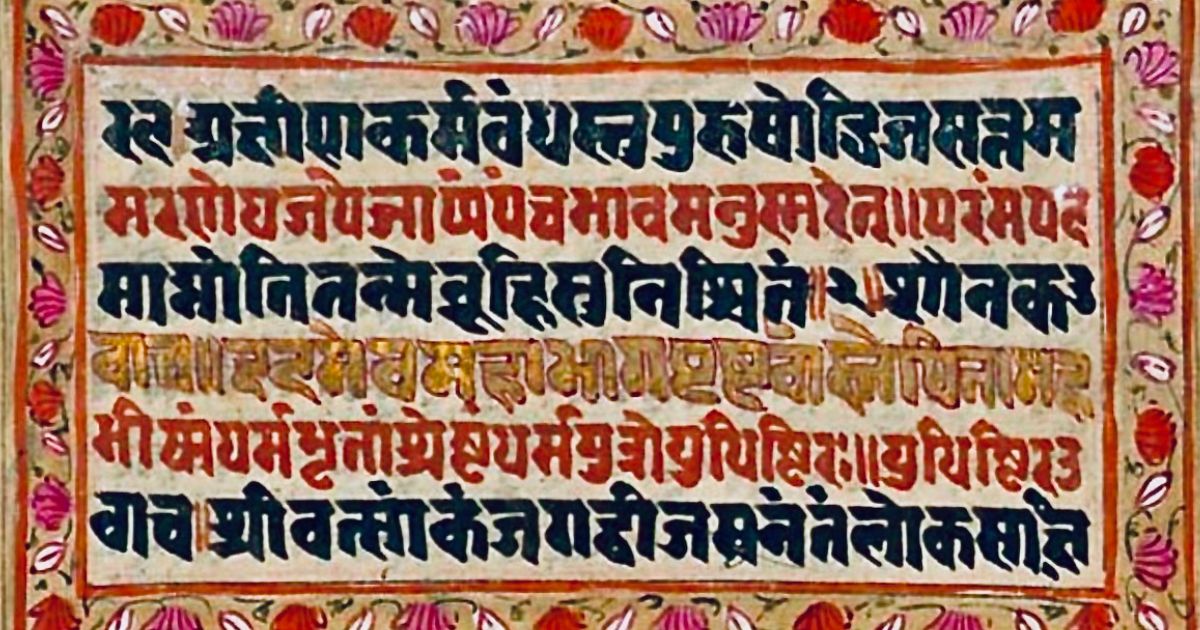
Krishna tells Arjuna to keep his soul fixed on Him, keep practising yoga, and make Him his refuge. Then Arjuna will know Him whole and in every part, and nothing more will be left to know in this world. Of many thousand people, he says, perhaps one strives for truth, and of those who strive and rise high, only one here and there knows Him as He is.
Earth, water, flame, air, ether, life, mind, and the sense of self are His lower nature. Behind them lies a higher nature that brings forth all the worlds, like a womb, and everything hangs on Him as pearls hang on a string. He is the taste of water, the light of the sun and moon, the smell of wet earth, and the wisdom of the wise. Yet He is not caught in the moods that Nature makes. The world, bewildered by those moods and by like and dislike, never sees Him behind the veil.
Four kinds of people know Him: the one who weeps, the one who wants to know, the one who works to help, and the one who sits certain and enlightened. The last is dearest. Those who turn to smaller gods are given the faith they ask for and get a small reward that soon withers. A wise soul who can say "All is Vasudev" is hard to find. Those freed from like and dislike seek refuge in Him from birth and death, and they hold on to Him in the hour of death.
Krishna's insight cuts through one of modern life's biggest traps: the belief that meaning comes from external achievements rather than from how we show up each day. In ancient India, people chased temporary pleasures and lesser gods for quick fixes. Today, we chase promotions, online validation, the next purchase, the perfect relationship—anything that promises to finally make us feel valuable. The pattern is identical across millennia. But Krishna reveals something revolutionary: the divine isn't distant or conditional. It's already present in the taste of your morning coffee, the strength you show up with after a bad night's sleep, the patience you offer a difficult customer. This isn't mystical thinking—it's practical wisdom. When you recognise that your worth isn't tied to external circumstances, you stop being thrown around by every setback or success. You develop what Krishna calls 'steady wisdom'—the ability to find your centre regardless of what's happening around you. For people whose labour is undervalued, this recognition is powerful. Society constantly tells us our value comes from climbing ladders, earning more, achieving status. But Krishna suggests our value was never in question—it's in how we bring care, competence, and connection to whatever we're doing. The question becomes: where are you already sacred, and how might recognising that change everything?
Explore this chapter with AI to uncover deeper meaning and practical takeaways.
AI Discussion