
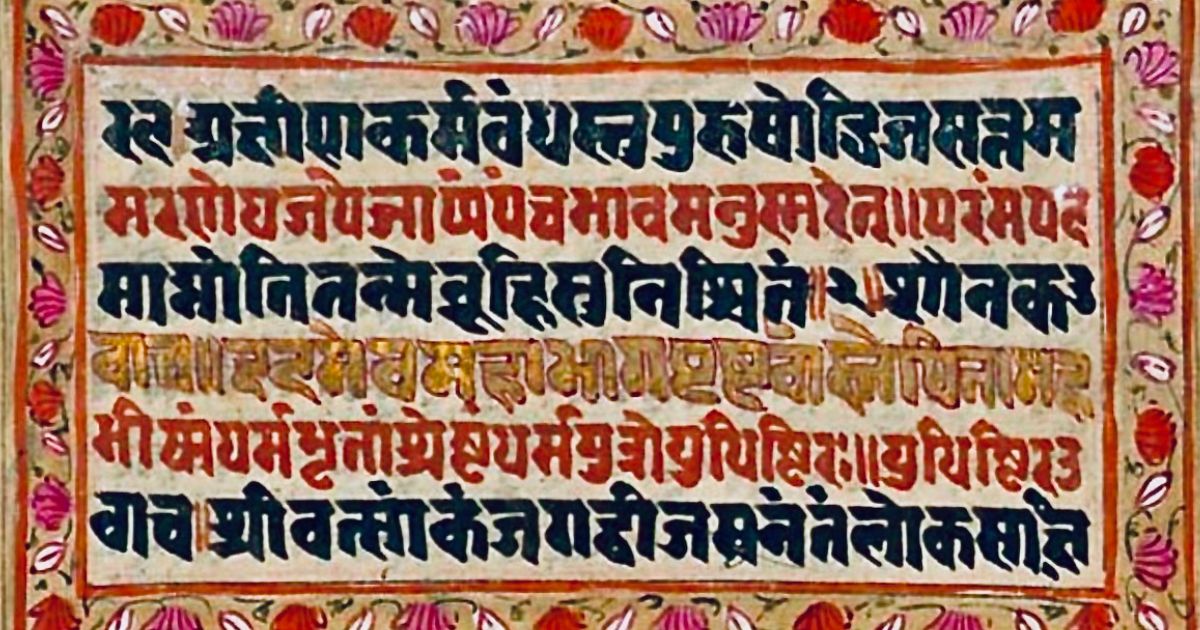
Arjuna asks about people who give up the holy rules but still keep faith at heart and worship. What is their state: sattva, rajas, or tamas?
Krishna says faith is threefold and springs from the three qualities. The faith of each believer conforms to what he truly is, so that wherever you see a worshipper, you see someone growing like what he worships. The soothfast adore true gods, the passion-ruled worship Rakshasas and Yakshas, and the dark pray to Pretas and Bhutas. People who practise bitter penance that no rule requires, out of proud hypocrisy, torture the elements inside their own flesh, and Krishna says they are devoted to devils and not to heaven.
Food, worship, abstinence, and giving each divide three ways. Food that brings strength, health, and joy is soothfast. Food that is too sharp, hot, or salty brings aches and unrest, and stale, tasteless food belongs to those who love the dark. A sacrifice made without hope of reward, because it should be done, is soothfast. One made for gain or good repute is passionate, and one made against the rules, without hymn or gift, is dark. Words that harm no one, are true, and are gentle make the religion of speech, and serenity of mind is the religion of the mind. A gift given gladly to a fit person, in the right place and time, with nothing expected back, is soothfast. A gift made with a grudge or to be repaid is passionate. The chapter ends on the last kind, flung in disdain at the wrong time: it does not bless.
Krishna's framework reveals something unsettling: there are no purely good or bad actions, only good or bad motivations behind them. A parent working overtime might be providing for their family (pure), trying to avoid dealing with problems at home (passionate), or punishing their spouse through absence (dark). A nurse staying late could be genuinely caring for patients, angling for recognition, or avoiding their own life. This ancient text anticipated what modern psychology confirms: we're incredibly skilled at lying to ourselves about why we do things. We tell ourselves we're being helpful when we're actually being controlling. We think we're being generous when we're buying approval. We believe we're standing up for principles when we're just being stubborn. The scary part isn't that others have mixed motives—it's that we do too, and we're often the last to know. But this awareness becomes a superpower. When you can catch yourself in the act of self-deception, you can choose differently. When you can read the real motivations behind someone's actions, you're not constantly surprised by their behaviour. The question isn't whether you have pure motivations all the time—nobody does. The question is whether you're honest enough with yourself to recognise when you don't, so you can gradually align your actions with your actual values instead of your ego's agenda.
Explore this chapter with AI to uncover deeper meaning and practical takeaways.
AI Discussion