
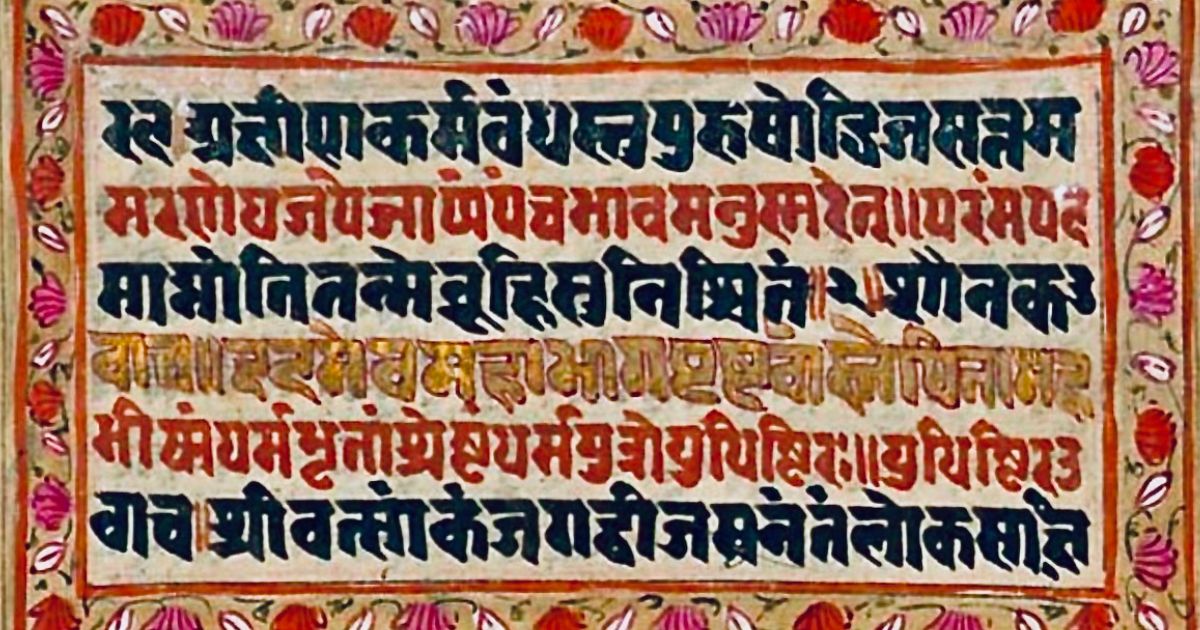
Arjuna asks for the truth about Sannyas, giving up acts, and Tyaga, giving up their fruit, and what separates the two. Krishna says the poets call Sannyas the giving up of acts born of desire, and the wise call Tyaga the giving up of the fruit of acts. Some saints say all action is sinful, and others say worship, penance, and alms must be done. Krishna sides with the second: those works purify, so do them gladly, but let go of attachment and reward. To drop a duty out of darkness, or because it is unpleasant, is no renunciation. The true act is done faithfully, saying "'Tis right to do," unvexed if it fails and unflattered if it succeeds, because no one in a body can stand wholly aloof from action.
Five things go into every act: the force, the agent, the instruments, the effort, and the God. Whoever sees himself as the sole actor sees nothing. Krishna sorts knowledge, action, the doer, the intellect, steadfastness, and pleasure into pure, passionate, and dark kinds, and true knowledge sees one changeless life in all lives. He links each person's duty to his nature and names the work of the four castes. Better your own work done with fault than another's done well, since every work has blame as every flame has smoke. Whoever does his allotted work, content, and offers it to the Source of all, finds perfection.
Then Krishna gives his last word. Give me your heart, adore me, serve me, let go of rites and written duties, and fly to me alone. I will free your soul from all its sins; be of good cheer. If Arjuna says "I will not fight," his own nature will drive him to it, for there is a Master in the hearts of men who makes their deeds dance. Krishna asks whether the ignorance that bred Arjuna's trouble has vanished. Arjuna answers that trouble and ignorance are gone, his doubt has fled, and he will do according to Krishna's word. Sanjaya closes by saying that wherever this song of Arjuna and God is heard, there will be blessing, victory, and power.
Krishna's radical advice—do your own work imperfectly rather than excel at work that isn't yours—challenges everything we're taught about climbing ladders. In ancient India's rigid caste system, this was revolutionary. Today, it's still controversial. We live in a culture that equates worth with advancement, where staying in a 'lower' position feels like failure. But what if the EMT who stays on the ambulance, the CNA who never becomes a nurse, the line cook who never opens a restaurant—what if they're actually winning by honouring their authentic capacity? The tragedy isn't the person who never gets promoted. It's the person who gets promoted into misery and stays there because quitting feels like admitting defeat. We see it everywhere: the brilliant teacher who becomes a mediocre administrator, the gifted mechanic who opens a failing shop because he's great with engines but terrible with business, the natural caregiver who burns out in management. The system pushes us toward roles that look like success but feel like death. Krishna suggests a different metric: alignment. When your work matches your nature, you contribute more and suffer less. The question isn't whether you're moving up, but whether you're moving toward or away from who you actually are.
Explore this chapter with AI to uncover deeper meaning and practical takeaways.
AI Discussion