
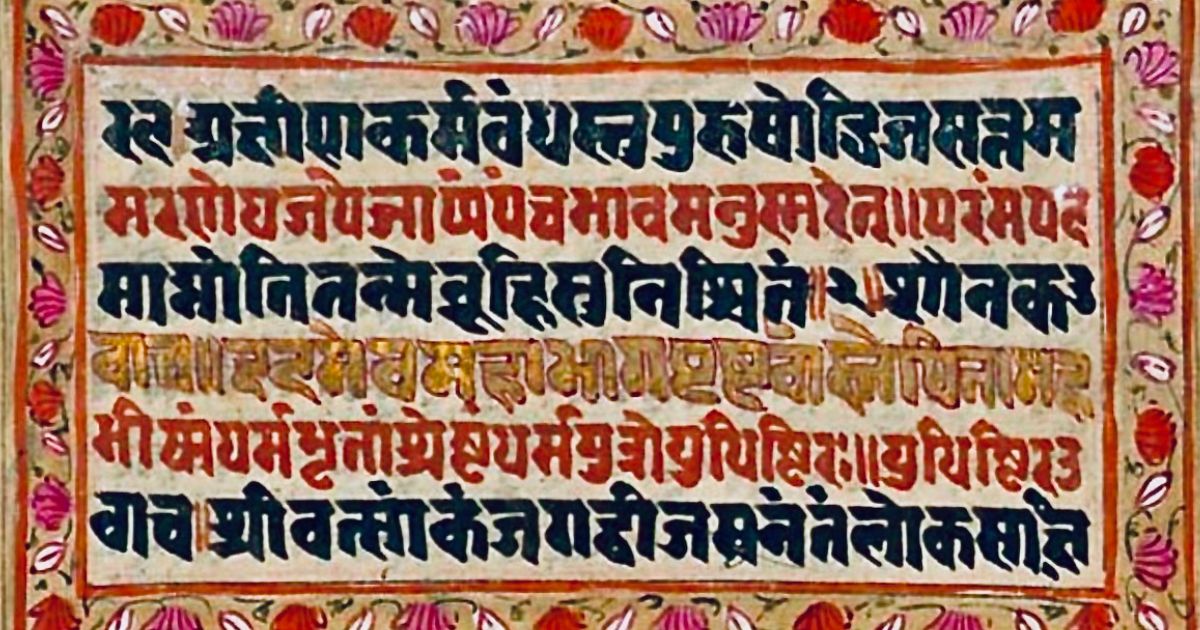
Arjuna asks about Life that seems and Soul beyond that sees, and what it is we know, or think we know. Krishna answers that this flesh is the field, and the Soul that views and knows it is the knower of the field. In every field, Krishna says, he is the knower.
The field includes the elements, the mind, the senses, desire and dislike, pleasure and pain. Krishna then lists what true wisdom looks like: humility, truthfulness, harmlessness, patience, self-control, a light hold on home, wife, and children, an even heart in good and bad fortune, and steady worship of him. Anything else is ignorance. He describes the Supreme as having hands, feet, and eyes everywhere, glorified in the senses yet beyond them, close to all and measurelessly far, the Light of Lights in the heart of the dark.
Nature and Spirit both have no beginning. Nature does the acting, and Spirit, bound to matter, feels pain and pleasure. Yet the Spirit within the body is also the Lord and witness, one Soul with him. Some find that Soul through meditation, some through study, some through work, and some by hearing of it from others and holding to it. Whoever sees the same living Soul in every form stops doing wrong to himself. Whoever sees that works are Nature's doing, and that the Soul is not the agent, reaches Brahma. Like the air, which avoids taint because it is so subtle, and like the sun, which is unchanged by what it lights, the Soul stays pure in every place.
Krishna's teaching about the 'field' versus the 'knower' addresses something that destroys people daily: the inability to separate identity from circumstances. In ancient India, warriors faced the same trap we do - becoming so identified with their role, their success, their reputation that any threat to these externals felt like a threat to their very existence. Today, this pattern shows up everywhere. The single mother whose child's behaviour problems make her feel like a failed parent. The worker whose job loss makes him question his worth as a man. The student whose grades become her entire sense of intelligence. We live in a culture that encourages this fusion - you ARE your job title, your relationship status, your bank account, your achievements. Public feeds amplify this by turning every aspect of life into performance and comparison. But Krishna reveals something liberating: there's a part of you that remains constant while everything else changes. Your body ages, your circumstances shift, your emotions fluctuate, but something in you simply observes it all. This isn't about becoming cold or disconnected. It's about finding an unshakeable centre that allows you to engage fully while maintaining perspective. When you can watch your own drama without drowning in it, you make better decisions and waste less energy on things beyond your control.
Explore this chapter with AI to uncover deeper meaning and practical takeaways.
AI Discussion