
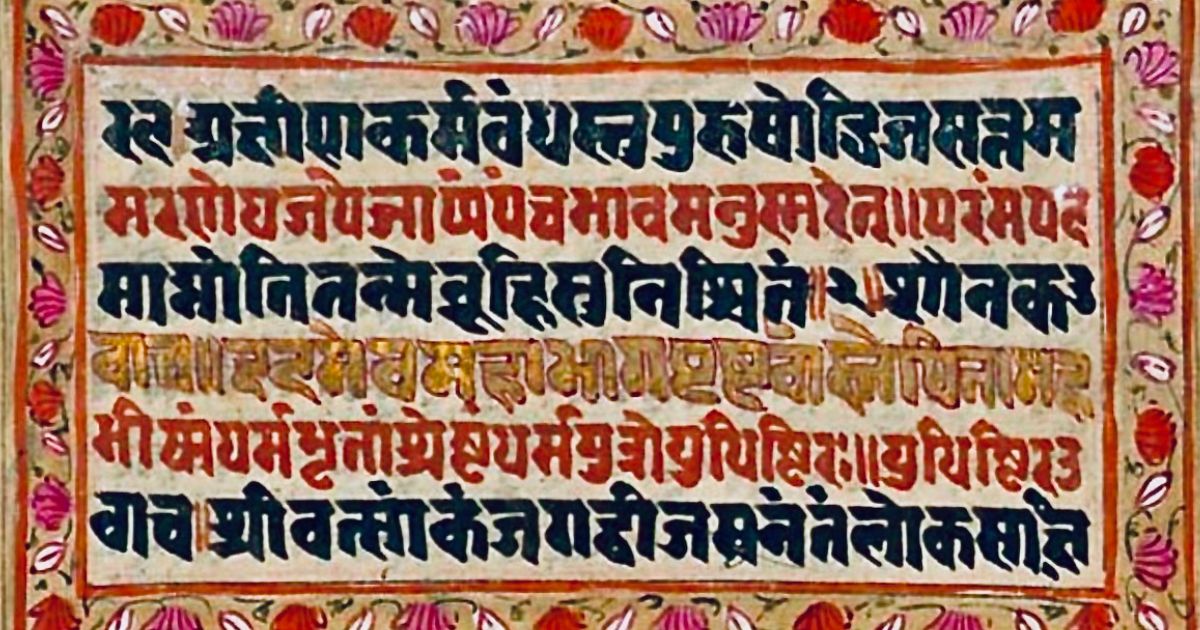
Arjuna says Krishna's teaching has cleared his darkness. Now he wants to see the glory with his own eyes, wholly revealed, if he can bear the sight. Krishna says human eyes cannot take it, so he gives Arjuna divine sight and shows his universal form.
What Arjuna sees is like a thousand suns rising at once. Countless faces, arms, and eyes fill every direction. Gods, sages, and whole worlds are folded into one body, and nowhere does it begin or end. At first he is full of wonder, and he bows with joined hands. Then fear takes over. He sees Bhishma, Drona, Karna, and the best of both armies rush into Krishna's flaming mouths, like rivers pouring into the sea or moths flying into a fire. He asks who this is and why the face is so fierce.
Krishna answers that he is Time, the slayer, come to consume. Except for Arjuna, not one of the chiefs on the field will leave it alive, and they are already slain. Arjuna must arise and strike, because he is only the instrument. Trembling, Arjuna praises him and begs pardon for the times he treated him as a casual friend, calling him by name in jest or at rest. Then he asks for the gentle charioteer's form again. Krishna takes it back, and Arjuna's mind grows calm. The chapter closes with Krishna saying that this sight is not won by study, sacrifice, or penance, but only by full service, faith, and surrender.
The Gita's cosmic vision scene reveals something uncomfortable about human nature: we often demand truths we're not equipped to handle. Arjuna insists on seeing Krishna's divine form, gets exactly what he asked for, then immediately begs for it to stop. This wasn't Krishna being cruel—it was Arjuna learning the difference between curiosity and readiness. Modern workplaces are full of similar dynamics. Employees demand transparency about company finances, then become too anxious to work effectively when they learn about potential layoffs. Healthcare workers insist on knowing every detail about administrative decisions, then burn out from information they can't act on. Parents demand complete honesty from teenagers, then can't respond helpfully because they're overwhelmed by details. The pattern reveals a crucial distinction: there's information that serves you, and information that you serve. Useful truth comes in doses you can metabolize into better decisions. Overwhelming truth just creates paralysis. The wisdom isn't in avoiding difficult realities, but in receiving them at a pace that allows for constructive response. Sometimes the most mature question isn't 'What's really happening?' but 'How much can I handle right now while still being effective?' Truth is a tool for navigation, not a test of courage.
Explore this chapter with AI to uncover deeper meaning and practical takeaways.
AI Discussion