
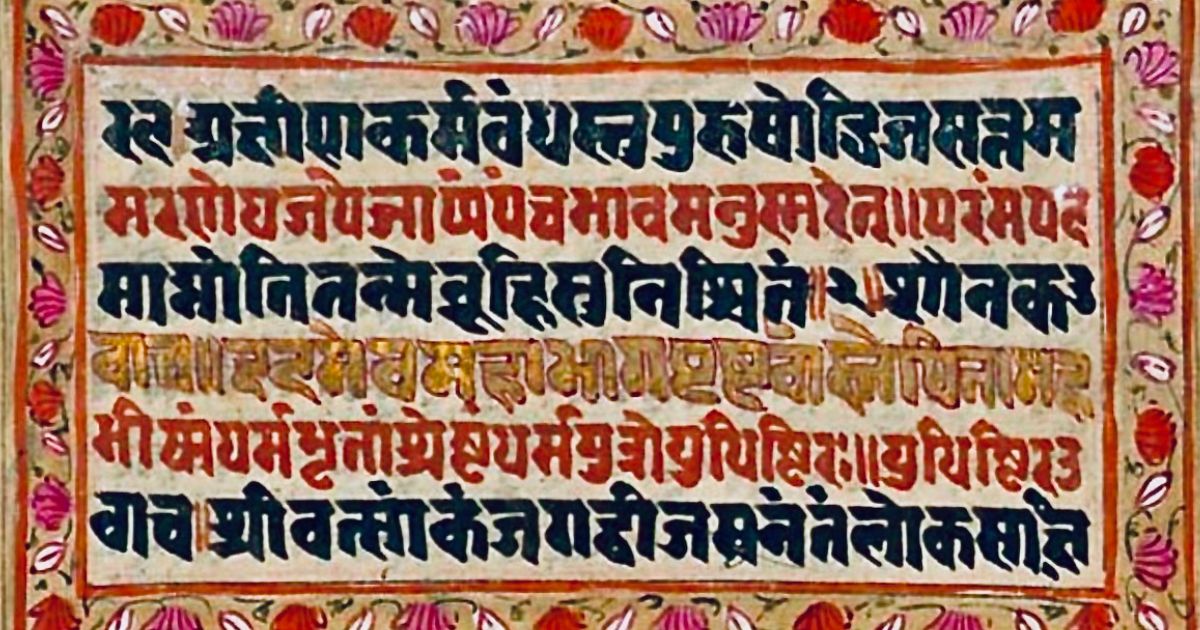
Krishna says that neither the gods nor the kingly sages know His nature, because He made them. Only the person with faith-enlightened eyes sees Him as He is, unborn and undying. Every human quality comes from Him: intellect, skill, endurance, truthfulness, joy and grief, birth and death, fear and fearlessness, shame and honour, the wish to give and the will to help. To those who love and serve Him He gives a mind of perfect mood, and He lights the lamp of wisdom inside their darkened souls.
Arjuna answers that he knows this is true. He calls Krishna the High Abode, the first and the eternal, as the saints Narada, Vyasa, Asita, and Devala have said. But how can he come to know Him, however long he muses on Him? Under what forms can he grasp Him? He asks Krishna to say again, clearly, where His greatness appears, because his ears cannot drink enough of such words.
Krishna agrees to unfold some of His glories. He is the spirit seated in every creature's heart. He is the sun by day and the moon among the stars by night, OM in sacred speech, the Himalaya among hills, the fig-tree among trees, the sea among waters, Garuda among birds, the tiger among beasts, Rama among warriors, and the Ganges among rivers. He is time itself, the death that seizes all, and the birth that brings beings to light. Among the Pandavas, He is Arjuna, because Arjuna is His.
Whatever lives, lives by Him, and wherever there is wondrous work, majesty, or might, it has come from Him. No tongue can finish telling these glories. The chapter closes on a question: how could Arjuna take in the vastness of this? Krishna made all of it, and yet He stays apart as its separate Lord.
The Bhagavad Gita was written during a time when society was rigidly structured by duty and role, yet it offers something radical: the idea that any work, done with the right understanding, connects us to something magnificent. Krishna doesn't tell Arjuna to abandon his responsibilities or find different work - he shows him how to see his existing role differently. This speaks directly to modern life when dignity is tied to job title. We're often told that meaningful work requires advanced degrees or creative careers, that service jobs are just stepping stones to something better. But this ancient text suggests otherwise. The home health aide changing bedsheets, the maintenance worker fixing broken systems, the cashier helping customers navigate their day - all participate in the same web of human care and connection. The difference isn't the work itself, but learning to see how individual actions serve larger purposes. This doesn't mean accepting exploitation or poor conditions - fighting for fair treatment is also part of serving the larger good. But it does mean recognising that dignity and meaning aren't determined by job titles or pay. When we can see our work as part of something larger than ourselves, even the most routine tasks become opportunities for connection and service. The question becomes: How do we cultivate this vision in a culture that often reduces work to mere survival?
Explore this chapter with AI to uncover deeper meaning and practical takeaways.
AI Discussion