
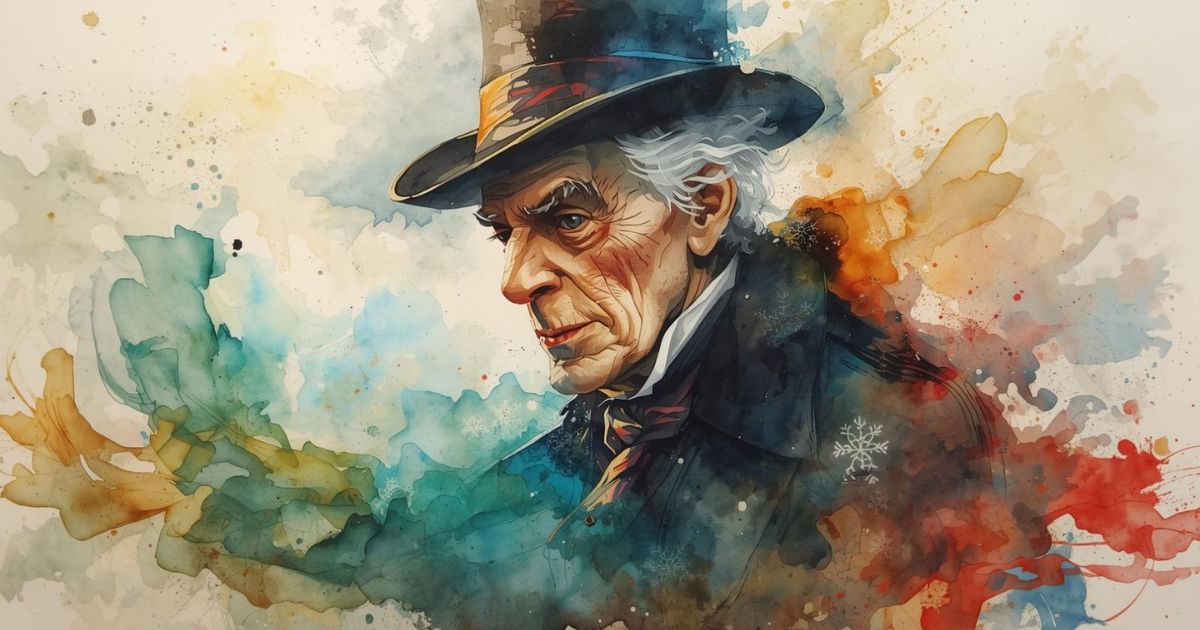
The phantom comes slowly, gravely, silently. Scrooge bends on his knee. A deep black garment hides the head, the face, and the form. Only one outstretched hand shows. He asks if this is the Ghost of Christmas Yet to Come. The spirit does not speak. It points onward. Scrooge follows into the city, among merchants who chink the money in their pockets, look at their watches, and toy with their gold seals. The hand singles out a little knot of businessmen. A man with a monstrous chin says he does not know much about it either way. He only knows the man is dead, last night, he believes. God knows what was the matter with him. A red-faced gentleman asks what he has done with his money. Left it to his company, perhaps. He has not left it to me. That is all I know. The joke gets a general laugh. It is likely to be a very cheap funeral, the same speaker says. He does not know of anybody to go to it. Suppose they make up a party, and volunteer.
The spirit points into a quarter Scrooge recognises by its bad repute. Alleys reek. In a low shop where rusty keys, rags, bones, and grease are bought, old Joe sits by a charcoal stove and smokes. A woman with a heavy bundle slips in, then another woman, then a man in faded black. They had not meant to meet. The charwoman, the laundress, and the undertaker's man have each come from the same death. They sell what they took. Bed-curtains, taken down, rings and all, with him lying there. Blankets. A shirt, the best he had, which they would have wasted by burying him in it. Joe tells the money out on the ground. The woman laughs. He frightened every one away from him when he was alive, to profit them when he was dead. Scrooge shudders from head to foot. The case of this unhappy man might be his own. His life tends that way now.
The scene changes before he can finish. He almost touches a bed, bare and uncurtained. Under a ragged sheet lies a body, plundered and bereft, unwatched, unwept, uncared for. The phantom points at the head. A finger would lift the cover and show the face. Scrooge longs to do it and cannot. He asks to see some emotion, some tenderness, connected with this death. The room becomes a poor sitting-room where a husband tells Caroline there is hope yet. If he relents, she says, amazed, there is. Nothing is past hope if such a miracle has happened. He is past relenting, her husband answers. He is dead. She is thankful in her soul to hear it. The debt will pass to someone else, and before that day they will be ready with the money. They may sleep tonight with light hearts. The only comfort this death has purchased is relief from the man who held the debt.
Then the hand leads him to Bob Cratchit's house, and the noise of the last stave is gone. The little Cratchits sit still, looking up at Peter, who has a book before him. The mother and the girls sew. Peter reads that he took a child and set him in the midst of them. Bob comes from the churchyard in his comforter. His tea is ready. The children climb onto his knees and lay a cheek against his face, as if to say he should not be grieved. He praises the work on the table. They will be done long before Sunday. He wishes his wife could have gone. It would have done her good to see how green a place it is. He promised the child he would walk there on a Sunday. My little, little child, he cries, and breaks down all at once. The phantom does not leave Scrooge in that room. It brings him to an iron gate, and then to a neglected grave, walled in by houses, overrun by grass and weeds. The finger points at the stone. Scrooge reads his own name, Ebenezer Scrooge. Am I that man who lay upon the bed? The finger points from the grave to him, and back again. He catches the spectral hand and begs to sponge away the writing on the stone. The spirit, stronger yet, repulses him. He holds up his hands in a last prayer to have his fate reversed, and sees the hood and dress shrink, collapse, and dwindle down into a bedpost.
Dickens wrote this during the Industrial Revolution when traditional community bonds were fracturing under economic pressure, sound familiar? Today's gig economy, remote work, and social media create the same isolation Scrooge experienced. We can accumulate followers, likes, and LinkedIn connections while remaining fundamentally alone. The chapter's genius lies in its simple test: who would genuinely grieve your absence? Not who would attend your funeral out of obligation, but who would actually miss you. Tim Cratchit had no money, no status, no influence, yet his death devastates everyone who knew him because he consistently chose connection over convenience. He remembered names, showed up when it mattered, and treated everyone with dignity regardless of their station. Meanwhile, the wealthy corpse lies alone because he treated people as transactions. This isn't about being popular or people-pleasing; it's about authentic investment in others' wellbeing. In our current economy where everyone's hustling to get ahead, it's easy to fall into Scrooge's trap, seeing every interaction as either useful or wasteful. But the chapter suggests that our desperate focus on accumulating wealth and status might be making us poorer in the ways that actually matter when the final accounting comes.
Explore this chapter with AI to uncover deeper meaning and practical takeaways.
AI Discussion