
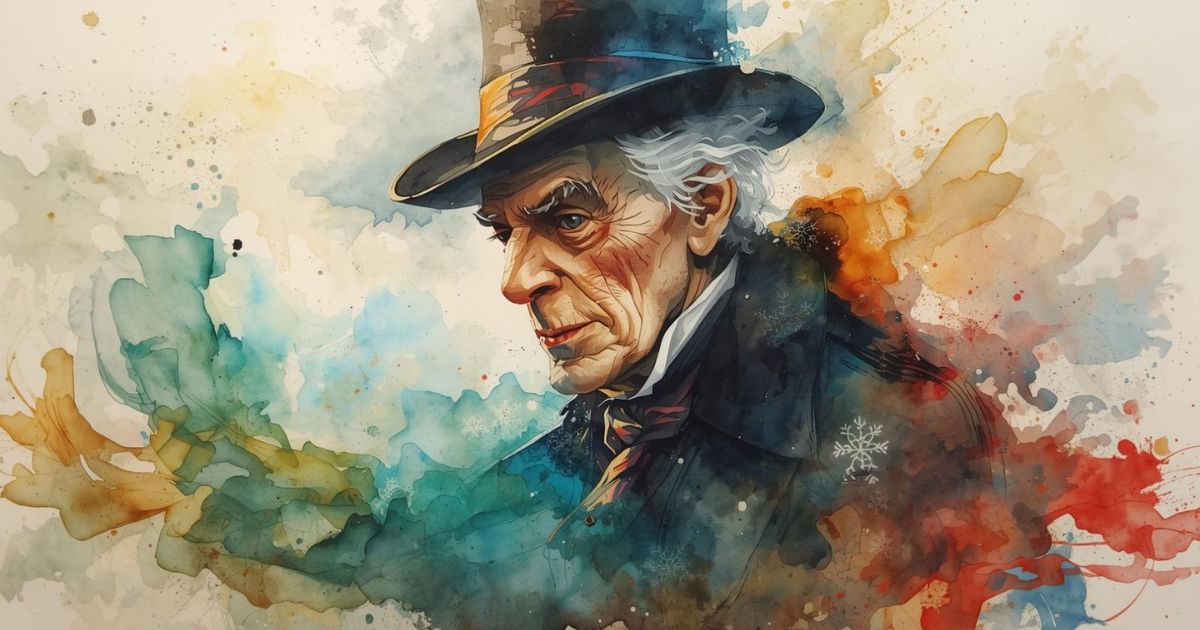
Scrooge wakes on the stroke of One and will not be taken by surprise. He draws every bed-curtain aside himself and lies watching. The bell finds him ready, and the room does not. Holly, mistletoe, and ivy have turned it into a grove. A blaze roars up a hearth that had been a dull petrification. Heaped food and drink fill the chamber. On a couch sits a jolly giant in one simple deep green robe, bordered with white fur, breast bare, a holly wreath set with icicles on his curls. He holds a glowing torch, shaped like Plenty's horn, high enough to light Scrooge as he peeps round the door. An antique scabbard hangs at his middle. No sword is in it, and the sheath is eaten up with rust. Come in, the ghost says, and know me better. Scrooge has never seen the like of him, and has never walked with his younger brothers. More than eighteen hundred, the ghost answers. A tremendous family to provide for, Scrooge mutters. He is told to touch the robe.
They go out into Christmas morning. People on the house-tops shovel snow and throw snowballs, laughing when the shot goes right and laughing when it goes wrong. The poulterers' shops are still half open. Chestnuts, onions, pears, apples, and grapes are piled so that mouths water for nothing. The spirit's torch sprinkles a blessing where poor people carry their dinners to the bakers' ovens, and where a quarrel on the street is about to turn sharp, the sprinkle changes the tone. Then the ghost leads him to his clerk's door and blesses Bob Cratchit's dwelling before they enter. Martha, a poor apprentice at a milliner's, is late. She hides. Bob comes in with at least three feet of comforter hanging before him, and Tiny Tim on his shoulder. The child has a little crutch, and his limbs are supported by an iron frame. The goose is their own. They smelled it outside the baker's. After the dinner, Bob gives the toast. God bless us, says the family. God bless us every one, says Tiny Tim, last of all, close by his father's side. Scrooge asks whether Tim will live. If these shadows remain unaltered by the Future, the ghost says, the child will die. Scrooge begs that he be spared. The spirit quotes him back: if the child is like to die, he had better do it, and decrease the surplus population. Let him forbear that cant until he has discovered what the surplus is, and where it is. It may be that he is more worthless, and less fit to live, than millions like this poor man's child.
Scrooge bends his head, then lifts it because his own name is spoken. Bob calls him the Founder of the Feast. Mrs Cratchit reddens. She will drink the health for her husband's sake and for the day's, not for Scrooge's. She names him odious, stingy, hard, unfeeling. The children drink after her. The spirit does not leave the night in that parlour. A hut where miners live shows a cheerful company round a glowing fire. A solitary lighthouse, on a reef a league from shore, holds two men who have made a fire of their own, and one of them strikes up a song like a gale. Far from any shore, on a ship, every man of the watch hums a Christmas tune, or speaks under his breath of some bygone Christmas and the people who remember him at home. Then Scrooge hears a laugh he knows. It is his nephew's. Fred's party is already at the table. Fred is sorry for his uncle and means to keep asking him, year after year. If the visit only put Scrooge in the vein to leave his poor clerk fifty pounds, that would be something. They laugh. A game called Yes and No begins. Fred is thinking of an animal, a live one, rather disagreeable, a savage one that growls and grunts, talks sometimes, lives in London, walks the streets, and is not led by anybody. The table cries out that it is Uncle Scrooge.
Blind man's buff follows. Topper will catch nobody but the plump sister, and when he has her in a corner he pretends he must press a ring upon her finger and a chain about her neck to be sure. Scrooge's niece sits out of the buff with a footstool, then beats her sisters at How, When, and Where. Scrooge wants the evening to go on. The spirit will not stop. As they move, the giant grows older, and the hair goes grey. He opens his robe. Two children cling there, a boy and a girl, yellow, meagre, ragged, scowling, wolfish. This boy is Ignorance. This girl is Want. Beware of them both, and most of all beware the boy, for on his brow the spirit sees Doom written, unless the writing be erased. Scrooge asks if they have no refuge or resource. Are there no prisons, says the spirit, turning on him for the last time with his own words. Are there no workhouses? The bell strikes Twelve. Scrooge looks for the ghost and does not see it. As the last stroke ceases, he remembers Marley's prediction, lifts his eyes, and beholds a solemn phantom, draped and hooded, coming like a mist along the ground towards him.
Dickens understood something profound about human psychology: the standards we create for others become the prison that eventually confines us. When the Ghost throws Scrooge's words back at him about Tiny Tim, we witness a devastating moment of recognition. Scrooge suddenly realizes that his casual cruelty toward the poor wasn't abstract philosophy, it was a weapon that could be turned against anyone he might come to love. This pattern appears everywhere in our current moment. The person who says 'just get a better job' discovers how impossible that is during a recession. The one who dismisses mental health struggles faces their own breakdown. Those who argue against disability accommodations watch their aging parents struggle with mobility. Healthcare workers who judge 'difficult patients' become patients themselves and experience the system's indifference. Social media amplifies this dynamic, making our harsh judgments permanent and searchable. The tweet dismissing someone's financial struggles gets screenshotted when you start a GoFundMe. The post mocking people who 'can't handle' certain jobs resurfaces when you're struggling with workplace stress. Dickens shows us that this isn't karma or cosmic justice, it's simple human psychology. When we dehumanize others, we create frameworks that can be applied to us. The cruel logic we use to dismiss others' pain becomes the standard by which our own suffering is measured. Recognition of this pattern offers a path forward: audit your judgments before life does it for you.
Explore this chapter with AI to uncover deeper meaning and practical takeaways.
AI Discussion