
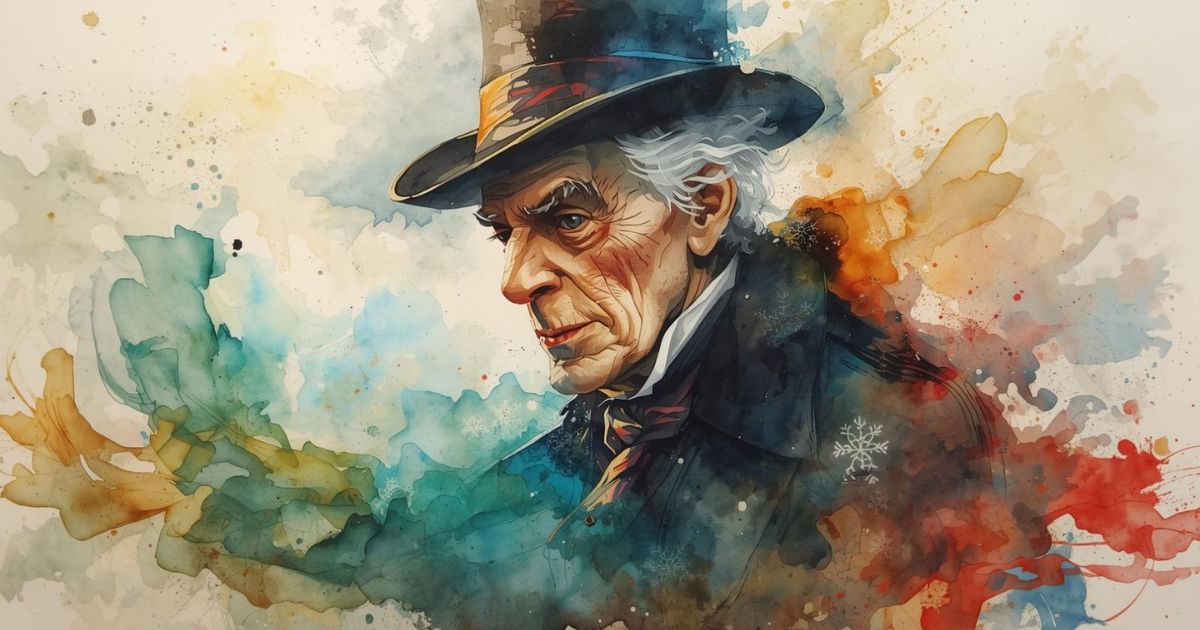
The bedpost is his own. The bed is his own. The room is his own. Best and happiest of all, the time before him is his own, to make amends in. He is on his knees to Jacob Marley. The bed-curtains are not torn down, rings and all. He is here. The shadows of the things that would have been may be dispelled. He calls down to a boy in Sunday clothes who has loitered in the street. What is today? Christmas Day. He has not missed it. The spirits have done it all in one night. He sends the boy for the prize turkey at the poulterer's in the next street but one, the big one, not the little prize turkey, and promises half a crown if the man is back in less than five minutes. The bird is twice the size of Tiny Tim. It goes to Bob Cratchit's, and Bob is not to know who sends it. Waiting at the street door, Scrooge pats the knocker. Last night it wore Marley's face. He says he shall love it as long as he lives.
He meets the portly gentleman from yesterday's counting-house. Not a farthing less. A great many back-payments are included in it. Will you do me that favour? Don't say anything, please. He goes to church and walks the streets. In the afternoon he passes his nephew's door a dozen times before he knocks. The niece starts, because he has forgotten she sits in the corner with the footstool. Fred does not shake his arm off, though it is a mercy he does not. Scrooge is at home in five minutes.
Next morning the office door stands wide open. Nine o'clock, then a quarter past, and still no Bob. Bob is eighteen minutes and a half late. Scrooge begins in the old voice, then tells him he is about to raise his salary. Bob trembles and steps nearer the ruler, with a momentary idea of knocking Scrooge down and calling the people in the court for a strait-waistcoat. To Tiny Tim, who did not die, he was a second father. He had no further intercourse with spirits, and lived upon the Total-Abstinence Principle ever afterwards. It was always said of him that he knew how to keep Christmas well, if any man alive possessed the knowledge. And so, as Tiny Tim observed, God bless Us, Every One.
Scrooge's story is often misread as a tale of instant redemption, but Dickens actually shows us something more complex: the brutal honesty of real change. Notice that Scrooge doesn't just wake up transformed, he wakes up with work to do. The turkey, the nephew's door, the charity collectors, each requires separate acts of courage. This reflects a truth about human nature that Victorian readers understood better than we do: character change is a practice, not an event. In working-class communities, this pattern is everywhere. The parent trying to break cycles of anger, the person in recovery choosing sobriety daily, the worker learning to advocate for themselves, all face the same gap between knowing better and doing better. What makes Scrooge's story radical isn't that he changes, but that he keeps changing when it's hard, boring, or inconvenient. The famous ending, 'he knew how to keep Christmas well', isn't about holiday spirit. It's about sustaining transformation when no one's watching, when the emotional high fades, when old patterns reassert themselves. This is why the story endures: it promises that change is possible while refusing to lie about the cost. In a culture obsessed with quick fixes and dramatic breakthroughs, Dickens reminds us that real transformation is built one choice at a time, one day at a time, one act of courage at a time.
Explore this chapter with AI to uncover deeper meaning and practical takeaways.
AI Discussion