
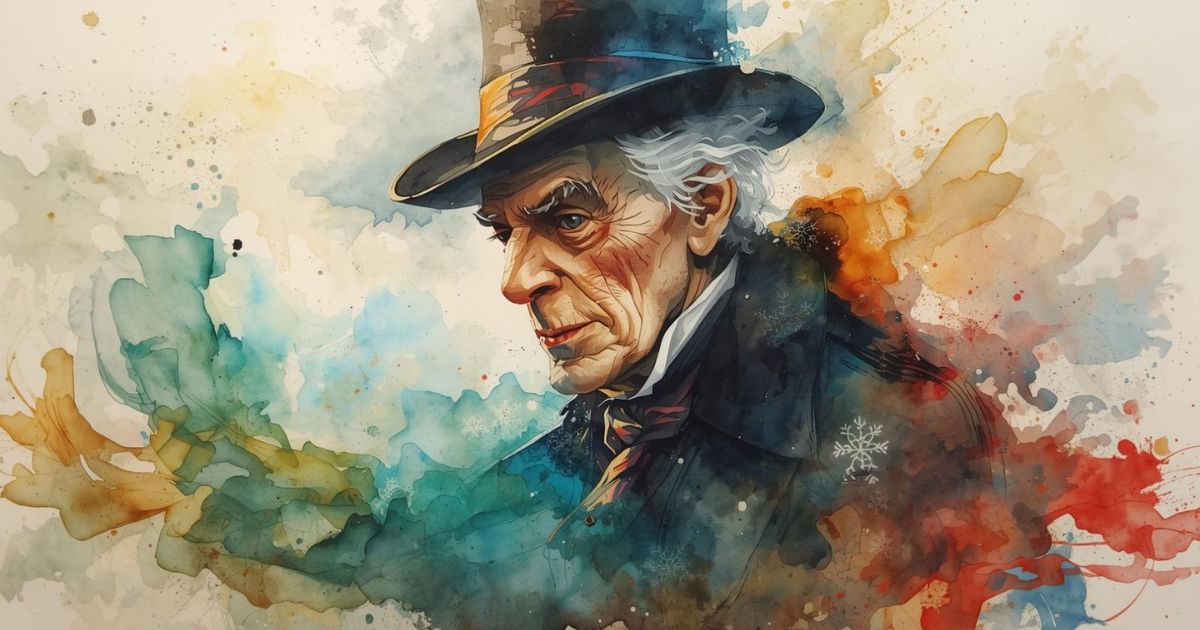
Scrooge wakes in a dark so complete he can hardly tell the window from the wall. A neighbouring church strikes the quarters, and then the hour climbs from six to seven, from seven to eight, and on to twelve. It was past two when he went to bed. He tries his repeater. That little watch also beats twelve and stops. He decides an icicle has got into the clock, scrambles up to see whether the sun has failed, and finds the night still there. He waits. When the bell tolls One, a light draws the bed-curtains aside. The Ghost of Christmas Past stands close: a figure like a child and like an old man at once, with a jet of light from the crown of its head and a cap under its arm that can put the light out. Scrooge asks it to cover the light. The spirit refuses. A touch, and they are no longer in the bedroom.
They stand on an open country road towards a little market-town, and the spirit brings him to a schoolhouse where one boy has been left behind. The other boys have gone home for Christmas. This one sits alone with a book. Scrooge weeps to see him, then cries out that the figure on the page is Ali Baba. One Christmas, when that solitary child was left here all alone, Ali Baba did come. The ghost notices the trembling lip and the wet cheek. Scrooge says it is a pimple, and begs to be led on. He knows the road. He could walk it blindfold. Strange, the ghost says, to have forgotten it for so many years. A later Christmas shows the same school emptying again, until a little girl runs in. Fan has come to bring him home, home, home. Father is kinder than he used to be. She died a woman, the ghost says, and had children. One child, Scrooge answers. His nephew. He says yes, and he is uneasy.
The school is gone. They are in a city street on Christmas Eve, at a warehouse door Scrooge knows at once. He was apprenticed here. Behind a high desk sits Fezziwig in a Welsh wig, laughing from his shoes upward, calling Ebenezer and Dick. Dick Wilkins is there, the fellow apprentice who was very much attached to him. No more work tonight. The shutters go up. Floor is cleared, fiddler fetched, Mrs Fezziwig and the daughters come down, and the warehouse fills with a dance. Afterwards the ghost calls it a small matter to make these silly folks so full of gratitude. Scrooge answers that the happiness Fezziwig gives is quite as great as if it cost a fortune. Then he feels the spirit looking at him, and he thinks of his own clerk.
The next room holds a young man and a fair girl in a mourning dress. Belle tells him another idol has displaced her. A golden one. He calls that the even-handed dealing of the world, which condemns poverty and also condemns the pursuit of wealth. She says he fears the world too much, and that Gain has become the master passion. She releases him, with a full heart, for the love of the man he once was. A later hour shows her married, with her husband and their children around her. The husband laughs and says he passed Mr Scrooge's office window that afternoon. The partner lies upon the point of death. Scrooge sat alone inside. Quite alone in the world, he believes. Scrooge begs to be taken away. He seizes the extinguisher-cap and presses it down over the spirit's head. The light still streams from under it in an unbroken flood upon the ground. He is back in his own bedroom. He gives the cap a last squeeze, reels to the bed, and sinks into a heavy sleep.
Dickens understood something profound about human psychology that we're still grappling with today: the mechanisms we develop to survive difficult circumstances often outlive their usefulness and become the very thing that destroys our happiness. Scrooge's childhood abandonment taught him that people leave and love hurts, so he built walls. But those same walls that protected him from further abandonment eventually isolated him from all human connection. This pattern plays out constantly in modern working-class life. The single mother who becomes so self-reliant after being let down repeatedly that she can't accept help even when it's genuinely offered. The factory worker who stops trusting management after years of broken promises, but then misses opportunities for advancement because he can't recognize when change might actually be positive. The person who grows up poor and becomes so focused on financial security that they sacrifice relationships, health, and joy in pursuit of a safety that always feels just out of reach. The tragedy isn't that we develop these protective patterns, they often save us. The tragedy is when we don't recognize that the threat has changed, and our armour has become our prison. What survival mechanism from your past might be limiting your present?
Explore this chapter with AI to uncover deeper meaning and practical takeaways.
AI Discussion