
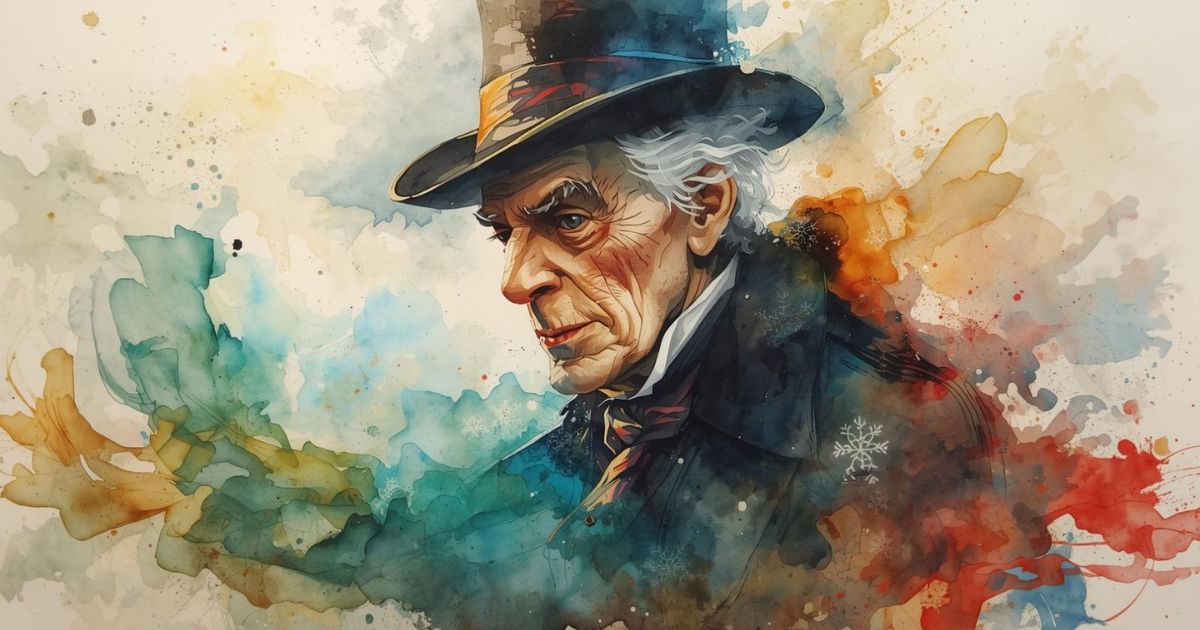
Marley is dead, and the burial register says so. The clergyman, the clerk, the undertaker, and the chief mourner signed it. Scrooge signed it too. His name is good upon 'Change for anything he chooses to put his hand to. Seven years later, on the night of that death, the counting-house is bitter and foggy. Bob Cratchit's fire is so small it looks like one coal. He cannot build it up, because Scrooge keeps the coal-box in his own room. Come in with the shovel, and the master says they will have to part. Fred arrives with a merry Christmas and a dinner for tomorrow. Scrooge says he will see him in that extremity first, then asks why Fred married. Because he fell in love, Fred says. Scrooge treats the answer as more absurd than the holiday. Fred leaves without an angry word. At the outer door he wishes the clerk the greetings of the season, and the clerk returns them. Scrooge has overheard. He mutters about a man on fifteen shillings a week, with a wife and family, talking of a merry Christmas.
That courtesy lets two portly gentlemen in. Hundreds of thousands lack common necessaries, they say, and hundreds of thousands lack common comforts. Scrooge asks if there are no prisons, and if the Union workhouses are still in operation. Told that many would rather die than go there, he says they had better do it and decrease the surplus population. It is not his business. It is enough for a man to understand his own business, and not to interfere with other people's. The gentlemen leave. Scrooge then allows the clerk Christmas Day, calling it not convenient and not fair, and naming the half-crown he might stop from the wage. He eats his melancholy dinner in his usual melancholy tavern, reads the newspapers, sits over his banker's book, and walks home to chambers that once belonged to Marley.
The key is in the lock when the knocker stops being a knocker. Marley's face looks out of it, spectacles turned up on the forehead, hair stirred as if by breath, lit like a bad lobster in a dark cellar. Scrooge stares. It is a knocker again. He searches the rooms, double-locks the door, and sits to a low fire. Then the bells begin to ring, and a clanking comes up the stairs through the door he locked himself. Marley's ghost stands there, bandage round the head, a chain clasped about the middle and wound about like a tail. Scrooge looks closely. The links are cash-boxes, keys, padlocks, ledgers, deeds, and heavy purses wrought in steel. The body is transparent. He can see the buttons on the coat behind. He calls the vision humbug. The spirit cries out, shakes the chain, takes off the bandage, and lets its lower jaw drop upon its breast. Scrooge falls on his knees.
The ghost wears the chain it forged in life, link by link, of its own free will. Scrooge's own chain was as heavy and as long as this one seven Christmas Eves ago, and he has worked on it since. Marley wrings his hands. Mankind was his business. The common welfare was his business. Charity, mercy, forbearance, and benevolence were all his business. The dealings of his trade were a drop of water in that ocean. He cannot interfere for good any more. He can only warn. Three spirits will come. The first tomorrow, when the bell tolls One. The second on the next night at the same hour. The third on the night after, when the last stroke of Twelve has ceased to vibrate. Scrooge asks if he might take them all at once and have it over. He may not. When the ghost has gone, Scrooge looks from the window. The air is full of phantoms in chains. One of them cries because it cannot help a wretched woman with an infant on a doorstep. They want to help the living, and the power is gone. The door is still double-locked. Scrooge tries to say Humbug and stops at the first syllable. He goes straight to bed without undressing, and falls asleep upon the instant.
Dickens wrote this story during the Industrial Revolution when factory owners justified brutal working conditions as economic necessity. Sound familiar? Today's version plays out in every workplace where managers claim they 'can't afford' basic human decency, no sick days, no flexibility for family emergencies, no consideration for workers' lives outside the job. The genius of Scrooge's character is showing how this mindset corrupts the person enforcing it, not just the people suffering under it. When you constantly choose profit over people, you don't just harm others, you rewire your own capacity for connection. The scary part isn't that Scrooge became evil, but that he became numb. He genuinely couldn't see the suffering around him anymore. This happens in every industry where 'efficiency' becomes the only value that matters. Healthcare workers pressured to rush through patient interactions. Teachers forced to teach to tests instead of teaching children. Retail managers required to schedule workers just under full-time to avoid paying benefits. The system demands these choices, but the cost isn't just economic, it's spiritual. What happens to your soul when your job requires you to stop seeing people as people?
Explore this chapter with AI to uncover deeper meaning and practical takeaways.
AI Discussion