
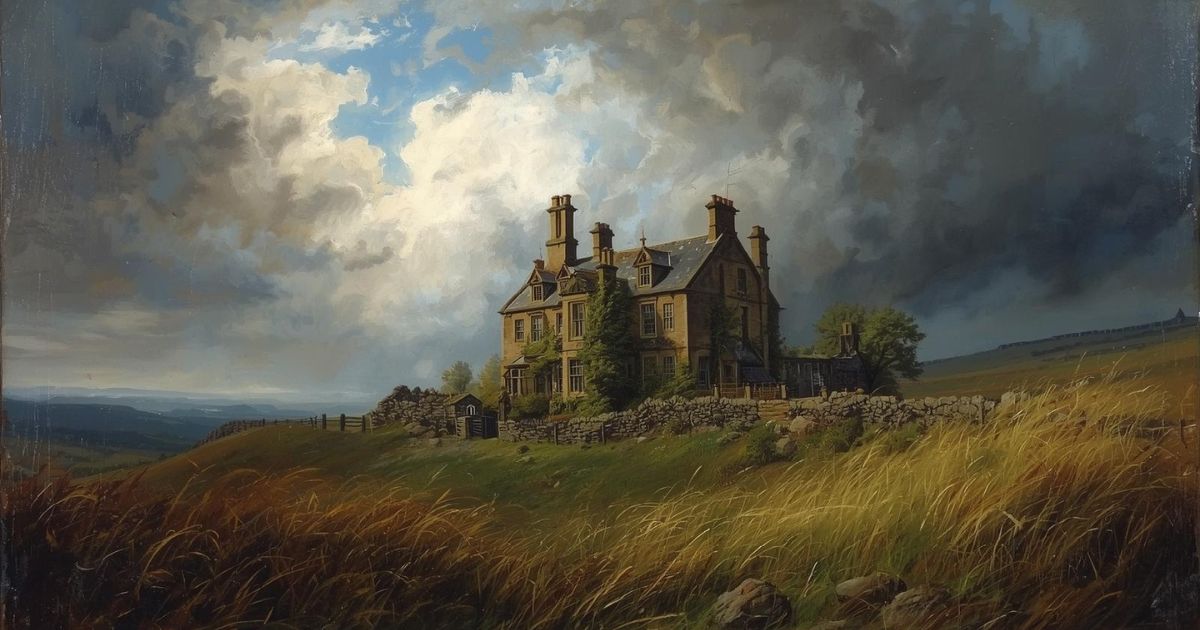
In 1801, Mr. Lockwood, the new tenant of Thrushcross Grange, visits his landlord Heathcliff at Wuthering Heights on the Yorkshire moors. The house is a weathered stone fortress carved with the date 1500 and the name Hareton Earnshaw, built to withstand brutal wind. Heathcliff greets him with barely concealed hostility: suspicious eyes, a clenched-teeth invitation that means "go to the devil," and surly silence. Lockwood is not repelled. He fled a seaside romance the previous summer when a woman finally returned his gaze, shrinking away until she left town. He considers himself a misanthropist and imagines Heathcliff as a kindred isolate.
Inside, Joseph the cantankerous servant takes his horse. The sitting room is rough northern farmer's quarters, but Heathcliff himself is dark, erect, and gentlemanlike in an incongruous way. When Heathcliff warns Lockwood not to pet the bitch and leaves for the cellar, Lockwood sits among the dogs. He foolishly winks and makes faces at them. The mother bitch attacks. Half a dozen dogs join the assault. Lockwood fights with a poker and shouts for help. Heathcliff and Joseph return without hurry. A kitchen woman bursts in with a frying pan and restores order.
Heathcliff asks what the devil is the matter, sets out wine, and offers it as if nothing occurred. Lockwood refuses at first, then drinks to avoid giving further amusement. Heathcliff's manner eases slightly; they discuss Thrushcross Grange. Lockwood volunteers to return tomorrow. Heathcliff clearly wants no repeat visit. Lockwood announces he shall go nonetheless, astonished at how sociable he feels compared with his landlord.
Lockwood arrives at Wuthering Heights already committed to reading isolation as depth. Heathcliff's closed teeth, suspicious eyes, and barely contained contempt should function as a warning. Lockwood instead treats them as proof that they are the same kind of person: two misanthropists who have chosen distance over society. That misreading is not abstract. He projects his own story onto Heathcliff, admits he may be attributing his traits too liberally, and still stays when the dogs attack him. The pattern is familiar in ordinary life: staying drawn to someone whose energy is openly hostile because their intensity feels like understanding; returning after a clear rejection because loneliness makes the rejection feel like honesty; interpreting another person's danger as mystery.
Explore this chapter with AI to uncover deeper meaning and practical takeaways.
AI Discussion