
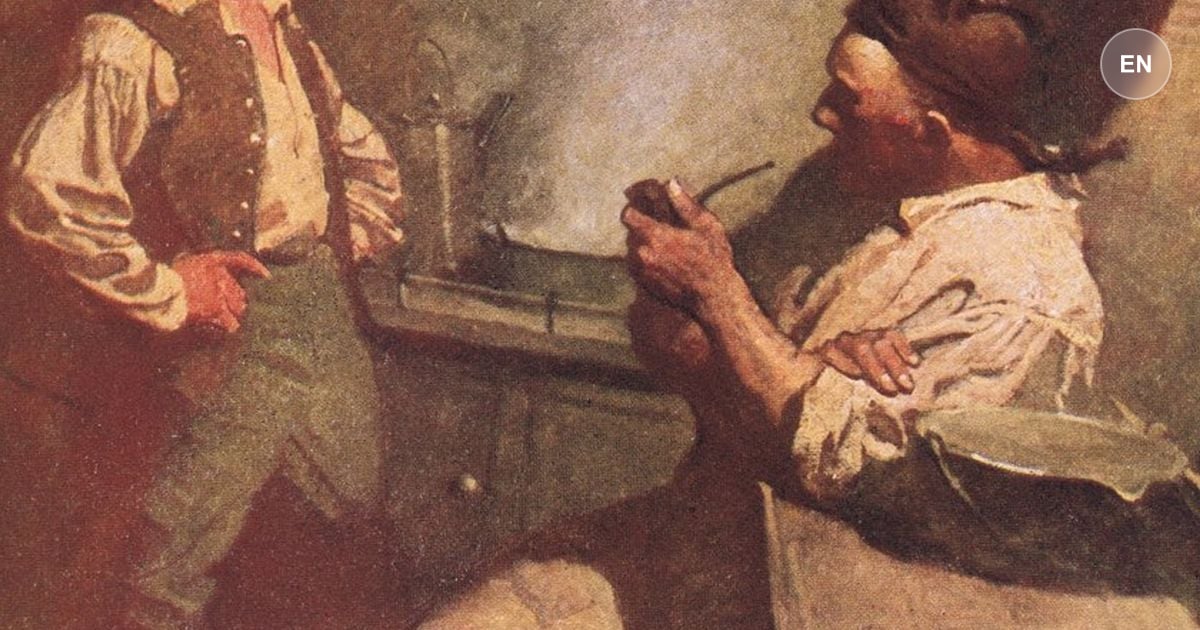
Jim and his mother face a terrifying dilemma after the captain's death. They need money owed to them from the captain's belongings, but dangerous pirates are coming for his sea-chest. When they seek help from neighbors, they discover a harsh truth about human nature: fear makes people abandon others in their time of need. Despite knowing about Captain Flint's reputation and seeing suspicious strangers around, not one villager will help defend the inn.
Jim's mother delivers a fierce speech calling out their cowardice, declaring she and Jim will face the danger alone rather than lose what rightfully belongs to her fatherless boy. Armed only with a pistol and their determination, mother and son return to the inn under a rising moon. They find the key to the captain's chest around his neck and discover it filled with exotic treasures and foreign coins. Jim's mother insists on taking only what's owed - no more, no less - even as the blind beggar's tapping stick announces imminent danger.
Her stubborn honesty nearly gets them killed when pirates arrive, forcing them to flee with only partial payment and a mysterious oilskin packet Jim grabs. The chapter reveals how crisis strips away social pretenses, showing both the worst in people (the neighbors' abandonment) and the best (a mother's fierce protection of her child's future). It demonstrates that sometimes doing what's right means standing alone against overwhelming odds.
Stevenson wrote this during the Victorian era's rapid economic changes, when traditional community bonds were breaking down under industrial pressure. People were becoming more mobile, more individualistic, more willing to cut ties when convenient. Sound familiar? Today's gig economy has accelerated this pattern. We work with people intensely for short periods, form what feel like friendships, then scatter when contracts end. Social media creates the illusion of community while actual mutual aid networks weaken. The villagers who abandoned Jim's family weren't evil, they were rational actors protecting their own interests. They calculated that helping meant risking everything for people who weren't family. This cost-benefit analysis happens constantly now. Your work friends who don't visit when you're sick. Neighbours who won't watch your kids in emergencies. Family members who disappear during financial crises. The difference is that Jim's mother had clear moral expectations: decent people help each other, period. She was willing to be called foolish rather than abandon principle. Today, we're taught that self-preservation is wisdom, that you can't help others if you don't help yourself first. But what happens to a society where everyone makes that calculation? Where does real security come from if not from people who'll actually show up?
Explore this chapter with AI to uncover deeper meaning and practical takeaways.
AI Discussion