
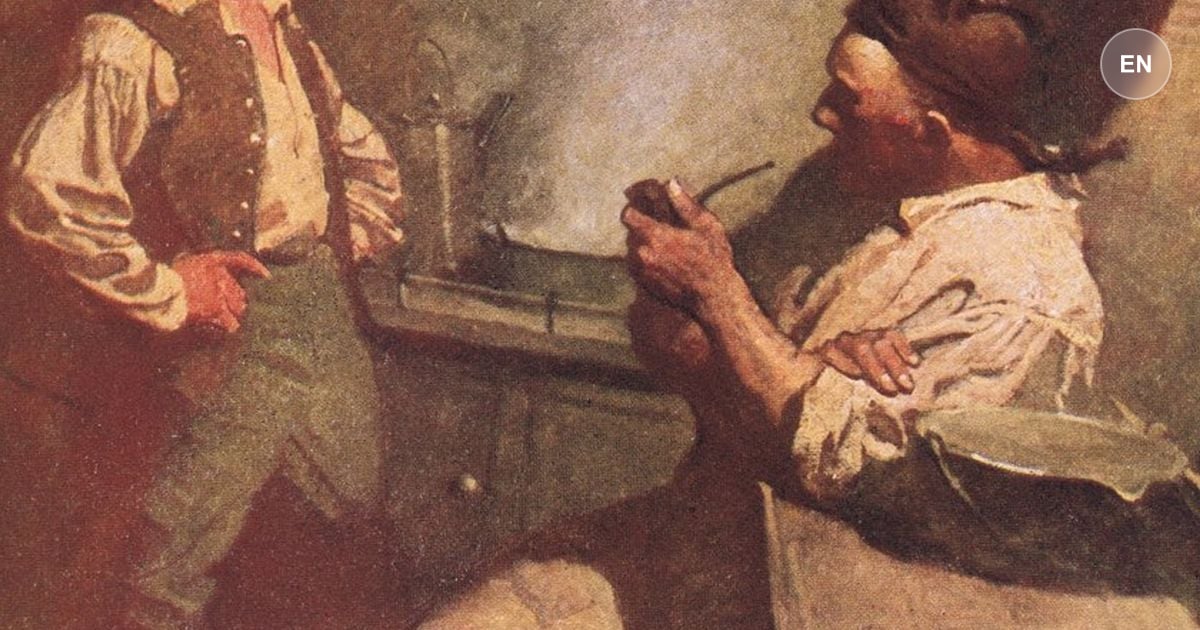
Jim awakens alone in his tiny coracle at the dangerous southwest end of Treasure Island, surrounded by treacherous cliffs and massive sea lions. His first instinct is to paddle straight to shore, but he quickly realizes this would mean certain death on the rocks. Instead of panicking, he observes his situation carefully and notices the northward current Silver had mentioned. Jim decides to work with the ocean rather than against it, letting the current carry him toward the gentler Cape of the Woods.
When he tries to paddle aggressively, the coracle nearly capsizes, teaching him that some situations require patience and subtle adjustments rather than force. Through careful observation, he discovers that ocean waves aren't the smooth mountains they appear from shore, but are full of valleys and peaks that a small boat can navigate if left mostly alone. As thirst begins to torment him under the blazing sun, Jim spots the Hispaniola sailing erratically nearby. The ship's wild, unpredictable movements suggest no one is steering, the crew must be drunk or dead.
Seeing an opportunity to reclaim the ship for Captain Smollett, Jim makes a bold decision to pursue the much larger vessel in his tiny coracle. Through determination and careful timing, he manages to get close enough to leap aboard just as the ship's bowsprit passes overhead, leaving his coracle destroyed but gaining access to the pirates' ship. This chapter shows Jim maturing from reactive fear to strategic thinking, learning to read situations and find opportunities within danger.
Stevenson wrote Treasure Island during Britain's imperial expansion, when individual survival often meant reading larger forces correctly. Jim's coracle scene captures a timeless truth: sometimes the most powerful response to overwhelming circumstances isn't resistance, it's intelligent cooperation. This isn't about giving up your goals or accepting injustice. It's about recognizing when direct confrontation will destroy you and finding indirect paths to the same destination. In modern workplaces, this pattern plays out constantly. The employee who fights every new policy burns out, while the one who finds ways to make changes work for their department advances. The parent who battles their teenager's independence creates rebellion, while the one who channels that energy toward positive goals maintains influence. The patient who ignores medical advice and pushes through pain often worsens their condition, while the one who works with their body's healing process recovers faster. Jim's lesson isn't passive acceptance, it's tactical intelligence. He still wants to reach shore safely, but he achieves it by reading the ocean's power and using it rather than fighting it. The question isn't whether to have goals and standards, but how to achieve them when you're outmatched. Sometimes the fastest way forward means going with the current first, then making your move when conditions align.
Explore this chapter with AI to uncover deeper meaning and practical takeaways.
AI Discussion