
Socrates continues by asking who should learn philosophy and when. The young should not be thrown into dialectic too early, he warns, or cleverness will replace character and produce stylish skeptics who mock everything. Gymnastics, music, and military service must come first so the soul is disciplined before it confronts arguments that can undermine belief. Even gifted students need years of habit before they can handle abstract questioning without moral drift. Premature dialectic turns philosophy into a game that destroys reverence for law and custom without replacing it with knowledge.
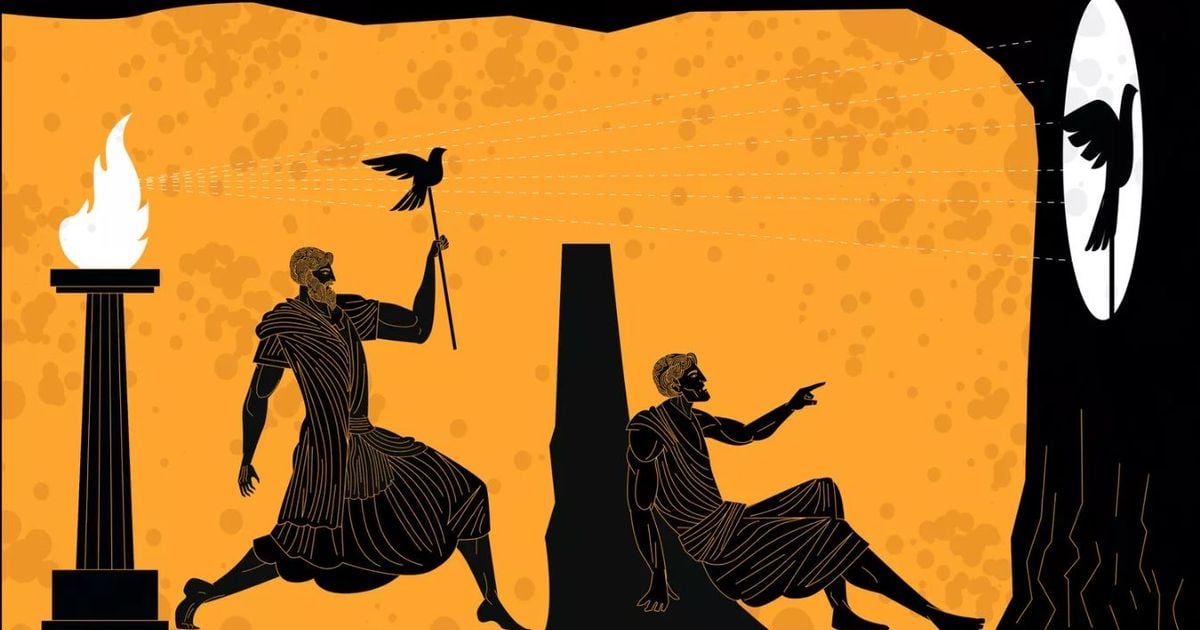
He then presents the allegory of the cave: prisoners chained underground take shadows for reality until one is freed, dragged into sunlight, and slowly adjusts to the true world. Returning to the cave, the enlightened prisoner looks foolish to those still watching the wall. The image captures both the philosopher's insight and the hostility awaiting anyone who tries to lead others toward painful truth. Education is not stuffing sight into blind eyes but turning the whole soul toward the light. The painful ascent shows why most people prefer familiar illusions to the disorientation of seeing things as they are.
The curriculum for future rulers follows that ascent: years of mathematics and harmony train the mind to grasp invisible structures, culminating in dialectic and contemplation of the Good itself. Arithmetic, geometry, astronomy, and music are not mere technical subjects; they habituate the soul to realities that cannot be touched or bought. Only after this long preparation should philosophers be sent back into public life, compelled to govern for the city's sake rather than their own preference for study. The chapter ties political reform to a pedagogy that reshapes what people take to be real, and it answers Adeimantus' earlier worry that guardians would be miserable by showing that the deepest satisfaction belongs to minds aligned with truth. The cave is not only a picture of ignorance; it is a warning about how painful enlightenment feels to communities built on shared illusions. That is why returning philosophers must be compelled to rule: the city punishes truth tellers unless law forces them to serve the common good.
The cave isn't just a philosophy problem - it's an everyday workplace reality. Think about the last time someone came back from training, a conference, or even another job with new ideas. What happened? Nine times out of ten, they hit a wall of resistance that had nothing to do with whether their ideas were good. Plato understood something about human nature that every shift worker knows: we defend our routines like our lives depend on them. Because in a way, they do. When you've survived twenty years doing things one way, someone suggesting change feels like they're saying those twenty years were wasted. That your expertise is worthless. That you've been a fool. The resistance isn't logical - it's primal. In healthcare, it's the aide who suggests a patient dignity protocol and gets told 'we don't have time for that fancy stuff.' In retail, it's the stocker who proposes a better inventory system and hears 'corporate tried that ten years ago.' In families, it's the adult child who suggests counseling and gets 'we don't air our dirty laundry.' The pattern is always the same: the new perspective is attacked not on its merits, but because it implies the old way was lacking. Here's what Plato knew that matters for us: the prisoners aren't evil. They're terrified. The shadows on the wall aren't just what they see - they're who they are. Take that away, and what's left? This is why change management fails, why good ideas die, why the best workers often leave. We treat resistance as stupidity when it's actually fear. The freed prisoner's mistake wasn't seeing the light - it was expecting others to welcome it. Real change requires understanding that you're not just introducing a new procedure or perspective. You're asking people to admit they've been watching shadows. That's why the best reformers move slowly, honor the old way even while changing it, and find allies among those whose chains sit loose.
Explore this chapter with AI to uncover deeper meaning and practical takeaways.
AI Discussion