
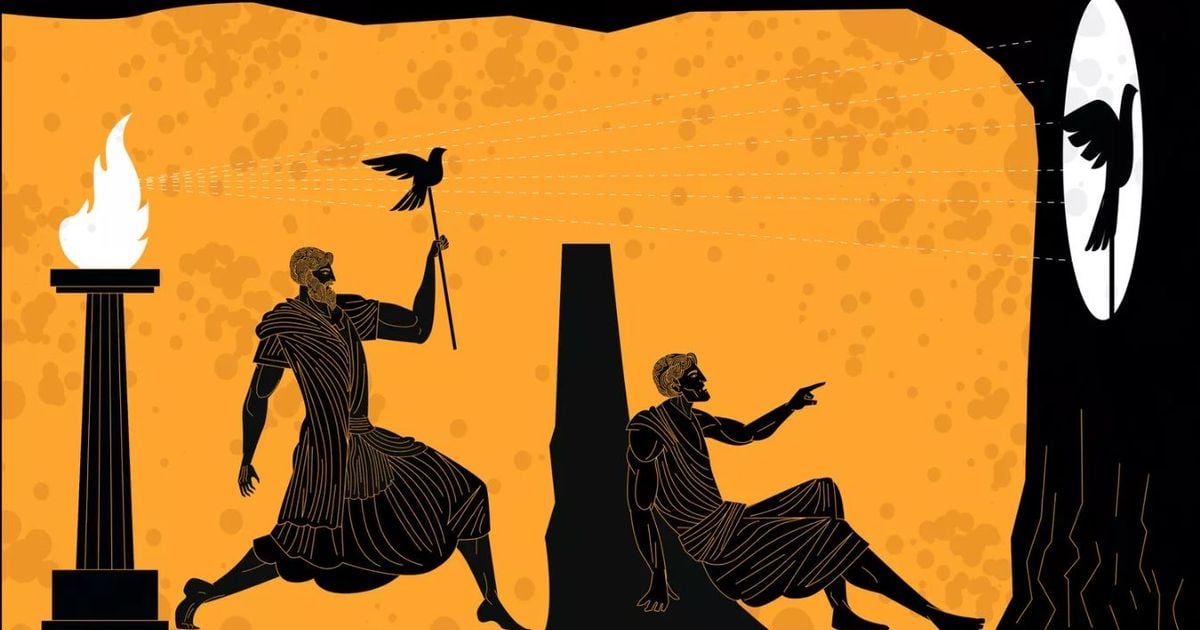
Socrates must explain what philosophers are and why cities reject them. A philosopher loves learning for its own sake and grasps eternal forms, especially the Form of the Good that makes all other knowledge intelligible. Most people, he says, live among shadows: they chase honor, money, or pleasure and mistake appearance for reality. That is why democracies elevate flatterers while treating serious thinkers as impractical or dangerous. The many confuse philosophy with idle cleverness or with the sophistry that teaches young men to win arguments without caring about truth.
He compares ordinary souls to a mutinous ship where the crew fights over the helm while dismissing the true navigator who reads the stars. The navigator sees truths the crew cannot judge, yet they call him a stargazing fool. Likewise, philosophers see beyond customary opinion, which makes them unpopular even when they alone know where the city should sail. Corrupt education and theatrical rhetoric train citizens to reward charm over wisdom. Public assemblies cheer speakers who mirror their prejudices and punish anyone who asks uncomfortable questions about justice, courage, or the soul.
Still, Socrates argues that philosophy is the craft best suited to rule because it orients the soul toward what is rather than what seems profitable. The problem is not philosophy itself but the worldly honors that tempt philosophers away from their calling or poison them once they gain power. Young talents who might have become lovers of wisdom are diverted into law courts and political campaigns where reputation matters more than understanding. The dialogue now must show how long disciplined training could produce rulers who love truth more than applause, preparing the famous account of education that culminates in the allegory of the cave. Until that training is described, the third wave of Book V remains a slogan rather than a plan. Cities that mock philosophers still need someone who can see beyond the next election or the next war, yet they rarely fund the slow education that produces such rulers. Until that changes, the ship of state will keep promoting charismatic pilots who cannot read the stars at all.
Plato's ship of state reveals an uncomfortable truth: we actively participate in our own deception. The sailors don't just ignore the navigator—they mock him for studying the stars while they're trying to party. They drug the captain not because they're evil, but because his careful steering interferes with their immediate desires. This pattern repeats everywhere humans gather, from ancient Athens to modern workplaces. The warehouse workers in Andreas's story aren't stupid. They're exhausted, overworked, and desperate for hope. The new manager offers them what they crave: simple solutions, someone to blame, and the promise that change can be easy. Andreas offers them reality: complex problems, shared responsibility, and the hard work of actual improvement. Who would you choose after a twelve-hour shift? The pattern persists because it meets emotional needs. The smooth talker makes people feel smart for understanding his simple solutions. The expert makes people feel stupid by revealing how much they don't know. The crowd doesn't reward truth; it rewards comfort. This is why every organization eventually fills with people who tell leadership what they want to hear rather than what they need to know. But here's what Plato also shows us: reality always wins. The ship still needs to reach port. The warehouse still needs to function. The navigator's knowledge remains true whether anyone listens or not. The question isn't whether expertise matters—it's whether we'll recognize it before or after the crash. When you understand this pattern, you stop taking it personally when your knowledge gets dismissed. You realize you're not crazy—you're just holding a map in a room full of people insisting they don't need directions. The skill is learning when to speak, when to document, and when to simply position yourself to help pick up the pieces when reality arrives.
Explore this chapter with AI to uncover deeper meaning and practical takeaways.
AI Discussion