
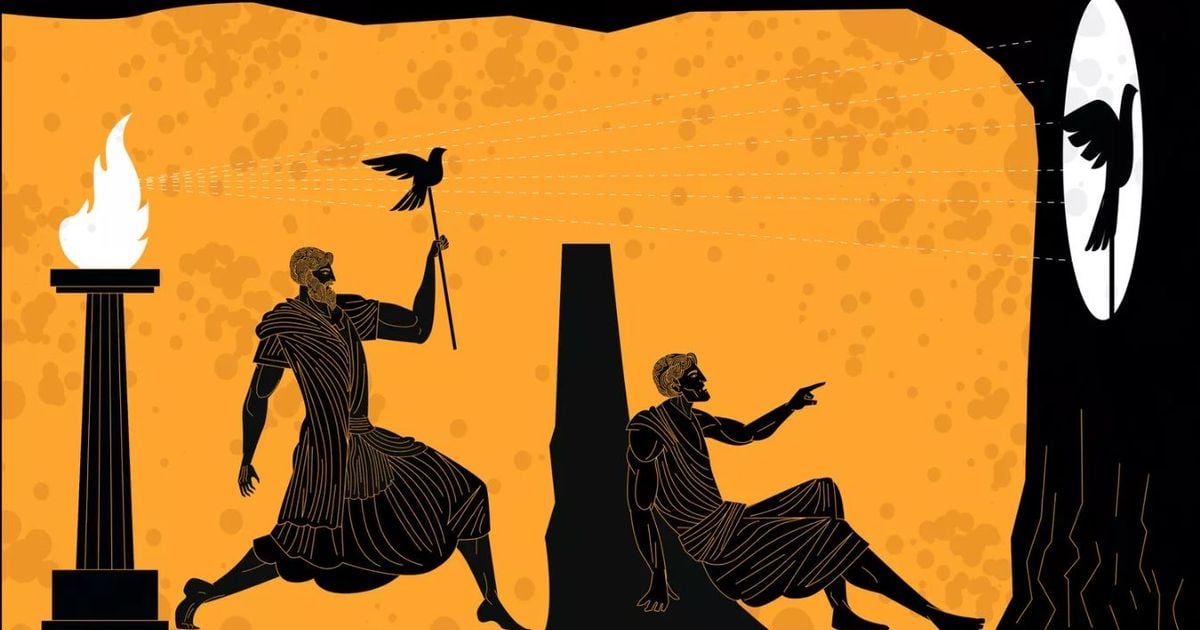
Socrates turns from defending justice in the abstract to designing the education that would produce worthy guardians. Because stories shape character before reason fully awakens, the city must censor poetry that shows gods lying, grieving, or lusting. Homer and Hesiod may be beloved, but if divine models behave badly, children learn that wickedness is normal. Tales must instead praise courage, self-control, and devotion to duty, even when that means editing the cultural canon that every Greek grew up reciting. Socrates is not banning art altogether; he is asking what habits a republic installs when it hands its youth stories of quarreling Olympians and weeping heroes.
The training continues through music and physical exercise, though Plato treats both as disciplines of the soul rather than mere entertainment or bodybuilding. Too much soft music produces laziness; too much harsh gymnastics breeds brutality. The balanced guardian should be gentle with citizens and fierce toward enemies, like a well-bred watchdog that distinguishes friend from stranger. Rhythm, harmony, and habit work together so that virtue becomes second nature long before young rulers encounter formal argument. Physical training also prepares bodies for war, but its deeper purpose is to keep appetite from overruling reason when fear or pleasure surge.
Socrates then introduces the controversial noble lie: citizens should believe they were born from the earth with different metals in their souls, gold for rulers, silver for warriors, bronze or iron for workers. Children may not inherit their parents' metal, allowing merit to move people between classes. The lie is not casual propaganda; it is meant to bind the community to a shared origin and to justify specialization without constant civil war over status. Critics in the dialogue object that deception corrupts rulers, yet Socrates replies that founding myths already shape every society, and a city that tells the truth about human inequality without a unifying story may fracture faster than one guided by a carefully taught fable. Education, myth, and law begin to merge as tools for keeping the ideal city unified. The guardians' childhood is therefore the first constitution the city writes, long before anyone votes on a law.
Plato understood something profound: humans are story-making animals. We don't just tell stories; we live by them. Every organization, every family, every individual operates according to narratives—most of which we've never consciously examined. Think about the stories in your own workplace. There's usually an origin story about how the company started, tales of legendary employees who 'went above and beyond,' cautionary tales about those who didn't make it. These aren't neutral entertainment. They're behavioral programming. A restaurant that constantly retells stories of servers who covered extra shifts without complaint is teaching new hires what's expected. A factory where everyone knows about the guy who got fired for questioning safety protocols is teaching workers to keep quiet. But here's where Plato gets really interesting with his 'noble lie' about metals in the soul. He's showing us that stories don't have to be literally true to be functionally powerful. The story that 'anyone can make it in America' shapes behavior whether it's statistically accurate or not. The narrative that 'this company is a family' affects how people act whether it's genuine or manipulation. The question isn't whether we live by stories—we all do. The question is whether we're conscious of which stories we're living by, and whether those stories serve our actual interests or someone else's. When you start paying attention, you'll notice stories everywhere: the self-talk that runs through your head, the family legends that get repeated at gatherings, the workplace myths that guide unwritten rules. Some of these stories lift you up. Others keep you down. But once you see them as stories rather than fixed reality, you gain the power to rewrite them.
Explore this chapter with AI to uncover deeper meaning and practical takeaways.
AI Discussion