
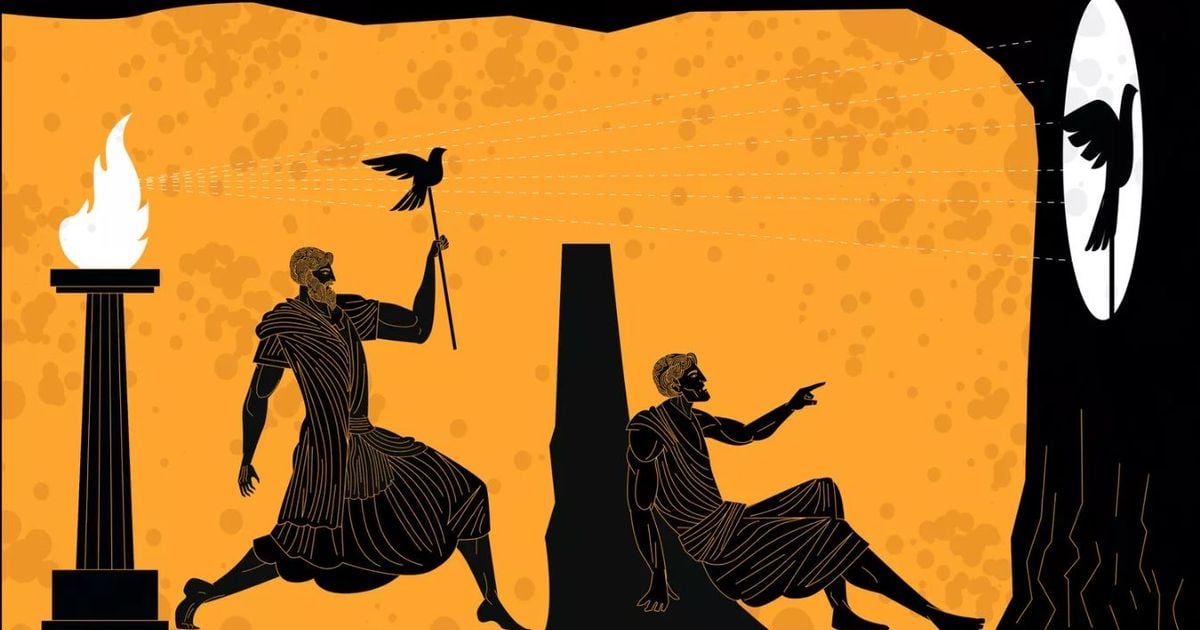
Thrasymachus is silenced, but Glaucon refuses to let the argument rest. He sorts goods into three kinds: things valued for themselves, things valued for themselves and their results, and things valued only for their results. Justice, he says, belongs in the awkward middle category: most people practice it reluctantly, as a necessary burden, because they fear punishment and crave reputation rather than because they love what is right. Ordinary citizens praise justice in public while privately wishing they had the strength to cheat without consequence.
To make the case vivid, Glaucon tells the story of Gyges' ring, which grants invisibility. With that power, he argues, even a decent person would steal, seduce, and murder because no witness could hold them accountable. He then paints two extreme portraits: the perfectly unjust person who maintains a spotless public image while secretly committing every crime, honored and wealthy to the end; and the perfectly just person who appears wicked, tortured, and ruined while remaining innocent inside. If appearance alone decides fortune, injustice seems plainly smarter. Glaucon insists Socrates must prove that the invisible just life is still better, not merely safer when someone is watching.
Adeimantus adds that parents, poets, and priests rarely praise justice on its own merits. They promise rewards in this life or the next, which only proves that people need external incentives to behave. He attacks the religious bargain where the rich buy forgiveness through sacrifice while the poor suffer, and he notes that hymns celebrate virtue chiefly for the fame and favors it brings. Homer and the tragedians teach that good men suffer while clever villains prosper, so culture itself undermines moral earnestness. Together the brothers demand that Socrates show justice as good in itself, chosen for its own sake, not because it looks profitable or god-approved. That challenge forces the dialogue beyond refuting cynics and toward building an ideal city where justice can be seen clearly, which is where Socrates will begin his famous construction of Kallipolis in the books that follow. Until that city is imagined, justice remains a word everyone uses and no one can defend when the cost of honesty is high.
Every smartphone is a Ring of Gyges. Behind that screen, you're invisible - anonymous comments, fake profiles, digital spaces where your real name doesn't follow. The pattern Plato identified hasn't changed; only the technology has. When consequences feel distant, character reveals itself. Consider how people transform online. The gentle coworker who becomes vicious in community forums. The faithful spouse who maintains dating profiles 'just to look.' The honest employee who inflates their LinkedIn accomplishments. Each believes they're wearing an invisibility ring. But here's what Glaucon and Adeimantus were really asking: Is there any reason to be good when you could get away with being bad? Their answer was no - unless someone proves that justice has value beyond its consequences. This matters because we all get our own invisible rings. Maybe it's access to the cash register. Maybe it's knowledge of which corners can be cut. Maybe it's information that could destroy someone you dislike. The warehouse worker who finds inventory 'errors' faces the same choice as Gyges with his ring. So the question becomes: Who are you when you're invisible? And perhaps more importantly - are you the same person in the dark as in the light? Because if not, then maybe you're not as good as you think. Maybe you're just powerless. The real test of character isn't how you act when everyone's watching. It's who you become when you think no one ever will.
Explore this chapter with AI to uncover deeper meaning and practical takeaways.
AI Discussion