
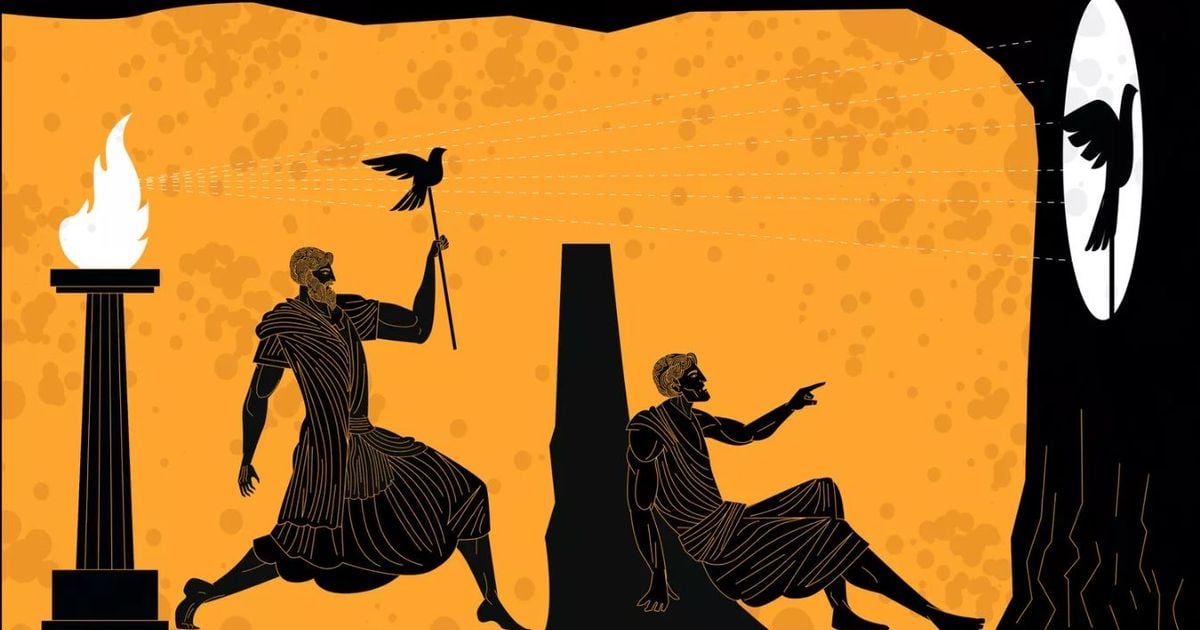
The final book returns to poetry, pleasure, and immortality. Socrates renews his attack on tragic and epic imitation, claiming that poets stir emotion by copying appearances rather than grasping truth. A painter who mirrors a bed is twice removed from the form of bedness; likewise Homer depicts heroes and gods without knowing the good they should embody. Drama makes spectators weep for fictional suffering, laugh at comic shame, and temporarily surrender rational control. That emotional surrender feels noble in the theater, but in civic life it trains citizens to honor passion over judgment. Even Homer, beloved as Greece's teacher, must be banished from the just city because he flatters the soul's lower parts and teaches young guardians to admire rage, grief, and revenge. Tragedy rewards the spectacle of virtue collapsing; comedy rewards shamelessness. Neither genre teaches steady character. Socrates therefore repeats the curriculum logic of Book III at a deeper level: if the soul is to be just, the stories that shape it must be governed by knowledge of the good, not by crowd-pleasing imitation.
He also examines poetic inspiration, arguing that poets often write from irrational possession rather than understanding, which is why they cannot explain their own best lines. That weakness would matter less if poetry were private entertainment, but in Athens it was civic education. Socrates then turns to the immortality of the soul and the Myth of Er, a soldier who dies, journeys through the afterlife, and returns to report what he saw. Souls are judged, some ascending to the heavens and others descending beneath the earth, paying tenfold penalties for crimes committed in human life. After purification they gather in a meadow to choose new lives before drinking from the river of forgetfulness and being reborn. The scene is unforgettable: souls that lived badly often rush toward tyrannical lives out of habit, while philosophic souls choose modest patterns. Even Odysseus, weary from struggle, seeks a quiet private life. A lottery decides the order of choosing, yet character still governs what each soul reaches for when the masks of future lives are spread before them. The myth does not replace dialectic; it shows that justice has consequences beyond reputation and that education writes default settings into the chooser. Er's report also describes rewards for just souls and terrible punishments for tyrants, as if the universe eventually corrects what public opinion often celebrates. Plato uses the story to speak to readers who still doubt that justice pays when the wicked prosper on earth. The myth is poetry in service of philosophy, not a literal map, yet it makes the moral stakes vivid for listeners who love stories more than syllogisms.
The dialogue therefore ends on responsibility rather than certainty. Socrates has not restored Homer to Athens, built his ideal city in stone, or proven every step to skeptics who demand empirical politics. He has instead linked justice, knowledge, and happiness into one arc: cities fail when they reward appearance, souls fail when appetite rules, and art matters because it teaches desire. Readers who began with Thrasymachus asking why the just person should bother are invited to see justice as alignment with reality itself. The closing image of souls choosing lives warns that freedom without wisdom repeats the same mistakes across lifetimes. The Republic closes where philosophy must always close, with a call to turn from shadows toward the Good and to accept the slow labor of self-rule in whatever city we actually inhabit. The harbor festival that opened the conversation now feels distant: the work ends not with a constitution enacted but with a soul warned about what it loves. Between the attack on poetry and the myth of Er, Socrates also argues that pleasures associated with imitation are lower than the pleasures of knowing reality, because imitation feeds opinion rather than understanding. That claim reunites aesthetics with ethics: what delights us in art trains what we pursue in law, friendship, and office. The Myth of Er therefore answers Glaucon and Adeimantus on a plane beyond courtroom reputation. Even if the perfectly just person is tortured on earth and the clever villain dies in a festival of praise, the chooser in the meadow still lives with the habits forged here. Philosophy is the practice of choosing better lives before the lots are cast. Readers leave the dialogue with homework: examine which shadows you call sunlight, and which stories you let govern your desires when no ring of Gyges hides your actions. The last word belongs not to policy manuals but to the soul that must choose, again and again, whether to live by appearance or by the Good it has glimpsed through philosophy. That closing challenge returns the reader to the Piraeus festival where the argument began, now armed with ten books of reasons to examine every easy answer about justice.
Plato identified something we see everywhere today: people who can perform knowledge they don't actually possess often get more respect than those who quietly know what they're doing. The pharmaceutical rep who's never treated a patient can influence doctors. The consultant who's never run a department can restructure entire companies. The politician who's never balanced a household budget can promise economic solutions. Why does this happen? Performance triggers our emotions, and emotions feel like proof. When someone speaks passionately about healthcare, we assume they care about patients. When someone presents confident charts about productivity, we assume they understand work. When someone moves us to tears talking about family values, we assume they live those values. But Plato warns us that the most dangerous false experts are often the most convincing performers. They've studied how to appear knowledgeable without doing the hard work of actually becoming knowledgeable. Real expertise is often quieter, less dramatic, more focused on results than applause. The nurse who's worked the floor for ten years doesn't need to give speeches about patient care. The mechanic who actually fixes cars doesn't need to explain why they're good at their job. The parent who raised decent kids doesn't need to lecture others about family values. True competence speaks through outcomes, not presentations. Recognizing this pattern protects us from being manipulated by skilled performers and helps us identify the people who actually know what they're doing.
Explore this chapter with AI to uncover deeper meaning and practical takeaways.
AI Discussion