
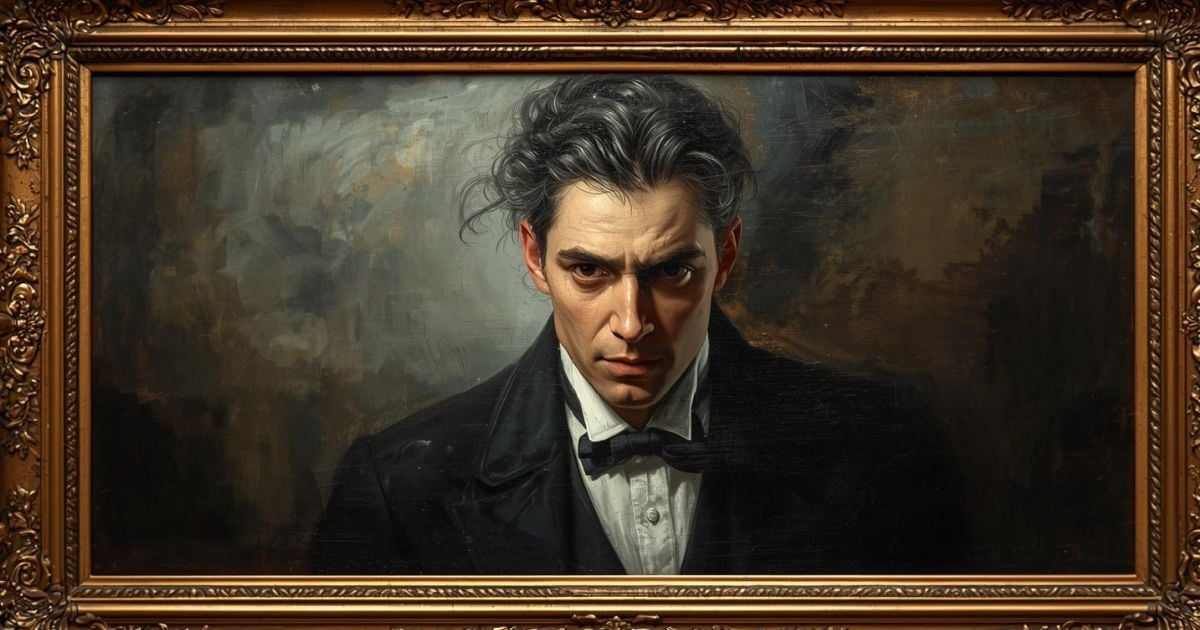
A month later Dorian waits in Lord Henry's Mayfair library, sulky because Henry is late on principle, until Victoria, Lady Henry, fills the interval with nervous chatter about Wagner, church, and how many photographs her husband keeps. When Henry arrives she leaves, and Dorian announces he is too much in love for marriage in the abstract. The girl is Sibyl Vane, an actress Henry has never heard of, and Dorian is ready to defend her before the introduction is finished.
He explains the search. Henry's talk about beauty sent him east through grimy streets until he bought a box, on impulse, for Romeo and Juliet in a wretched little theatre. A hideous man with greasy ringlets and a huge diamond stood at the door. The orchestra was a young player at a cracked piano, and Romeo was a stout elderly actor, but Sibyl as Juliet filled him with tears. He threw her flowers. The man at the door insisted on taking him behind. Night after night since, he has watched her die in an Italian tomb and wander the forest of Arden as Rosalind, then appear as Imogen. She calls him Prince Charming because, she says, he looks more like a prince than a person, and she knows nothing of life outside the play. He calls her a genius and sacred, and means to take a West End theatre and bring her out properly. Henry answers that no woman is a genius, that women are a decorative sex, and that only sacred things are worth touching. He spends the rest of the hour on marriage and the meanness of other people's tragedies, and calls Basil a Philistine who puts his charm into paint and leaves only prejudice for life. Dorian admits the portrait is a month younger than he is, that he delights in it, and that Basil's good advice annoys him. They will dine at the Bristol tomorrow and see her as Juliet.
Dorian rushes off to the theatre. Henry stays behind, pleased. To a large extent he thinks the lad is his own creation, made premature, and this sudden love is a phenomenon of curiosity and the desire for new experience. He walks home wondering how that fiery life will end. About half-past twelve a telegram is waiting on the hall table. Dorian Gray is engaged to be married to Sibyl Vane.
Dorian's confession to Henry is one of the clearest warnings in the novel. He does not describe Sibyl's habits, fears, or daily life. He describes Juliet, Imogen, and every heroine at once. That is not intimacy. It is casting.
We repeat the pattern whenever we fall for someone's stage presence, podcast voice, or carefully posted life. The feeling is real, but the object is thin. When the person fails to entertain us, we call it betrayal instead of humanity.
Henry sees the experiment clearly. Dorian believes he has found sacred love. Henry knows he has found excellent material. The engagement telegram arrives before anyone tests whether Sibyl can be ordinary on a Tuesday morning.
The useful question is not whether art moves you. It is whether you can love someone when the audience leaves.
Explore this chapter with AI to uncover deeper meaning and practical takeaways.
AI Discussion