
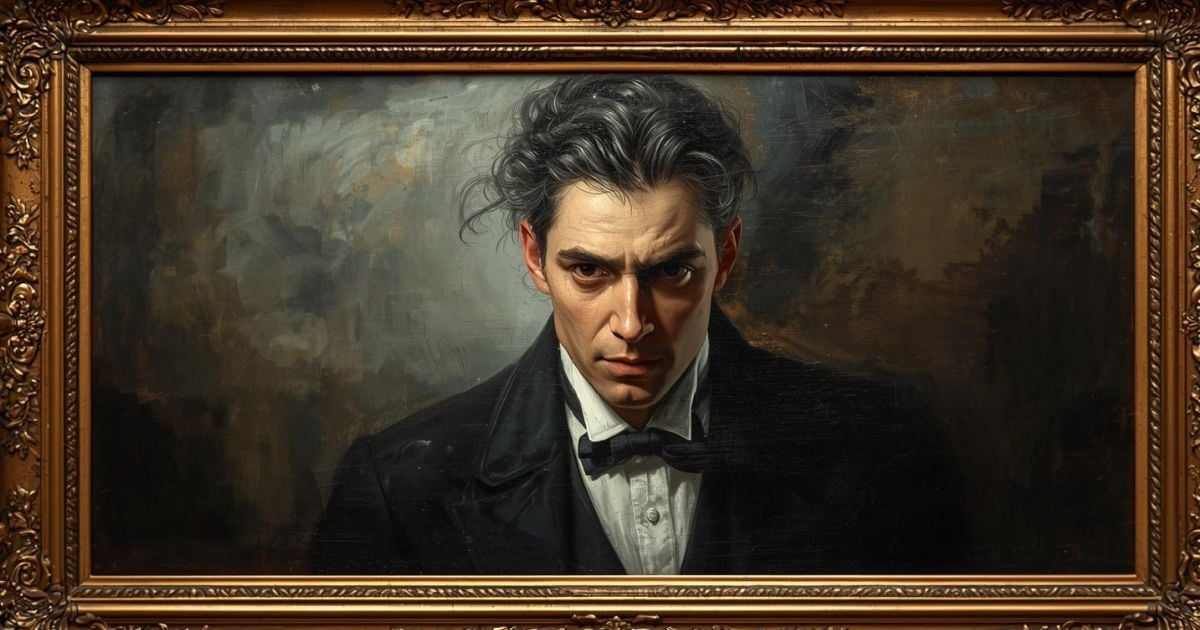
Dorian wakes peacefully the morning after murdering Basil, smiling like a boy until memory returns with blood-stained feet and he remembers the corpse still sitting upstairs in daylight. Such hideous things belong to darkness, not May sunshine, and he decides the murder must be driven from his mind before it strangles him. He dresses with extra care, lingers over breakfast, tears up a woman's letter, and sends Francis to fetch Alan Campbell from Hertford Street while every face he sketches turns into Basil Hallward.
He tries to forget in Gautier's Venice stanzas and the poem of Lacenaire's unwashed hand, but terror wins as the clock crawls and imagination turns the waiting room into a precipice. Campbell was once his inseparable friend, brought together by music and fascination at Lady Berkshire's, until their intimacy ended in silence and Campbell would not even hear music in Dorian's presence; now Dorian needs the chemist who works in dead-houses. When Campbell arrives pale and contemptuous, having sworn never to enter the house again, Dorian admits there is a dead man in the locked room and demands that body and belongings be reduced to ashes no trace can find.
Campbell refuses until Dorian first claims suicide, then confesses murder and reframes the task as science: destroy a specimen as Campbell has done a hundred times before. Friendship, pity, and appeals to the laboratory all fail, and Campbell says he will not peril his reputation for devil's work. Dorian writes on a slip of paper, pushes it across the table, and when Campbell reads it his face goes ghastly; a letter already stamped waits in the wings as pity becomes power and Dorian says it is his turn to dictate terms.
Campbell cannot leave; chemicals arrive by cab while Francis is sent to Richmond for orchids on a lovely day. Dorian flings the curtain over the portrait's blood-stained hand, cannot look at Basil's body, and waits downstairs five hours until Campbell returns calm and infamous. He says goodbye forever. Dorian climbs to the schoolroom and finds only the smell of nitric acid where his friend had sat.
Chapter 14 is the logistics of murder. Dorian cannot move Basil or live with him in daylight, so he needs a chemist and a former friend. Wilde is ruthless about sequence: charm, science, friendship, terror, letter, terms. Campbell is not persuaded. He is trapped. The orchid errand and the careful breakfast are the same performance from different angles, one for servants, one for the reader. What makes the chapter modern is how familiar the reframing sounds. Destroy the specimen. You have done worse in dead-houses. It is only evidence. Each sentence tries to shrink a corpse into a professional task. When that fails, the letter appears and the language changes. Now it is for me to dictate terms. The friendship dies in the same hour the body does. Campbell leaves vowing never to return, and Dorian smells nitric acid where a man had sat. That smell is the chapter's moral residue: you can dissolve a body and still not dissolve what you became to get rid of it.
Explore this chapter with AI to uncover deeper meaning and practical takeaways.
AI Discussion