
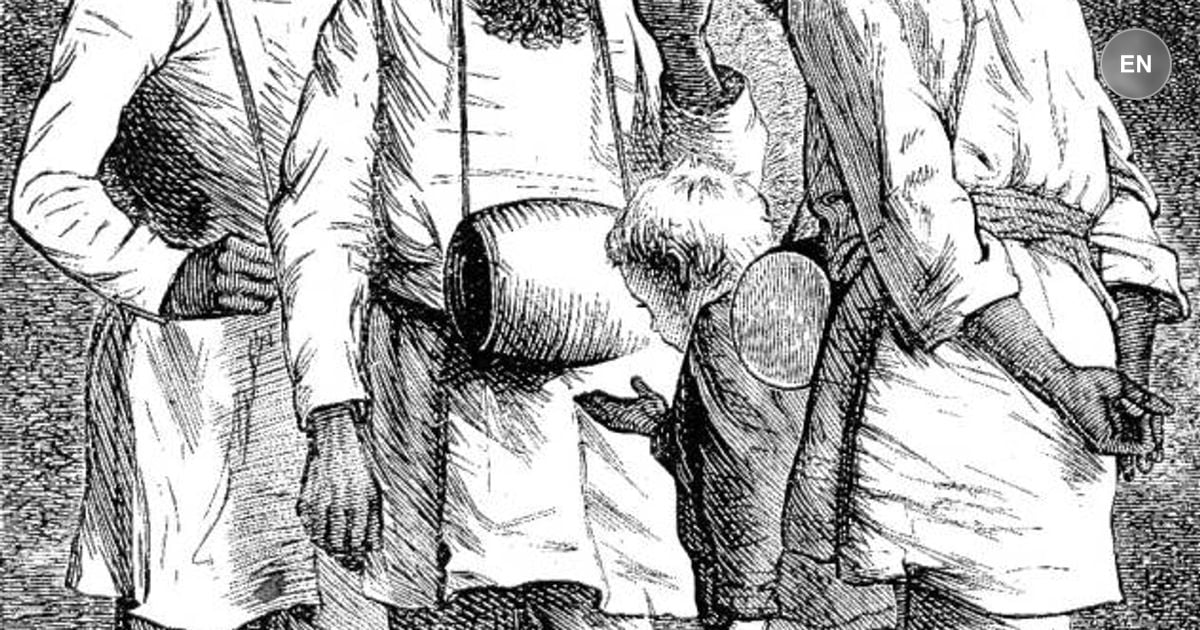
At a dinner party dominated by tedious political talk, lawyer Bruff spots the celebrated explorer Murthwaite drifting toward sleep and seizes the moment. He drops a careful reference to the Moonstone case, and Murthwaite snaps to attention instantly, turning his back on the entire table of Conservatives and Liberals to focus on Bruff alone. This pivot from social performance to genuine engagement marks the chapter's first turn: two practical men abandoning polite convention to pursue a real problem. Murthwaite takes command of the analysis and walks Bruff through the conspiracy from its origins. He establishes that the three Indians currently in England are not the original guardians who followed Colonel Herncastle home years ago, but their successors, who inherited both the mission and the organization built to support it. That organization is modest but functional: access to money, a network of shady English go-betweens, and the quiet sympathy of a few Indian workers scattered through London.
Using this infrastructure, the Indians obtained a copy of Herncastle's will from Doctors' Commons, identified Rachel Verinder as the diamond's heir, and tracked Franklin Blake's movements from the city to Yorkshire. This is the chapter's second turn: what seemed like supernatural coordination resolves into ordinary surveillance and legal research. Bruff raises the central puzzle of the middle section. If the Indians believed the diamond was inside Lady Verinder's house, why did they wait weeks without making any move against it? Murthwaite's answer is crisp and grounded in cultural knowledge. No Indian operative runs an unnecessary risk.
Franklin Blake had already detected one of their spies in London and moved up his travel schedule to deposit the diamond in a bank before they could react. Attacking a man who had already outwitted them once was a poor gamble. Waiting for Rachel's birthday, when the will guaranteed the diamond would pass entirely into her hands and she would almost certainly wear it publicly, was the rational choice. The Indians appeared at the house on exactly that night and saw the Moonstone displayed on her dress, confirming their calculation was correct. Murthwaite also addresses the clairvoyance question directly. The mesmerized boy is a genuine sensitive subject, but what he reflects is only what the person mesmerizing him already believes.
The supernatural framing is psychological fuel for men on a long, dangerous mission, not an actual intelligence method. Bruff, a practical lawyer, finds this explanation far more credible than any mystical alternative. The chapter closes with Murthwaite summarizing the first act of the conspiracy: the Indians were caught lurking on the terrace, imprisoned as vagabonds, and their immediate plans collapsed. The diamond's mysterious disappearance that same night made Murthwaite's earlier advice to cut the stone into separate pieces irrelevant. The first chance was lost. Murthwaite signals that a second act is coming, and his systematic reconstruction of motive and method leaves Bruff, and the reader, with a clear framework for understanding what the Indians will do next.
Murthwaite's ability to decode the Indians' methods reveals something crucial about how knowledge works as power. The same situation that baffles everyone else becomes transparent to him because he has the cultural context and expertise they lack. This isn't about intelligence - it's about having the right framework for understanding. The Indians succeed precisely because most people don't have access to their cultural knowledge. Once someone who understands their methods enters the picture, their entire strategy becomes predictable. This dynamic plays out constantly in modern life, from healthcare to legal issues to workplace conflicts. Professionals often maintain their advantage by keeping their knowledge exclusive, using jargon and complexity to maintain the gap between expert and client. But sometimes, like Murthwaite, an expert chooses to bridge that gap and share their lens. The question becomes: when you're facing something that feels impossible to understand, are you looking for the right expert? And when you have expertise others lack, do you use it to help or to maintain advantage? Recognition of this pattern can transform how we approach problems that seem unsolvable.
Explore this chapter with AI to uncover deeper meaning and practical takeaways.
AI Discussion