
Miss Clack steps forward as Collins' most unreliable and yet most compulsively detailed narrator, a pious poor relation writing from Protestant exile in Brittany who has been hired by Franklin Blake to document what she witnessed at Aunt Verinder's London house during the summer of 1848. Her opening pages establish the central tension of her narration: she presents herself as a humble servant of truth while every sentence betrays wounded pride, class grievance, and religious superiority. She accepted Blake's payment only after what she calls a hard struggle between sinful pride and Christian humility, a formulation that tells us more about her vanity than her virtue. Her childhood habit of keeping a meticulous diary, instilled before her father's financial ruin, now provides the documentary backbone for her account, and Blake's editorial footnote confirms he will publish her manuscript without alteration, noting with dry amusement that the person chiefly concerned in her narrative is entirely unbothered by whatever Clack's pen might produce. The narrative opens in motion.
Clack happens to pass Aunt Verinder's Montagu Square house, knocks to inquire, and is left standing in the hall by Penelope Betteredge, whom she immediately identifies as a spiritual casualty requiring tract intervention. The exchange is a miniature comedy of mutual contempt: Clack offers a pamphlet on the sinfulness of cap-ribbons, Penelope returns it with the observation that a man who wrote it knows nothing about the subject, and Clack slips it through the letter box the moment the door closes. She receives an invitation to lunch the following day and departs satisfied that she has sown good seed. That same evening, at a committee meeting of the Mothers' Small-Clothes-Conversion-Society, a charity devoted to rescuing pawned trousers and cutting them down to fit innocent sons before irredeemable fathers can reclaim them, Clack learns that her admired friend Godfrey Ablewhite has been the victim of a violent attack. The details, relayed by her committee sisters, form the chapter's dramatic core.
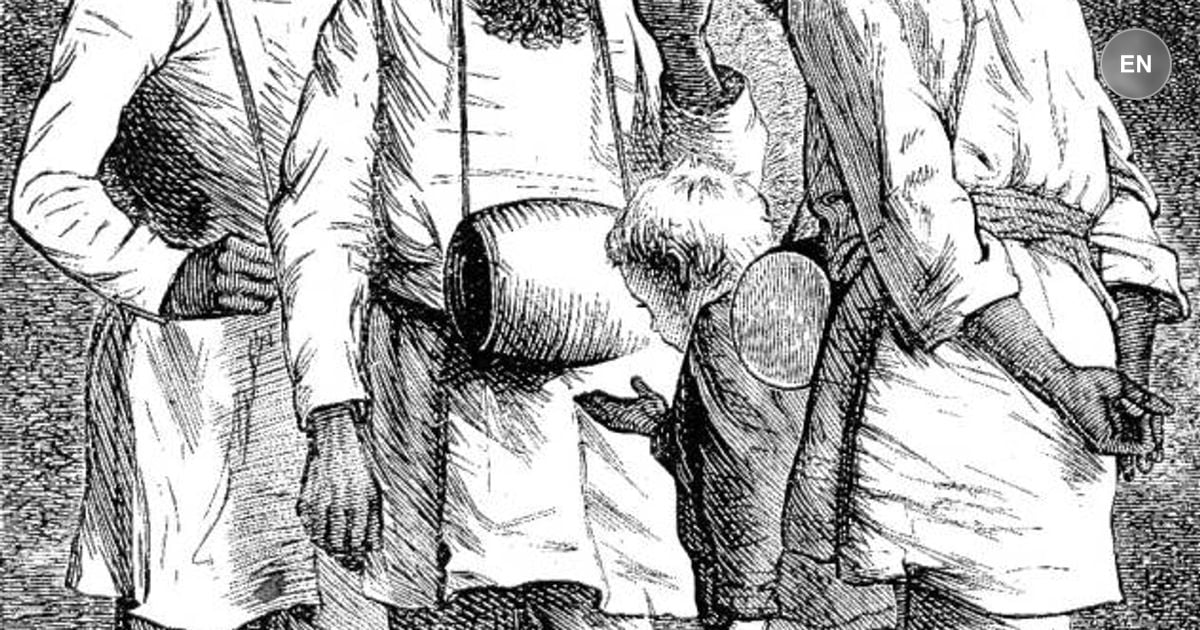
On June 30th, Ablewhite cashed a cheque at a Lombard Street bank and exchanged brief courtesies at the door with a stranger who turned out to be one Septimus Luker. Hours later, Ablewhite received a letter at his Kilburn home, delivered by an unknown boy, inviting him to a house in Northumberland Street on the pretext that an elderly lady wished to donate generously to his charity. He went immediately, because, as Clack notes, the Christian Hero never hesitates where good is to be done. Inside, he was seized from behind by at least two men with tawny-brown arms, blindfolded, gagged, thrown to the floor, and searched thoroughly from head to skin. The attackers found nothing, exchanged words in an unrecognized language that Ablewhite interpreted as disappointment and rage, then bound him to a chair and left.
A woman's footsteps on the stairs and a scream eventually brought rescue. The parallel attack on Luker, implied by the committee's account, follows the same pattern, pointing to a coordinated and systematic search by the same group. The Oriental manuscript left open on the table as a prop, the rented rooms, the professional silence throughout, and above all the searchers' evident frustration at finding nothing all suggest that the Indian pursuers of the Moonstone are still active in London and have identified two men they believe may be holding or concealing the diamond. Clack records all of this with her characteristic mixture of breathless moral commentary and precise factual notation, making her, despite herself, exactly the kind of witness the investigation needs.
Miss Clack represents a timeless human defense mechanism: when we feel powerless, wounded, or dependent, we often grab moral high ground as armor. Her religious fervor isn't really about faith, it's about finding a position where she can look down on the wealthy relatives who control her fate. This pattern echoes through every workplace, family, and community today. The colleague who constantly references 'proper procedures' when undermining a boss they resent. The family member who lectures about 'what's really important' while fighting for inheritance. The friend who weaponizes social justice language against someone they personally dislike. Collins shows us that righteous resentment follows a predictable formula: genuine powerlessness plus adopted moral position equals socially acceptable revenge. Miss Clack can't directly challenge her relatives' wealth and status, but she can judge their spiritual poverty. The danger isn't that she's wrong about their flaws, the danger is that her method makes real conversation impossible. When we recognize this pattern in ourselves or others, we can choose to address the actual power imbalance rather than fighting endless moral battles that solve nothing. The question becomes: what wound is the righteousness really trying to heal?
Explore this chapter with AI to uncover deeper meaning and practical takeaways.
AI Discussion