
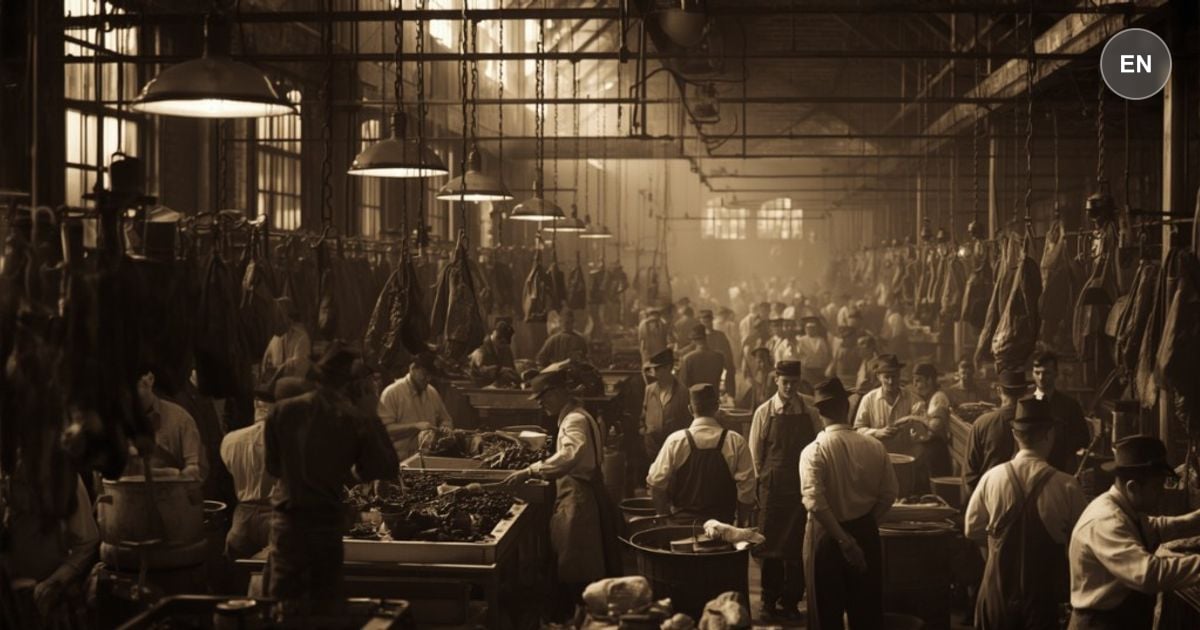
Jurgis breakfasts with Ostrinski's family and goes home to Elzbieta without the shy speech he had planned. He starts on the revolution. For hours she tests whether he is himself; once she is sure he is sane on every subject except politics, she lets the rest go. Life to her is the hunt for daily bread. Ideas exist only as they bear on that. All that interests her in this new frenzy is whether it will make him sober and industrious. When she hears he means to look for work and put money in the family fund, she gives him full rein, agrees with everything except the need to pay dues, and will even sit through a meeting now and then. In half an hour she has chosen her life-attitude, as quick as a hunted rabbit.
He finds a porter's place in a small hotel, toils till night, and runs to tell both households. Ostrinski interrupts at the address: Not Hinds's! Then Jurgis has the best boss in Chicago, a state organiser of the party. In the morning Tommy Hinds seizes his hand; he has not slept for discharging a good Socialist. After that it is Comrade Jurgis and Comrade Hinds. The squat blacksmith's helper talks Socialism all day among the spittoons; every employee is a party man; there is always a pile of books under the desk. Jurgis meets the Appeal to Reason, a propaganda paper with an "Army" of tens of thousands, sometimes a joke, sometimes desperately serious, always meant to be passed along. Hinds's house is a school. Terror of public voice gives way, at last, to standing up and speaking his piece with enthusiasm: Packingtown as he lived it, not as the headlines sell it. Guests who have only read about the yards hear a porter name fertilizer, inspectors, and the speed of the killing beds. He even walks the old streets with leaflets, fifty copies for the price of a glass of beer, undoing in small ways the work he once did for Scully's machine. People in Packingtown, Ostrinski's friends tell him, are beginning to get their eyes opened. People in Packingtown, Ostrinski's friends tell him, are beginning to get their eyes opened.
The education does not stay in the lobby. Meetings run every night. When a "pitchfork senator" comes to deny that Democrats buy votes, Jurgis, who has insisted on being there, dances and waves until the climax breaks him loose. He gets into the aisle and makes a speech of his own. It is a lie, he shouts; he knows because he bought them himself. He would have told the senator the whole of his Scully years if Harry Adams and a friend had not grabbed him about the neck and shoved him into a seat. The floor he scrubs still has to be scrubbed tomorrow. For the first time, the scars are evidence in a room that wants them.
Jurgis discovers something profound: his worst experiences become his most valuable asset when he finds the right audience. At Tommy Hinds's hotel, his meatpacking horror stories aren't shameful secrets, they're powerful testimony that educates and motivates others. This transformation happens because he finds a community that validates his experiences and gives them meaning beyond personal survival. The pattern appears everywhere today. The recovering addict who becomes a counselor. The abuse survivor who volunteers at shelters. The laid-off worker who helps others navigate unemployment. Their pain doesn't disappear, but it gains purpose. The key is finding communities that see your struggles as expertise, not weakness. Social media often pushes us to perform success, but real connection happens when we share authentic struggles with people who understand them. Your worst experiences might be exactly what someone else needs to hear. The question isn't whether your story matters, it's whether you've found the right audience to receive it.
Explore this chapter with AI to uncover deeper meaning and practical takeaways.
AI Discussion