
The orator has gone back to his seat, but the hall does not sit down. Someone starts a song Jurgis has never heard; stanza after stanza of the Marseillaise seizes him until he cannot think, only know that a new man has been born in the upheaval. Talk around him turns ordinary again, committee voices, the everyday world, and terror arrives on the heels of the miracle: if he walks out now the feeling may fade, and he will be the old Jurgis by morning. The thing is not to talk, he tells himself, but to get hold of others. He pushes through an unguarded door, down a hallway, into a crowded room. The speaker sits with shoulders sunk, face almost green, one arm limp; a big man with spectacles keeps saying the comrade is worn out. Jurgis steps forward anyway. He could not go away without telling how glad he is he heard, how he did not know anything about it all. The tired man looks into his face, hears that he wants to know more, and will not let him be turned aside.
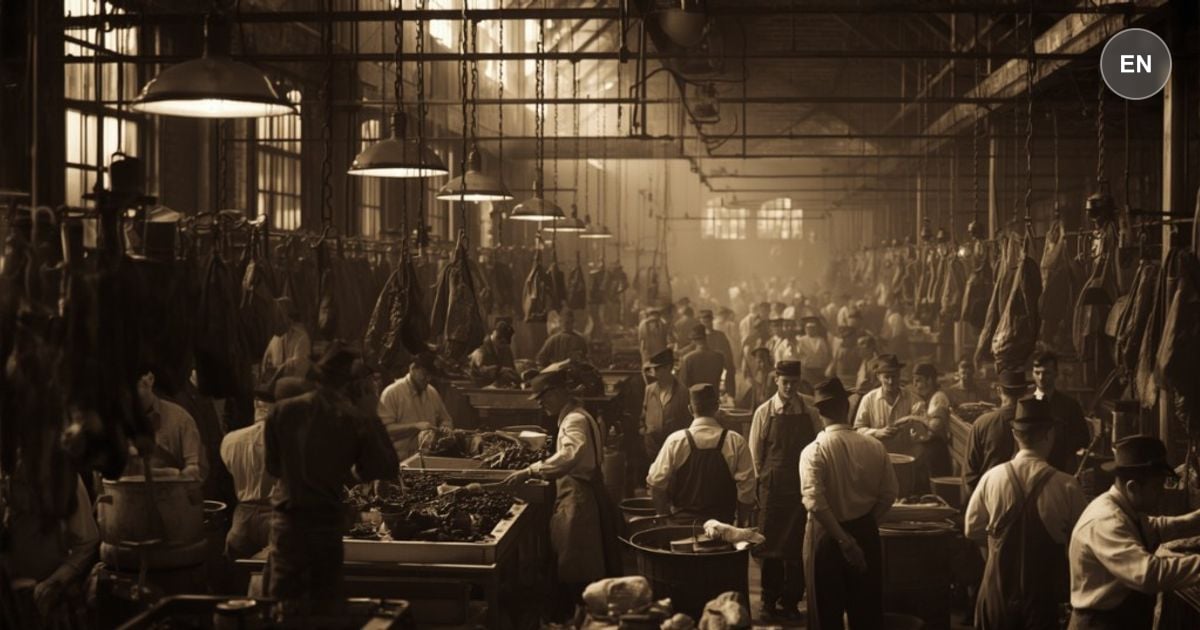
He is given Comrade Ostrinski, a Lithuanian pants finisher who organises while his wife lies ill in two rooms with no spare bed. They walk the night streets, Jurgis pouring out Ona, the fertilizer, the jail, the wandering, until Ostrinski presses his arm: you have been through the mill; we will make a fighter out of you. In the stiff kitchen, feet on the empty stove, voice dropped so as not to wake the next room, Ostrinski names the system in words a packing-house man can use. Workers bid against one another because they must eat tomorrow, so no one can get more than the hungriest will take; that is competition for the person who has only labour to sell. On top, the few combine. Two classes form with an unbridged chasm, and the many stay helpless until they become class-conscious and take the powers of government. Ostrinski has already begun once in the old country; in America people laughed, as if a ballot made wage slavery gentle. He sketches a world party of tens of millions, and then the Beef Trust as Jurgis has lived it: a hundred human lives not balancing a penny of profit, leather and grain already in the same mouth, the work of slaughter teaching ruthlessness. It is long after midnight when Jurgis lies down on the kitchen floor, and another hour before he sleeps, seeing Packingtown march in and take possession of the Union Stockyards.
There's a specific feeling that comes with sudden understanding - when scattered pieces of your experience suddenly form a clear picture. Sinclair captures this perfectly through Jurgis's transformation. One moment he's drowning in confusion and self-blame; the next, he sees the system clearly. This isn't just about politics or economics. It's about the profound relief that comes when someone finally explains the rules of a game you've been losing. Think about your own recognition moments. Maybe it was understanding why your schedule keeps changing at work, or why your rent keeps rising faster than your wages, or why your child's school never has enough supplies. The pattern is always the same: accumulation of painful experiences, encounter with an explanation that makes sense of those experiences, and the rush of clarity that follows. But here's what Sinclair shows us that's crucial - recognition without community leads nowhere. Jurgis doesn't just understand the system; he finds other people working to change it. The real power isn't in seeing the problem clearly, but in connecting with others who see it too. When you can move from 'What's wrong with me?' to 'What's wrong with this system?' to 'Who else is working on solutions?' - that's when understanding becomes power.
Explore this chapter with AI to uncover deeper meaning and practical takeaways.
AI Discussion