
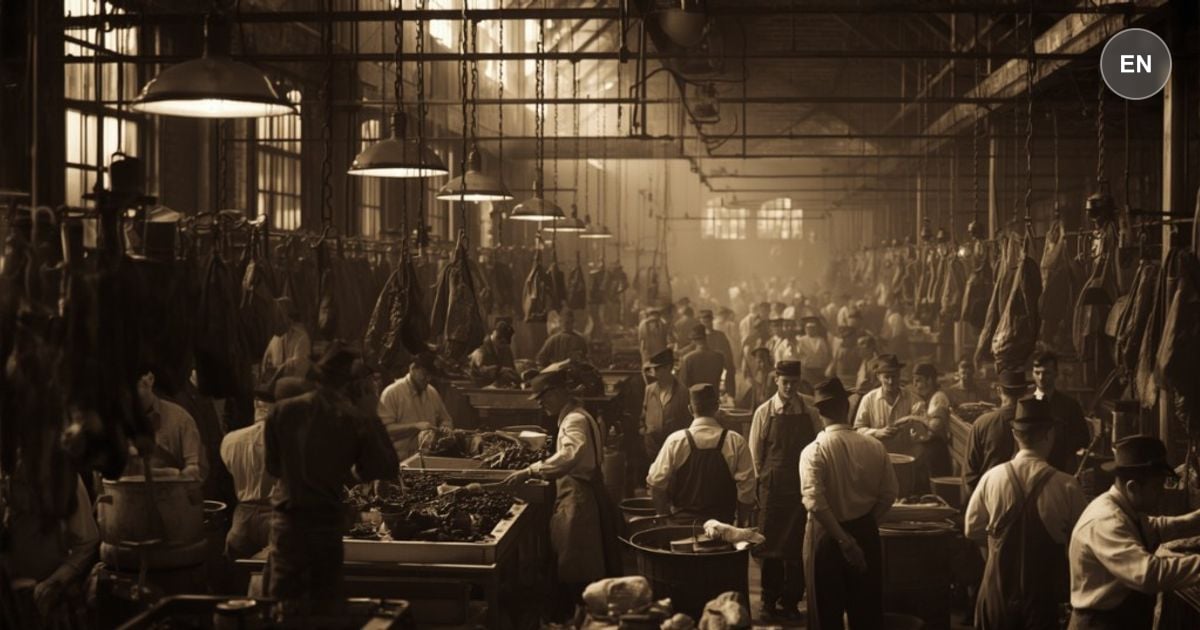
After the elections Jurgis still has nearly three hundred dollars in the bank, a linen collar, and Mike Scully's advice to lay low. When the union agreement expires in May, Packingtown talks strike: unskilled men at eighteen and a half cents, packers cutting a thousand of them toward sixteen, meat up and cattle down. Telegrams go out; fifty or sixty thousand men march off at noon; the Beef Strike is on. Jurgis walks to Scully's paved street asking for a place. That morning's papers carried Scully denouncing the packers and threatening to tear the plants down. In the house the same man knits his brows and asks why Rudkus will not stick by the job. Work as a scab? Jurgis stammers. Scully says the strike will be beaten in a few days, a hundred men have already begged him for street-cleaning, and a Republican is no use until the next election. Jurgis sees. He walks back into the hog room, tells Murphy he has come to work, and names three dollars a day. Clerks and office boys, he learns before night, are getting five.
Durham's makes him a boss on the killing beds at five dollars a day during the strike and twenty-five a week after, with a promise that the firm means to teach the unions a lesson. He seizes it. The force he has to organise is clerks fainting in blood-heat, green hands who cannot take an order, and men who nap in shady corners until the fans go up. Knives go missing after the first meal. Jurgis learns to roar like an old stager, then to take a ten-dollar bill and a wink when he catches a man drawing two five-dollar cards. Replacement gangs sleep on cots in car sheds, cots stacked on tables to keep off rats; Cincinnati girls hired to pack fruit are put to corned beef and a public hallway; whisky comes in so no one need go outside the gates. On his first day as a strikebreaker he still quits early for beer at the Halsted Street gate. A cry of "Scab!" brings a crowd from saloons; hats fly over the fence; Jurgis trades blows and runs back into the yards while newsboys sell red headlines about a frenzied mob.
The packers offer arbitration. The unions accept: rehire within forty-five days, no discrimination against union men. Jurgis, anxious for the boss's place, is told to wait and see. Durham's strikebreakers are not leaving. That night a telegram leaves Durham and Company for every packing centre: Employ no union leaders. In the morning Jurgis stands by the hog-trimming door and watches a superintendent pick the line while stewards and delegates are passed over. The president of the Packing Trades Council is passed five times. "We all go back or none of us do!" The superintendent answers that they went out like cattle and like cattle they will come back. The butchers strike again on the spot. After that a scab who walks Packingtown fares badly, while Jurgis, drinking, knowing the word and despising himself, storms at his own gang until they drop.
Late in August a superintendent shouts them onto a police truck toward the dump, where strikers have knocked out an escaped steer for hungry children. Jurgis joins the "sport," then helps himself at a smashed bar while a cash drawer is cleaned. That night a lantern in a dark room flashes on Connor, the loading-gang boss who ruined Ona. Rage finishes the calculation Scully taught him. He smites the man, pounds his head on the stones, and wakes in the stockyards station house. Bush Harper will not stand for Phil Connor, a War-Whoop man they talked of sending to the legislature; Scully has run away to dodge the strike. Harper reduces the five-hundred-dollar bail to the three hundred still sewed in Jurgis's trousers, pockets the risk, and tells him only to clear out. Jurgis takes the dollar and fourteen cents left from the bank, adds the change from last night, and boards a streetcar for the other end of Chicago.
Sinclair shows us something uncomfortable: good people make terrible choices when they're desperate enough. Jurgis doesn't become a strikebreaker because he's evil, he does it because his family is starving. This creates a moral complexity that simple 'good versus evil' narratives miss. The real villains are the people who create these impossible choices in the first place. When workers are forced to choose between solidarity and survival, the bosses win either way. If you choose solidarity, you might lose your home. If you choose survival, you lose your community and often your soul. This pattern repeats endlessly in working-class life. The nurse who can't afford to strike because she needs health insurance. The factory worker who stays silent about safety violations because speaking up means losing benefits. The retail employee who pushes predatory products because corporate threatens their hours. The genius of this system is that it makes the victims blame each other instead of questioning who designed the game. Sinclair understood that individual moral choices matter, but they happen within systems designed to corrupt those choices. The question isn't whether desperate people will compromise, it's whether we'll build systems that don't force them to choose between their values and their survival.
Explore this chapter with AI to uncover deeper meaning and practical takeaways.
AI Discussion