
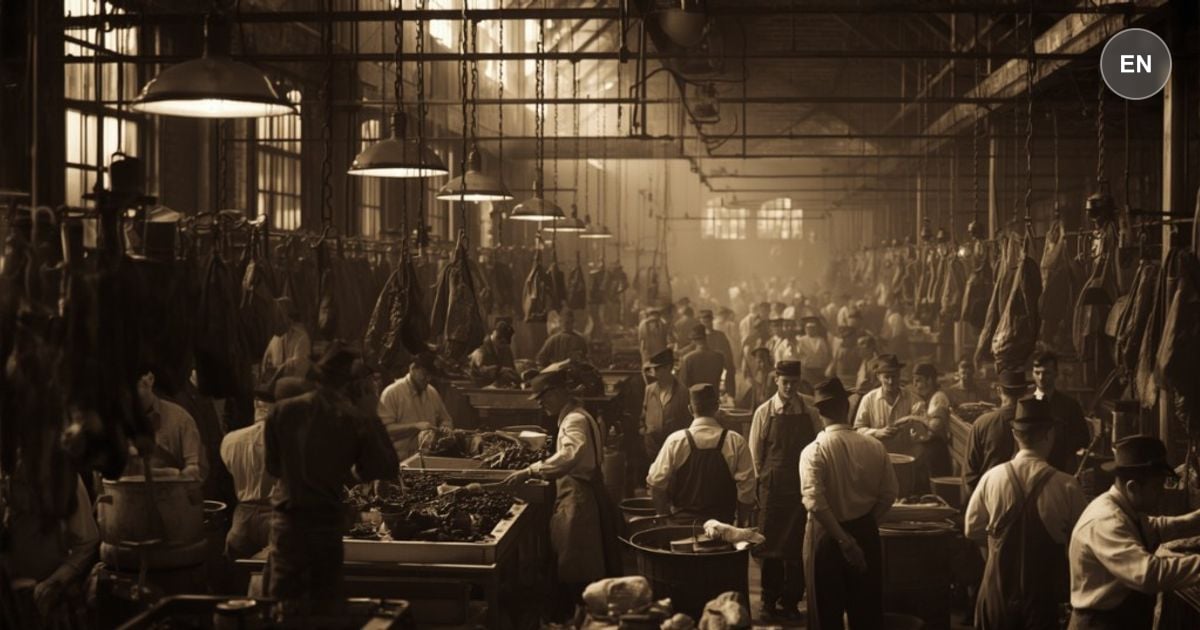
The harvester works close with less than half an hour of warning. The men have already made every machine the market will take, so the trust waits for wear, and thousands walk into dead winter with a last pittance. Jurgis goes home with that small pay, seeing at last that a kind boss cannot keep a job when the world owns enough machines. Elzbieta holds his money so he cannot drink it. For ten days he hunts stores, docks, mills, and railroad yards; a hundred men wait at every chance. He sleeps on a Harrison Street station step in a gale five degrees below zero, and street gangs with squared policemen drive him off the satchel trade. The children keep the household alive. A severe lady threatens Vilimas with a truant officer. A stranger tries to pull Kotrina into a cellar. Little Juozapas, one-legged on a broomstick crutch, rakes Mike Scully's dump for frozen bread and bones. A settlement worker in a bird hat climbs the garret, weeps on Elzbieta's dirty wrapper, and writes a sealed letter to a steel superintendent in South Chicago.
Jurgis pays two fares for the fifteen-mile ride and waits among a hundred strangers at a stockaded gate while thousands of mill hands pour in at dawn. The letter gets him inside. He tours Bessemer caldrons that tilt without warning, a river of white fire he first takes for an accident, then rolling mills that punch living ingots into rails. A boss can use another man with a crowbar, so he starts on the spot. The commute costs a dollar twenty a week, so he sleeps on a Polish lodging-house floor for ten cents and carries his bedding home on Saturday. In a week fear turns to the mill's own recklessness. A man's foot is mashed under a car. A furnace sprays two men with liquid fire. Jurgis burns the skin from his palm helping them and loses eight unpaid days. Elzbieta scrubs packers' offices at five in the morning. Marija later finds a place as a beef-trimmer in a smaller plant.
Laid up, Jurgis covers himself with blankets and plays with Antanas, a year and a half old, a talking fighter who treasures Sunday-paper animals and picks up "God damn" until the garret rings with it. When his hand heals, April rain turns Aniele's unpaved street into a canal. Jurgis wades home telling himself he has learned the lesson of accidents, that the children can go back to school, that next winter they might have a decent room.
One Saturday he jumps off the car under a rainbow, thirty-six hours of rest ahead of him, and finds a crowd at the door. Aniele seizes his arm before the ladder. From the garret comes Marija's wail. Antanas is dead. He drowned in the street.
Jurgis gets fired for being too good at his job, the factory made too many harvesting machines because workers like him were so efficient. This reveals something crucial about how modern capitalism works: it doesn't actually want maximum productivity from workers, it wants controllable productivity that serves profit margins. Today we see this everywhere. Hospitals lay off nurses after they work through a pandemic because 'patient volumes have normalized.' Teachers get fired after improving test scores because districts need to cut budgets. Warehouse workers get replaced by robots after they become too fast at picking orders. The cruelest part is how this gets framed as progress or efficiency rather than what it really is: a system that treats human labor as disposable. Workers internalize this as personal failure, 'I should have seen it coming' or 'I should have been more valuable', when it's actually structural logic. The system creates hope precisely to make the next blow more devastating. Understanding this pattern doesn't make it hurt less, but it stops you from taking it personally and helps you build better defenses. When you recognize that your job security depends more on market forces and corporate decisions than on your individual performance, you can plan accordingly. The question isn't whether you're working hard enough, it's whether you're building multiple streams of security that can't all be cut at once.
Explore this chapter with AI to uncover deeper meaning and practical takeaways.
AI Discussion