
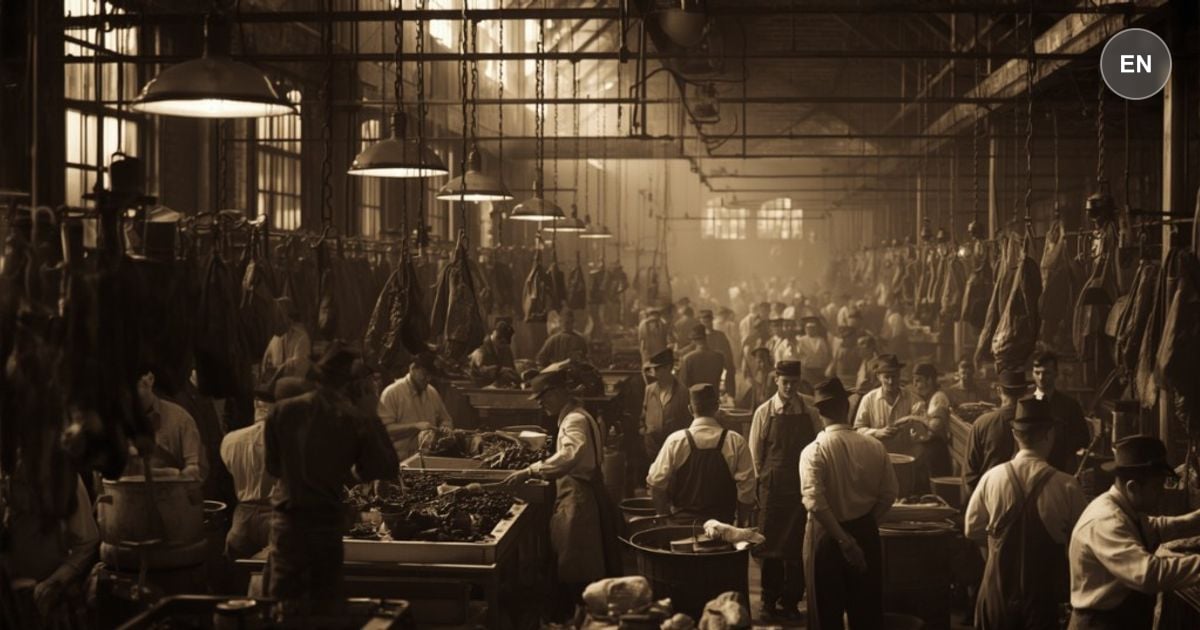
Jurgis returns sober and broke to find Ona unburied and the children hungry. Elzbieta begs him to stand up for Antanas; he swears he will work, then learns the yards have closed to him forever. His name travels on a secret blacklist shared among packers: strike a boss, lose not one job but the whole district. The blacklist closes every yard to the man who struck Connor. Elzbieta begs him to pull himself together for his son Antanas, and he promises to find work.
Two weeks downtown prove the mark is real. He sleeps in doorways and station houses, growing filthy, until an old union man sends him to the Harvester Trust. For nine days the factory seems like another country: clean floors, a reading room, wages that whisper of advancement. Hope returns like a reflex he cannot stop. Nine days at Harvester Trust whisper of advancement and clean floors.
On the tenth day a notice waits on the gate: the department closes indefinitely. The trust has made enough machines; workers are discharged in dead of winter because abundance, not need, sets the schedule. Thousands walk out with him, another crowd with nowhere to go and no one to blame who will listen. A tenth-day notice discharges thousands in dead of winter.
The system does not only exploit labor; it coordinates to destroy hope at the instant it appears, leaving Jurgis hungrier than before he believed again. Hope withdraws the moment he imagines a future for Antanas.
When Jurgis discovers he's been blacklisted for standing up to his boss, he learns a harsh truth: power structures don't just punish you directly, they coordinate to eliminate your alternatives. This isn't paranoia; it's documented reality. Today, tenant screening companies share databases of 'problem renters' who know their rights. Healthcare systems flag employees who report safety violations. Retail chains share information about workers who file wage complaints. Even in schools, parents who advocate too strongly can find themselves mysteriously excluded from volunteer opportunities their children need. The mechanism is always the same: challenge one authority figure, and they warn others about you. Your resistance becomes a permanent mark that follows you everywhere. This coordination isn't necessarily a conscious conspiracy, it's how systems naturally protect themselves. Authority figures instinctively understand that if troublemakers can just move to the next company or school district and start fresh, their power becomes meaningless. So they share information, formally or informally, to ensure that standing up for yourself carries lasting consequences. Understanding this pattern changes how you navigate resistance. Document everything in writing. Build relationships outside the system that might exclude you. Create multiple pathways before you need them. Most importantly, recognize that systematic exclusion isn't about your worth, it's about power protecting itself from accountability.
Explore this chapter with AI to uncover deeper meaning and practical takeaways.
AI Discussion