
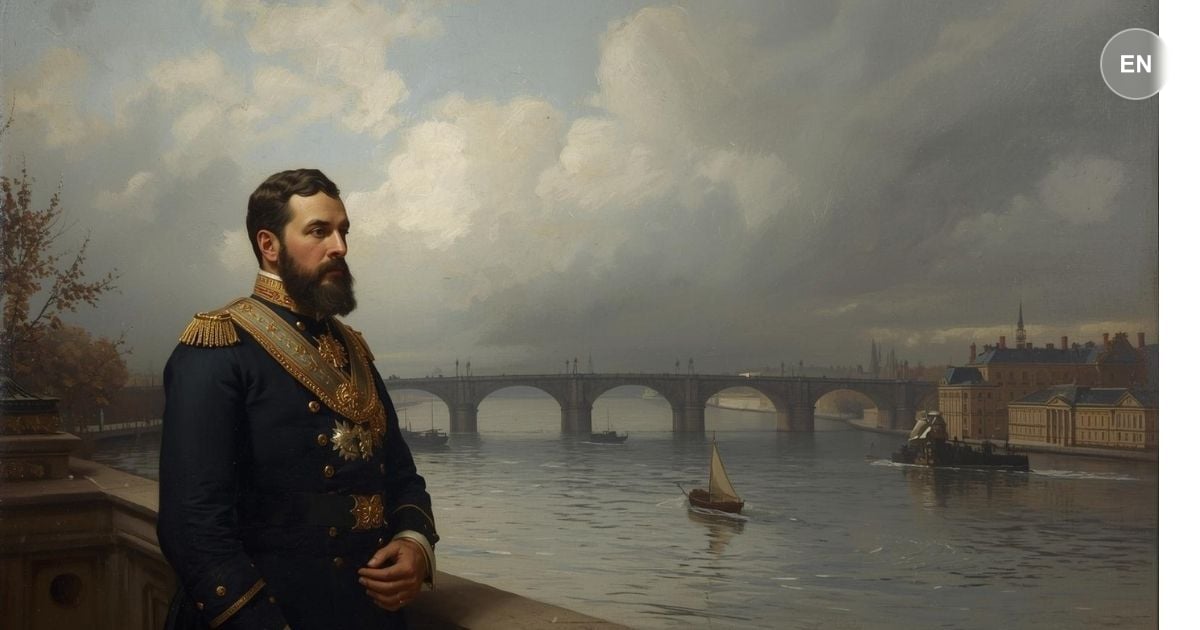
A faded silk handkerchief holds everything he owns, and that is already a verdict before anyone asks his name. On a thawing November morning the Warsaw train runs into Petersburg through fog so thick the windows show only a few yards. Two poorly dressed young men sit opposite each other, both restless to talk, neither knowing why this seating will matter. The black-haired one has slept in fur. The fair one is blue with cold in a Swiss cloak and answers every question as if rudeness were not in the carriage. He has been four years abroad for a nervous illness. When they ask whether he was cured, he says they did not cure him. They laugh at the wasted money, at the bundle, at the fact that he does not know where he will stay. He laughs when he sees them laughing.
A red-nosed clerk takes up the joke and then hangs a useful surname on it. If this traveller is really related to Mrs. General Epanchin, the faded handkerchief becomes a significant object at once. The prince agrees he is almost wrong to call her a relation. He wrote when Pavlicheff died and got no answer. He expected as much. The clerk treats other people's salaries, marriages, and second cousins as a science, yet he has never heard of Prince Myshkin as a living man. The prince says he is the last of a poor line, his father a sublieutenant, the kinship so thin the unanswered letter did not surprise him.
The black-haired passenger names himself Parfen Rogozhin, just back from fever in Pskoff, treated like a dog, now heir to millions his brother has already started stripping from a coffin. The clerk's tone flips to a bow. What holds the prince is not the fortune so much as the fever in the telling. Rogozhin needs a listener as a safety-valve for the agitation. He pours out Nastasya Filippovna: one glimpse from a shop into a carriage, a sleepless night, his father's loan bonds turned into diamond earrings, a laugh and thanks to "your friend Mr. Rogozhin" while Zaleshoff, dressed for the visit, took the credit. The old man crawled for the stones. She sent them back and said they were ten times dearer now she knew what they had cost Parfen. None of the three has seen her this morning. Lebedeff recites her box at the opera as if that were a fact he owned. Rogozhin seizes his arm when Lebedeff promises her proper earrings with the new money.
At the platform a crowd is already waving, though Rogozhin claimed he left in secret. He cannot say why he has taken a fancy to the prince, only that it is not the meeting itself, since he met Lebedeff too and feels nothing of the kind. He offers a fur coat, a full pocket, and a visit to Nastasya. The prince thanks him for the fancy, likes the dark-clouded face especially in the earring story, and admits he has hardly a copeck. They leave the carriage together and then they part. Rogozhin is pulled toward the Voznesensky with shouting friends and money promised by evening. The prince asks his way through the wet toward the Litaynaya, two miles still to go, the bundle still only a bundle.
Dostoevsky wrote The Idiot during a period when Russian society was rigidly hierarchical, where showing weakness could mean social death. Yet Prince Myshkin's radical honesty about his epilepsy and poverty becomes his superpower. This pattern reveals something profound about human nature that transcends historical periods: we're all hungry for authentic connection in spaces that demand performance. In modern workplaces, especially in healthcare, service, and manual labor, this dynamic plays out daily. Workers are expected to project competence and resilience, even when struggling with injury, financial stress, or personal challenges. The fear is that admitting difficulties will be seen as weakness, leading to fewer hours, missed promotions, or job loss. But Dostoevsky shows us that the opposite can be true. When we're selectively honest about our real challenges, not oversharing or seeking pity, but simply being human, we often discover that others are relieved to drop their own masks. The supervisor who admits they're learning too, the coworker who shares their own injury fears, the patient who opens up about their anxiety. This doesn't mean being unprofessional or oversharing. It means recognising that strategic authenticity can be a form of leadership. When you model that it's safe to be human, you create space for others to be human too. The question becomes: in a world that rewards performance, how do we practice the courage to be real?
Explore this chapter with AI to uncover deeper meaning and practical takeaways.
AI Discussion