
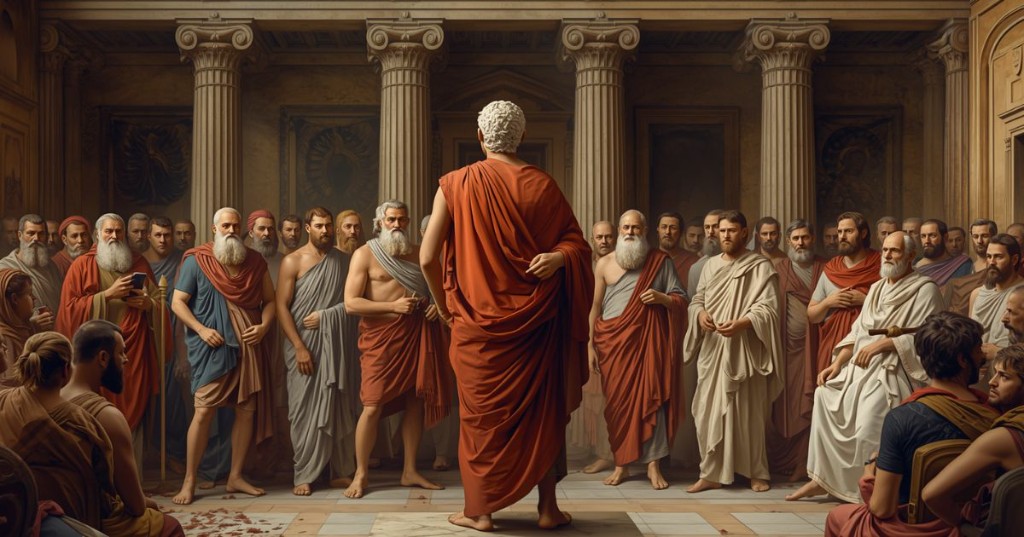
Before Socrates speaks a word in the Apology, Victorian translator Benjamin Jowett stops you with a warning: this is not a courtroom transcript. Plato's text is an artistic portrait of his teacher, true to Socrates' character but not verifiable line by line. Jowett weighs Xenophon's Memorabilia, notes that Socrates could have been acquitted had he flattered the jurors, and flags suspicion about the Delphic oracle origin story. He compares Plato to Thucydides shaping Pericles: ideal truth, not literal record. He notes the conversational manner and ironical simplicity that produce, in his view, a perfect portrait. He concludes that the speech breathes defiance throughout. Plato was present at the trial and later names himself among the sureties for a fine Socrates never paid, yet what we read is composition, not stenography.
Jowett maps the Apology in three parts and walks through Plato's embedded synopsis of the whole defense: old accusers and Aristophanes' slander, the oracle mission to expose false wisdom, Meletus cross-examined, the gadfly image, refusal to beg with weeping children, conviction, counter-penalty, prophecy, and death accepted without theatrical fear. That middle stretch is a road map for the speech you are about to read in the chapters ahead, not a substitute for reading it.
The introduction closes with Jowett's critical reading. He asks whether Socrates employs sophistries or deliberately provokes the jury, and largely absolves him: irony, not malice, shapes the Meletus exchange. He is less satisfied with the answer about corrupted disciples Alcibiades and Critias. He examines the claim that corruption must have been involuntary, probes the gods charge as an ad hominem answer to Meletus rather than full religious testimony, and asks whether apparent haughtiness is really integrity under pressure rather than deliberate insult.
Jowett notes that Socrates' prophecy of fiercer successors was never fulfilled, rejects Schleiermacher's claim of verbatim accuracy, and applies his final caution to the Platonic Socrates of this speech alone, not every portrait Plato drew elsewhere. He ends where scholarship must: faithful in spirit, but historical certainty stops there. You finish the introduction knowing how to read what follows: portrait first, transcript never, and every dramatic line weighed against that warning.
Socrates faced execution not because he was wrong, but because he was inconveniently right. This reveals something crucial about how power operates: institutions often protect themselves by attacking the messenger rather than addressing the message. When someone points out corruption, safety violations, or systemic problems, the response frequently focuses on discrediting the person rather than investigating their claims. We see this pattern everywhere today. The employee who reports harassment gets labeled a troublemaker. The resident who questions a zoning decision gets dismissed as a NIMBY activist. The patient who questions a medical decision gets branded difficult. The mechanism is always the same: shift focus from the problem to the person pointing it out. This tactic works because it's easier to destroy one person's credibility than to fix systemic issues. It also sends a message to others: stay quiet or face the same treatment. Understanding this pattern helps us navigate situations where we witness wrongdoing. It explains why good people often stay silent and why speaking up requires courage. Most importantly, it helps us recognize when we're seeing legitimate criticism versus character assassination. When institutions spend more energy attacking their critics than addressing criticism, that tells us something important about both the criticism and the institution.
Explore this chapter with AI to uncover deeper meaning and practical takeaways.
AI Discussion