
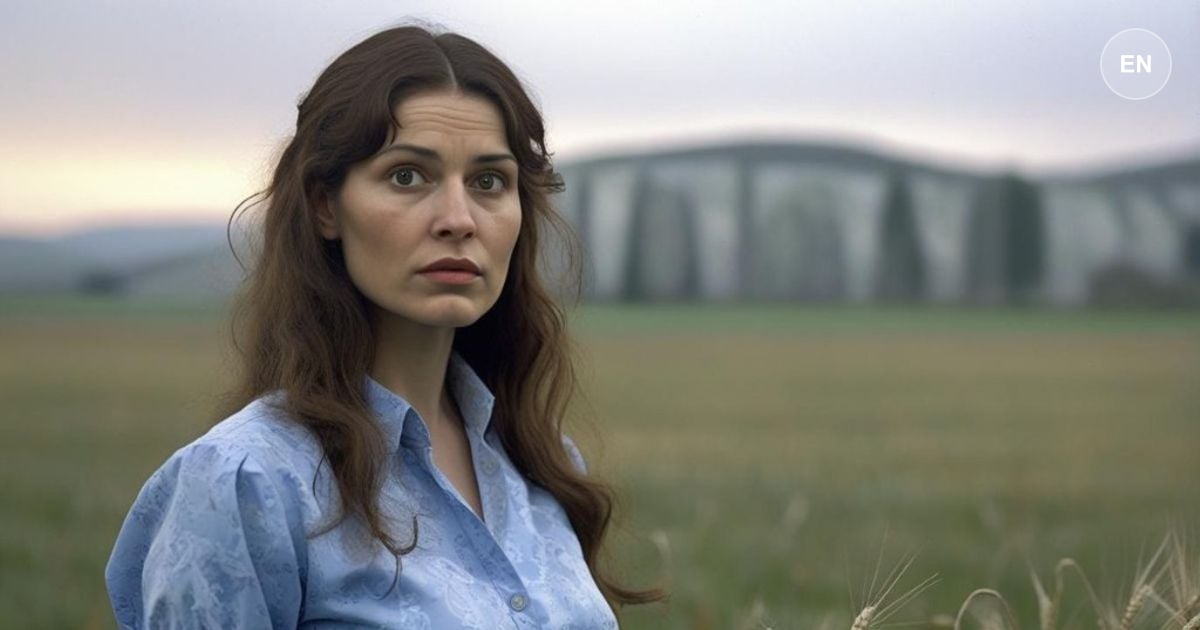
Young men at a Chalk-Newton inn were kind about her looks, and the kindness gave her a hope she had to protect. If strangers still spoke so, Angel might yet. So the strangers had to be kept off. In a thicket beyond the village she put on her oldest field-gown, tied a handkerchief over her chin and cheeks as if she had the toothache, and with a pocket glass and a small pair of scissors nipped her eyebrows off. The next man called her a mommet of a maid. Tears came. She said she did not care. She would stay ugly now. Angel was not there, she hated every other man, and she wanted them to scorn her.
She went on in a grey cape and a rough wrapper, face half hidden, through bad weather. She wanted a winter's work and a winter's roof, and she would take no more short hirings. Farm after farm refused the light jobs, dairy and poultry, until only rough work on arable land remained. Towards the second evening the chalk opened between the valley where she was born and the valley where she had loved. The farmers had plashed the trees out of the hedges. Far south the Channel lay like polished steel. Flintcomb-Ash sat in a dip of corn and swedes, hardly a tree in sight. Rain began. Tess set her cheek to a cottage wall warm from the fire inside, and said aloud that nobody would take her for Mrs Angel Clare.
Marian came along the empty street in a summer print, stouter and shabbier, and already a little gone in drink. She asked who had beaten Tess, and where the collar was, and why no wedding ring showed. The ring hung on a ribbon at Tess's neck. The cloth on her face was only so men would not catch hold of her. She asked Marian for a place, and for silence. She was not to be called Mrs Clare. If they took her on, nothing was to be said of him. His name was not to be brought down to the dirt. The farmer was away. His wife hired Tess until Old Lady-Day, women's field labour being cheap. The bed was in the cottage whose wall had warmed her. That night she wrote her parents the new address, in case a letter from her husband reached Marlott. She left the sorriness of the place out of it.
Hardy wrote Teresa during a time when women had few legal protections and even fewer economic options. A woman alone was vulnerable in ways we can barely imagine today. Yet Teresa's desperate choice to make herself 'ugly' for safety resonates powerfully in our current moment. How many women today dress down for night shifts, avoid eye contact on public transportation, or deliberately make themselves less noticeable in certain spaces? The mechanisms have evolved, but the underlying dynamic remains: when you lack power, visibility can be dangerous. What's particularly heartbreaking about Teresa's transformation is how she tries to convince herself she doesn't care about beauty anymore since Angel isn't there to see her. This reveals how survival mode can slowly erode our sense of self if we're not careful. The question isn't whether strategic invisibility is right or wrong, sometimes it's simply necessary. The question is whether we can maintain our sense of self while employing it, and whether we remember it's temporary armor, not our true identity. Marian's presence in this chapter offers another crucial element: the importance of allies who understand your situation without judgment. Even in our darkest moments, reconnecting with others who've walked similar paths can provide both practical help and emotional validation.
Explore this chapter with AI to uncover deeper meaning and practical takeaways.
AI Discussion