
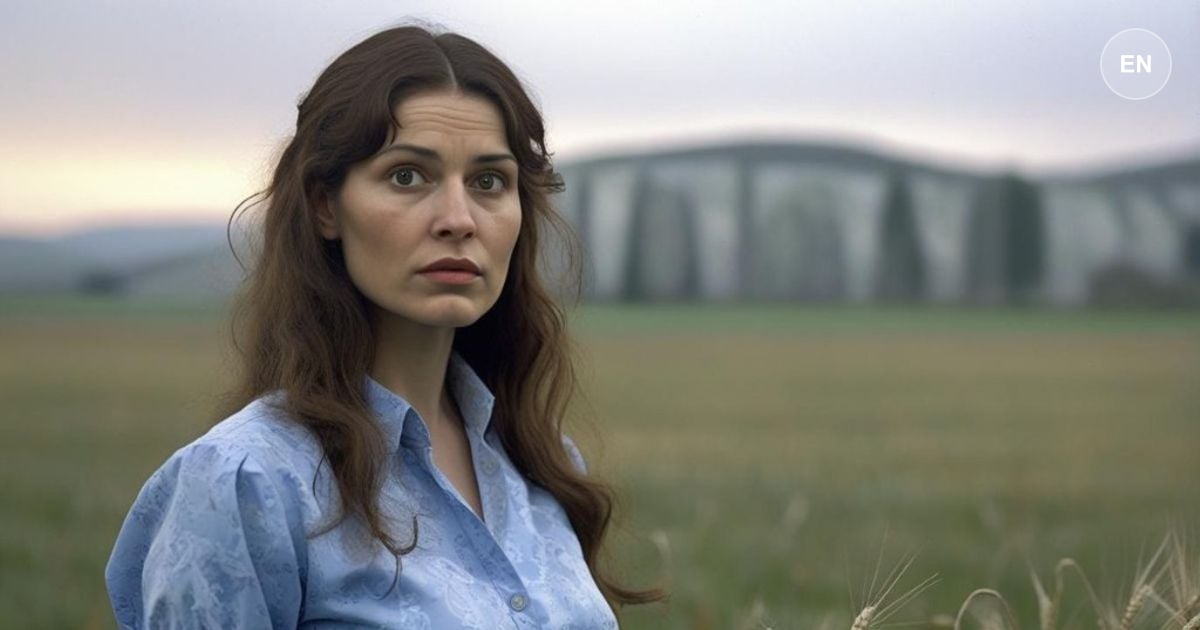
They drive the level road with Egdon dark on the horizon, the milk clucking in the cans. He plucks blackberries for her with the whip-lash. Rain begins. Her hair, loosened by the cows, turns clammy as seaweed. She thinks she ought not to have come. He is sorry for the wet and glad of her. He wraps them both in the sail-cloth that shades the cans, and asks his question before they are home. She says she will try. They pass an old manor, once a seat of the d'Urbervilles, a fierce family now gone. He never goes by such a house without thinking of them. She says yes, and no more.
At the station the cans go into the train while she stands under a holly and the engine light strikes her once. She thinks of London drinking the milk at breakfast, people who have never seen a cow. He brings her back to themselves. Her heart is his, and he wants her hand to follow. She tries to tell him the life before Talbothays. He is sure a large farm needs her more than any woman from a mansion, and he closes up each beginning. Marlott, the Sixth Standard, the plan that she should teach, a father not industrious who drank a little: he calls that nothing new, and presses her closer. Her breath quickens. She is not a Durbeyfield, she says at last, but a d'Urberville, of the family that owned the house they passed, and they are all gone to nothing. He laughs with relief. The dairyman had told her he hated old families. He did, as a principle, and affection has pulled him off it. The name may even help his mother accept her. She must spell d'Urberville from today. She would rather not. It is unlucky. He remembers the man near The Chase who took the name and quarrelled with his father. Then she can take his name, he says, and escape hers. As he understands it, the secret is out.
It is not. At the last moment her courage failed. She feared his blame for not speaking sooner, and the wish to keep him proved stronger than candour. If the marriage is sure to make him happy, and if he wants her very much, whatever her offences, she ought to say she will. He kisses her. She says yes, and breaks into a dry hard sobbing. She is glad, she has broken a vow to die unmarried, and a moment later she wishes she had never been born. Asked to prove she cares, she clasps his neck and kisses him as she has not done before. They drive on under the sail-cloth, the horse going as he will. She must write to her mother at Marlott. He has seen her before this summer, he says, at the dance on the green, where he would not dance with her. She hopes that missed hand is no ill omen now.
Hardy understood something we're still learning: the crushing weight of believing we must earn love through perfection. Teresa's tears after accepting Angel's proposal aren't joy, they're grief for the authentic self she's just buried. In 1891, women faced impossible standards around purity and virtue. Today, we face different but equally impossible standards around having our lives together, being low-maintenance, or presenting the perfect image on public feeds. The mechanism is identical: we calculate that partial truth plus performance equals safety. But Hardy shows us the fatal flaw in this logic, relationships built on edited versions of ourselves are houses built on sand. Angel falls in love with an idea of Teresa, not Teresa herself. When reality inevitably surfaces, the foundation crumbles. Modern research confirms what Hardy intuited: authentic relationships require vulnerability, and vulnerability requires risk. The job candidate who inflates their resume, the parent who pretends their family is perfect, the partner who never admits their struggles, all are walking Teresa's path. The question Hardy poses through Teresa's anguish is profound: what if the love that can't survive our honesty isn't love worth having? What if the connections that require us to perform aren't connections at all, but elaborate forms of isolation?
Explore this chapter with AI to uncover deeper meaning and practical takeaways.
AI Discussion