
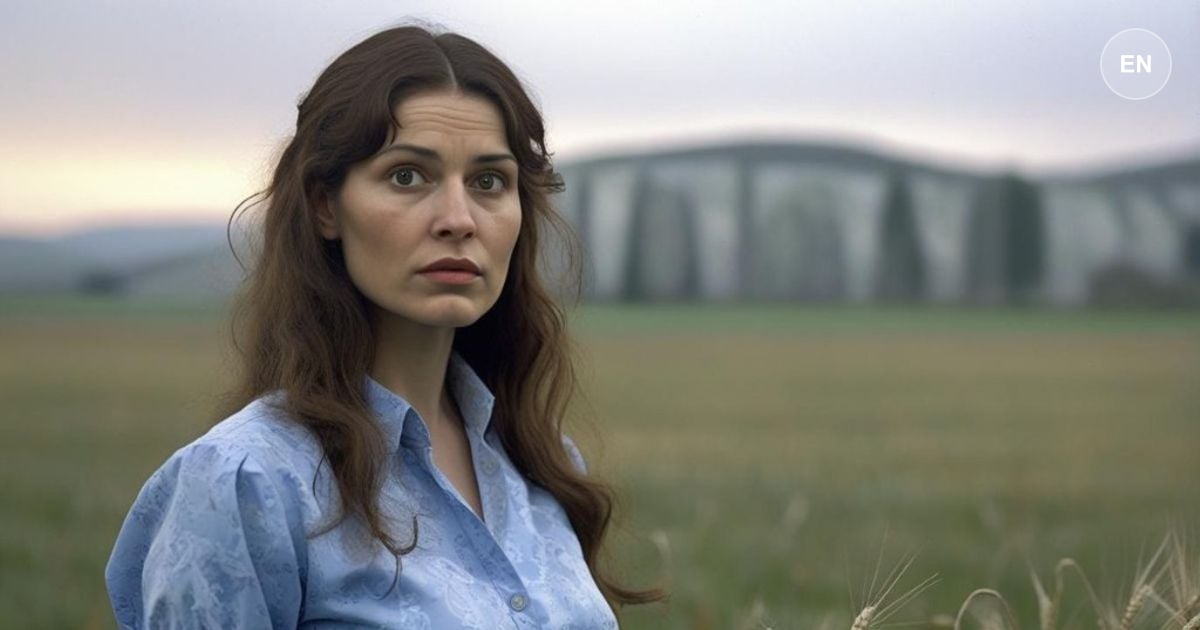
The heat after the rains sits so heavily on Talbothays that the cows follow the travelling shade of the smallest tree, and the milkers work out in the meads instead of driving the herd home. On one of these afternoons a few animals stand apart behind a hedge. Dumpling is there, and Old Pretty, who loves Tess's hands above any other maid's. Angel has been watching her. He asks her to take those next. She goes round the corner with her stool at arm's length and the pail against her knee. Old Pretty's milk starts to fizz. He follows, meaning to finish a hard-yielding cow that has strayed, and sits where the hedge hides him and he can see her.
She does not know he is there. She milks with her temple against the flank, eyes on the far meadow, still as a trance. The sun lies flat on her pink gown and white curtain-bonnet. Nothing moves but the cow's tail and her pink hands. He knows the curve of her mouth well enough to draw it from memory. Seeing it again, coloured and alive, runs through his nerves and ends in an ordinary sneeze. She feels the look and will not shift. Her colour deepens, then fades to a tinge. Resolutions and fears fall away. He leaves his pail to be kicked over if the cow likes, crosses to her, kneels, and clasps her in his arms.
Surprise takes her, and she yields with something very like an ecstatic cry. He is on the point of kissing her and checks himself. He ought to have asked. He does not mean it as a liberty. He is devoted to her in all sincerity. Old Pretty looks round, finds two people where custom has always allowed one, and lifts a hind leg. Tess slips free, afraid for the milk, and her eyes fill. She cannot say why she cries. When she sees the position clearly she tries to draw back. He tells her he has betrayed his feeling at last, that he loves her dearly and truly, and that it shall go no further now. She cannot tell what she thinks. Within a minute or two each of them is milking again. Nobody has witnessed the clasp. Dairyman Crick comes round that screened nook and finds the pair as far apart as mere acquaintances. Whatever passed between his last sight of them and this one, the grass holds no sign of it.
Hardy shows us something uncomfortable: even decent people can make destructive decisions when pushed past their limits. Angel isn't a villain - he's been respectful for months, maintaining appropriate boundaries with Teresa. But the oppressive heat, isolation, and accumulated attraction create a perfect storm that overwhelms his self-control. This isn't about moral weakness; it's about human psychology under pressure. We see this pattern everywhere today. The nurse who's worked double shifts for weeks finally snaps at a patient. The single parent juggling three jobs loses it over homework. The factory worker dealing with impossible quotas explodes at a coworker. Society loves to judge these moments as character failures, but Hardy suggests something more complex: we all have breaking points, and circumstances matter. The real question isn't whether pressure affects us - it's whether we recognize the warning signs and create healthy outlets before we reach our limit. Understanding this pattern doesn't excuse harmful behavior, but it does help us navigate high-pressure situations more intelligently. When we can predict our own breaking points, we can make better choices about when to step back, seek support, or change our environment before we do something we'll regret.
Explore this chapter with AI to uncover deeper meaning and practical takeaways.
AI Discussion