
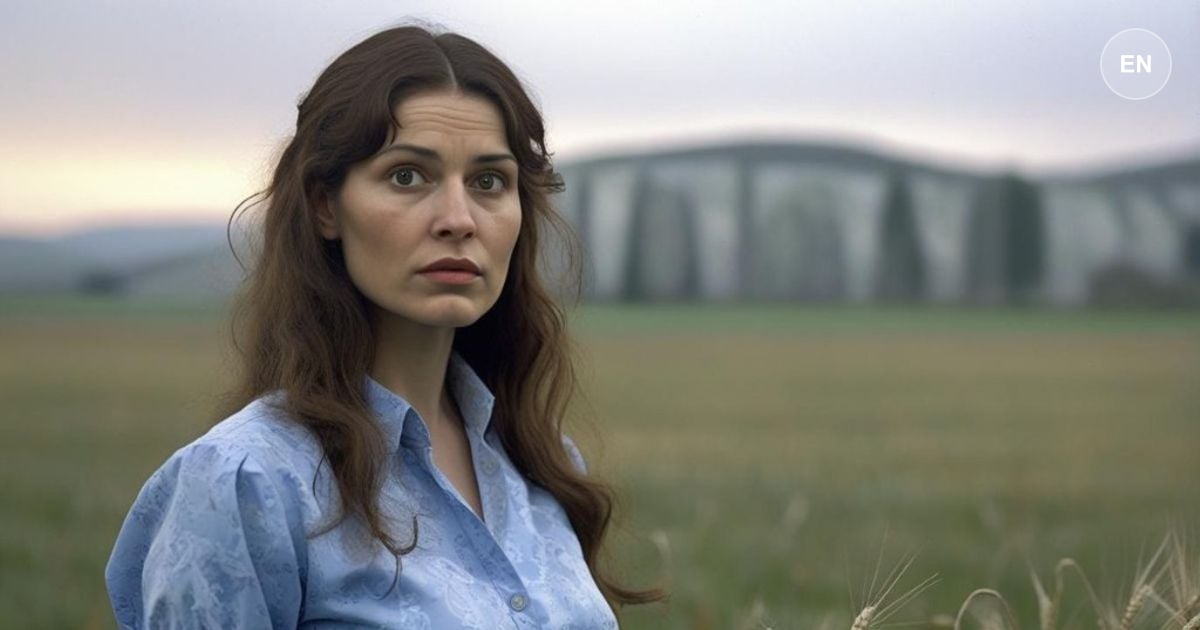
The churn turns after breakfast, and the butter will not come. Dairyman Crick, his wife, the maids, and Mr Clare stand over the cylinder while a horse outside keeps the churn turning. Squish, squash, and never the flick-flack they are waiting for. Crick talks bitterly of conjurors. Mrs Crick stays with the work. Perhaps, she says, somebody in the house is in love. Her husband will not take that as the cause. He tells them Jack Dollop, a milker who hid inside the churn when a mother from Mellstock arrived with a brass-mounted umbrella and a weeping daughter, and who was swung on the winch until he promised to make amends. The listeners smile. Tess has gone pale. She reaches the door and says, almost inaudibly, how warm it is. None of them connects her leaving with the story. Crick opens the door, calls her the prettiest milker he has, and tells her not to tire at the first breath of summer. She goes outside. The milk changes its note. Mrs Crick cries that it is coming, and the room lets Tess go.
She stays wretched all afternoon and keeps apart after the evening milking. To the others the tale was a humorous narration. She alone felt the sorrow in it, and how cruelly it touched her. She goes up first to the common chamber. She is dozing when Marian, Izz Huett, and Retty Priddle come in and stand barefoot at the window in the last red light, watching Angel Clare in the garden. Retty has seen Izz kiss the shade of his mouth on the wall by the whey-tub. The owning follows. Marian would marry him tomorrow. So would Izz, and more. So would timid Retty. They cannot all have him, and Izz thinks a gentleman's son, bound to farm abroad, will marry none of them, Tess included. Marian has watched him every day. He likes Tess Durbeyfield best. They blow him a silent kiss. They hear him climb the ladder to his own room. Marian snores. Izz lies awake a long time. Retty cries herself to sleep.
Tess is further from sleep than any of them. Jealousy barely stirs. She knows she has his preference, and that ordinary care would hold it. Mrs Crick has already told her of a laughing question he once put: what use a fine lady would be, with Colonial pasture to feed, cattle to rear, and corn to reap. A farm-woman, he had said, would be the only sensible wife. She has determined that she will never be tempted into marriage. Why, then, should she draw his eyes off Marian, Izz, and Retty, only to sun herself in them for the time he remains at Talbothays?
Hardy shows us something devastating: how trauma doesn't just hurt us in the moment, it rewrites our sense of what we deserve. Teresa could win Angel's love, but her shame about Alec makes her feel like she'd be cheating her friends out of happiness that should belong to 'good' women. This isn't noble self-sacrifice; it's shame masquerading as virtue. The mechanism works through twisted logic: when we carry secrets or past pain, we develop a hierarchy in our minds where others, those without our baggage, automatically deserve good things more than we do. This creates a prison where we either deny ourselves what we want or feel guilty for taking it. We see this everywhere today: the single parent who won't date because they think potential partners deserve someone 'without complications,' the person in recovery who won't apply for promotions believing colleagues with clean records should get them instead, the abuse survivor who minimizes their needs in relationships thinking partners deserve someone 'easier to love.' But here's what shame gets wrong: your struggles don't disqualify you from happiness, they often make you more capable of appreciating and protecting it. The question isn't whether you deserve good things despite your past, but whether you can recognize that healing and growth make you worthy of them. When have you caught yourself in this worthiness trap, and what would change if you questioned who created those rankings in the first place?
Explore this chapter with AI to uncover deeper meaning and practical takeaways.
AI Discussion