
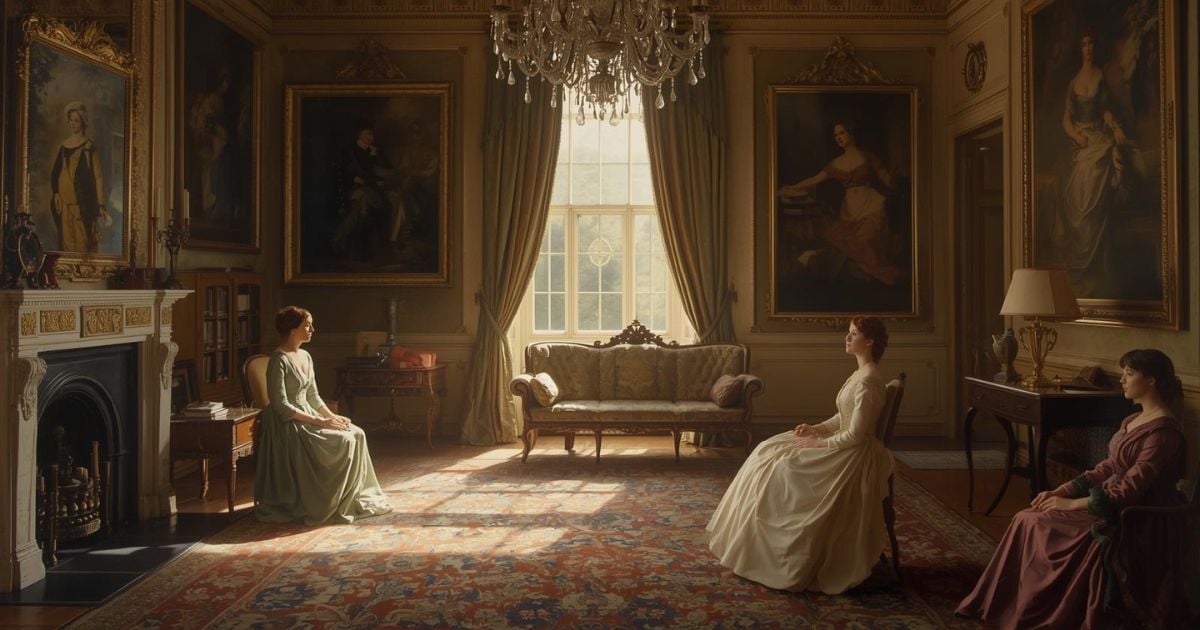
A handsome rescue arrives before anyone can say what the man is like. The Dashwoods are settled at Barton, and drawing, music, and walks please them more than Norland has pleased them since their father died. Sir John calls every day and is amazed to find them always busy. He offers his carriage. Mrs. Dashwood will not visit beyond walking distance. On a showery morning Marianne and Margaret climb the downs. Marianne has promised the clouds will clear. They join instead. The girls run for the garden gate. Marianne falls and twists her foot. Margaret cannot stop. A gentleman with a gun and two pointers puts the gun down and, when Marianne hesitates at the help she needs, carries her into the parlour.
Elinor and her mother rise in amazement. He is uncommonly handsome, and he explains himself with a frankness and grace that add to his looks. Had he been old, ugly, and vulgar, gratitude for any care of Marianne would still have been sure. Youth, beauty, and elegance make the act come home. He will not sit. He is dirty and wet. His name is Willoughby. His present home is Allenham, and he asks the honour of calling tomorrow. It is granted. He leaves in heavy rain and is more interesting for it. Marianne, too confused to look at him after he lifted her, has seen enough. His person and air match the hero of a favourite story. Carrying her in with so little ceremony is a quickness she particularly likes. Of all men's clothes, a shooting-jacket is the most becoming. The ankle is disregarded.
Sir John knows the name. Willoughby is down every year, as good a fellow as ever lived, a very decent shot, and not a bolder rider in England. Marianne asks for his manners, his pursuits, his talents, his genius. Sir John is puzzled. He is pleasant and good-humoured, and he has the finest little black pointer Sir John ever saw. Marianne can no more say that pointer's colour than Sir John can describe the shades of Willoughby's mind. Elinor gets the plainer facts. He owns nothing here. He is staying with the old lady at Allenham Court, a relation, whose possessions he is to inherit, and he has a small estate of his own in Somerset. Sir John tells Elinor he is well worth catching, and that Brandon will be jealous. Mrs. Dashwood smiles. Catching a man is not work her daughters were brought up to do. Men are safe with them, however rich. She is glad he sounds respectable. He danced, Sir John adds, from eight at night till four, and was riding again at eight. That, says Marianne, is what a young man ought to be. Eagerness should know no moderation, and leave him no sense of fatigue. Sir John says she will set her cap at Willoughby and forget poor Brandon. She hates that common phrase, and every phrase like making a conquest. He laughs as if he understood, and says it again. Willoughby is coming tomorrow. Will anyone ask him a question Sir John could not answer?
Marianne's instant connection with Willoughby reveals something profound about human vulnerability: our desperate hunger to be truly understood. When someone appears to share all our passions and validate all our feelings, it feels like finding our missing half. But Austen shows us the difference between being understood and being manipulated through understanding. Willoughby has studied Marianne's type, he knows exactly which poets to quote and which romantic ideals to espouse. This isn't understanding; it's performance. Today's world amplifies this dynamic exponentially. Online feed algorithms create echo chambers that make us feel understood while actually isolating us. Matchmaking apps let people craft perfect personas. Workplace manipulators study our professional profiles and mirror our professional values. The challenge isn't avoiding people who understand us, it's learning to distinguish between authentic understanding and strategic mirroring. Real understanding includes seeing our flaws and contradictions, not just reflecting our best self-image back to us. It involves disagreement, challenge, and growth. When someone seems to understand us perfectly from day one, we should ask: Are they seeing the real me, or are they showing me what I want to see? The most dangerous manipulations aren't obvious lies, they're truths wrapped around hidden agendas.
Explore this chapter with AI to uncover deeper meaning and practical takeaways.
AI Discussion