
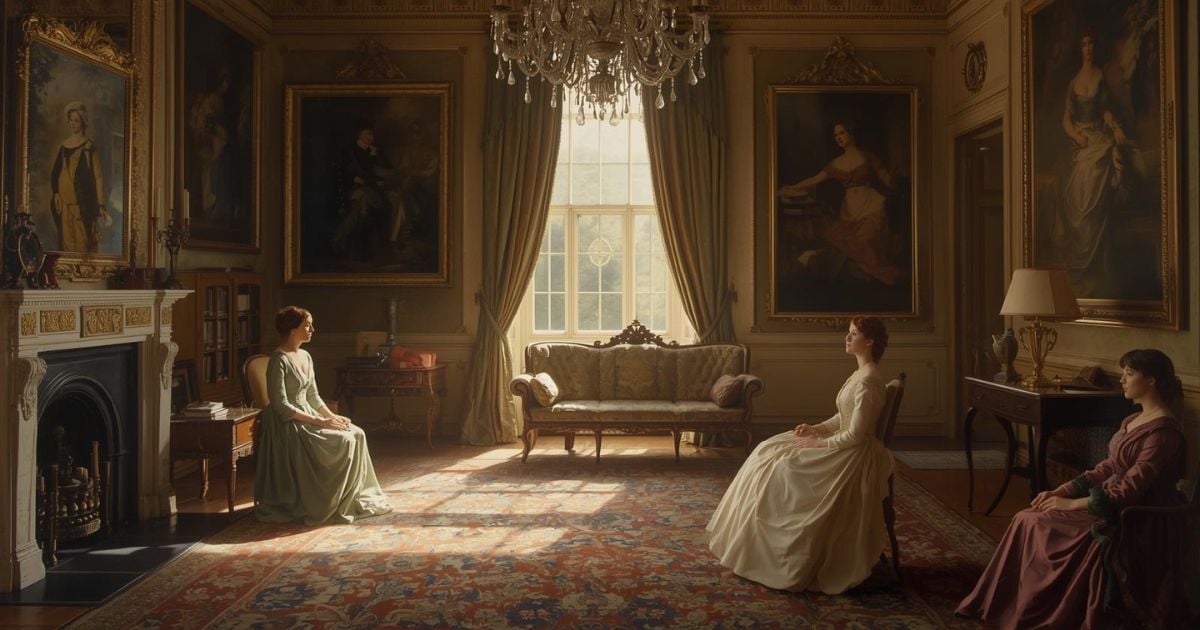
Matching every favourite thing, in one morning, starts to feel like knowing him. Willoughby calls early. Mrs. Dashwood receives him with more than politeness. He did not need a second look to be sure of their faces. Marianne is the handsomer, and her dark eyes have a life that is hard to see without delight. At first she holds that look back, embarrassed by the memory of his help. It passes when she finds frankness with his good breeding, and above all when he says he is passionately fond of music and dancing. She gives him a look that keeps most of his talk. She cannot be silent on a favourite amusement. The enjoyment and the judgment match. She goes on to books, praised with such delight that a young man of twenty-five would have to be very dull not to agree at once. The same books, the same passages. If an objection appears, it lasts only until her arguments and her eyes have been shown. He catches all her enthusiasm. Long before he leaves, they talk like old friends.
Elinor says that for one morning this is pretty well. Marianne knows Cowper and Scott, and that he admires Pope no more than is proper. At this speed, another meeting will finish picturesque beauty and second marriages, and then there will be nothing left to ask. Marianne is offended. She has been too happy and too frank. If she had talked only of the weather and the roads, and only once in ten minutes, there would have been no reproach. Her mother says Elinor was in jest. Marianne softens at once. He comes every day. The ankle is his first excuse, and the welcome ends the need for it. They read, talk, and sing. He reads with the sensibility Edward lacked. Mrs. Dashwood finds him as faultless as Marianne does. Elinor's only blame is that he says too much of what he thinks, without care for who is listening, and Marianne delights in that. Her despair at sixteen and a half, of ever meeting her idea of perfection, now feels rash. Before the week ends, her mother, who had not been counting his money, hopes and expects the marriage, and secretly congratulates herself on two sons-in-law, Edward and Willoughby.
Colonel Brandon's liking becomes visible to Elinor only when his friends stop joking about it. Their wit has moved to the luckier rival. She believes, unwillingly, that the feeling Mrs. Jennings gave him for her own amusement is now real. What can a silent man of thirty-five hope against a lively one of twenty-five? She likes Brandon, and his reserve seems like a weight on his spirits. Sir John has hinted at past injuries. Willoughby says Brandon is the man everybody speaks well of and nobody cares about, whom all are delighted to see and nobody remembers to talk to. Marianne says that is exactly her thought. Elinor calls it unjust. Willoughby answers that praise from Lady Middleton and Mrs. Jennings is itself a reproach. Marianne adds that he has neither genius, taste, nor spirit. Elinor can only call him sensible, well-bred, well-informed, gentle, and, she believes, kind. Willoughby will not be talked out of the dislike. He has three reasons. Brandon threatened rain when Willoughby wanted it fine, found fault with the curricle, and will not buy the brown mare. In every other respect he is ready to call Brandon irreproachable, and he still claims the privilege of disliking him as much as ever. The tastes have been declared the same. Will the next meeting ask the subject Elinor named, or only repeat the three reasons?
Marianne's instant attraction to Willoughby reveals something profound about human psychology: we often mistake intensity for intimacy. When someone helps us during a vulnerable moment, our brains flood with gratitude and connection chemicals that feel identical to romantic love. This rescue romance pattern was as powerful in Austen's drawing rooms as it is in modern workplaces, matchmaking apps, and crisis situations. The person who swoops in during our bad day, our family emergency, or our career crisis becomes associated with relief and salvation. But here's what Austen understood that we often forget: being good in a crisis doesn't necessarily make someone good for daily life. Willoughby excels at dramatic gestures and intense conversations, but can he handle the mundane work of actual partnership? The rescue dynamic creates an unequal foundation where one person is perpetually grateful and the other perpetually needed. Modern research confirms what Austen observed: relationships that begin during high-stress or vulnerable moments have higher rates of disappointment once normal life resumes. The hero complex can become addictive for both parties - the rescuer seeks situations where they're needed, and the rescued person begins creating crises to maintain the dynamic. Real love, Austen suggests, grows from seeing someone handle ordinary Tuesday afternoons, not just dramatic Monday emergencies.
Explore this chapter with AI to uncover deeper meaning and practical takeaways.
AI Discussion