
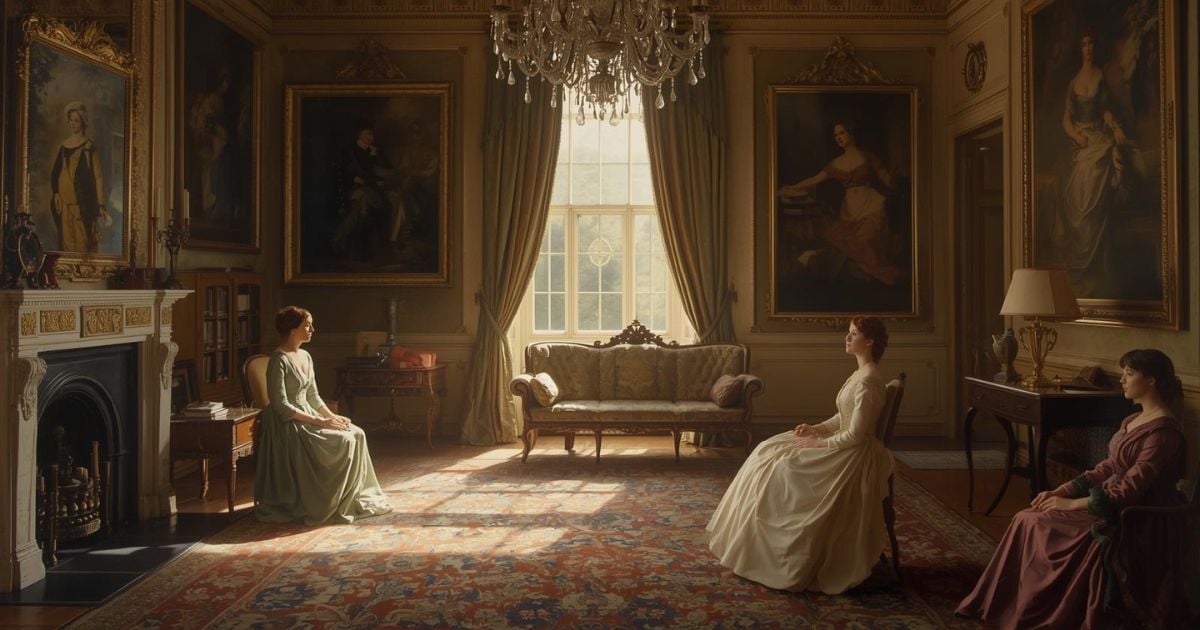
The sisters have been more than two months in town, and Marianne wants Barton. If any place can ease her, she thinks it must. Elinor is almost as anxious to leave, and more willing to admit how long the journey is. Mrs Jennings resists. Then Charlotte asks them to Cleveland, about the end of March, for Easter. Mr Palmer presses it too, his manners mended since Marianne's unhappiness was known, and Elinor accepts. Marianne cannot go to Cleveland. She cannot go into Somersetshire, where she had looked forward to going. Elinor does not argue the feeling down. She makes Cleveland a way home. It is within a few miles of Bristol, and from there Barton is one long day. They need not stay above a week. They might be with their mother in little more than three weeks. Their mother agrees. Marianne writes down the hours that still divide her from Barton.
Mrs Jennings tells Colonel Brandon that without the sisters they will sit and gape at one another as dull as two cats. Elinor goes to the window to measure a print she means to copy. He follows. Mrs Jennings is too honourable to listen, and she changes her seat so that she will not hear, to a place by the pianoforte. She still sees Elinor change colour. In one pause he seems to apologise for the badness of his house. In another she hears that he is afraid it cannot take place very soon. Surely, she thinks, he need not wait to be older. At the parting Elinor says she will always think herself very much obliged to him. He leaves at once, and with a coolness that offends the picture already drawn. Mrs Jennings had not thought her old friend so indifferent a suitor.
The offer was a living, not a hand. Delaford is vacant by that day's post. It is Edward's if he will take it, a small rectory of about two hundred a year. It can make him comfortable as a bachelor. It cannot enable him to marry, and Brandon is afraid the marriage cannot take place very soon. Elinor could hardly be more astonished if he had offered her his hand. She is the one fixed on to bestow it. She thanks him with all her heart, and she would rather he carried the news himself. She does not want Edward to take an obligation from her. He declines, from the same delicacy, and still wants it given through her. She has the address from Anne Steele, and she will tell Edward today. Will the fear that it cannot take place very soon be kept as a word about his marriage, or heard as a delay in hers?
Edward Ferrars represents something we rarely discuss: the trap of being too honorable. In 1811, breaking an engagement was social suicide, especially for men without independent wealth. Edward's trapped not by love, but by his word given years earlier to someone he's outgrown. Today, we face similar traps. The single mother who won't date because 'my kids come first', even when the kids are teenagers who want her to be happy. The worker who stays loyal to a company that's slowly destroying their health because 'they took a chance on me.' The friend who keeps bailing out someone who never changes because 'that's what friends do.' We turn virtues into chains, mistaking stubbornness for integrity. The cruelest part? Everyone suffers. Edward is miserable, Elinor is heartbroken, and Lucy gets a man who doesn't want to be there. Sometimes the most honorable thing is admitting you made a mistake when you were younger and finding a way forward that serves everyone better. Real honor considers current reality, not just past promises. The question isn't whether you gave your word, it's whether honoring that word still serves anyone, including yourself.
Explore this chapter with AI to uncover deeper meaning and practical takeaways.
AI Discussion