
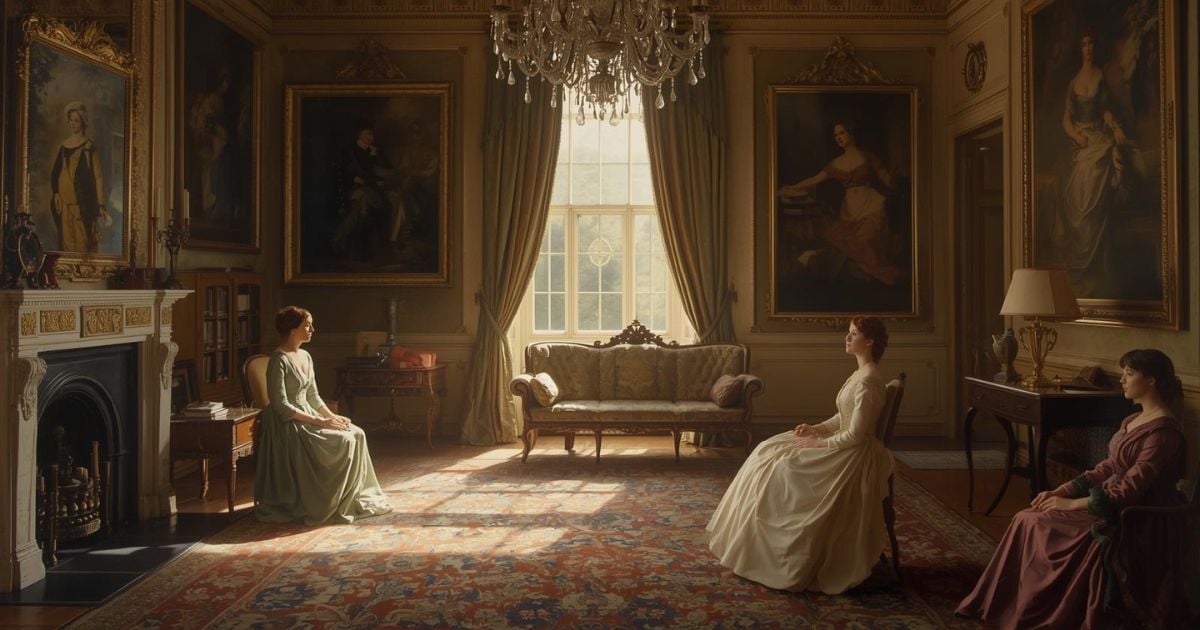
Only Elinor and Marianne know how little Edward was tempted into disobedience, and how small the comfort is, once friends and fortune are gone. Elinor will not dwell on it alone with her sister. Marianne's assurances are too warm. They would fix the belief that he still loves Elinor, and that belief is one Elinor would rather undo. Marianne cannot stay on the subject either. The comparison leaves her more dissatisfied with herself, a penitence without the hope of doing better now.
On a fine Sunday in the second week of March, Mrs Jennings and Elinor go to Kensington Gardens. Marianne stays at home. The Willoughbys are in town, and she will not risk meeting them. Anne Steele finds Elinor and needs little asking. Is Mrs Jennings angry? Not with her. Lady Middleton? Elinor cannot suppose it. The pink ribbons are the Doctor's favourite colour, and Anne does not care. Then she is triumphant. People may say Edward declared he would not have Lucy. It is no such thing. He came that morning, just home from church, and he had told them in Harley Street that he loved nobody but Lucy. Afterwards he rode into the country, stayed at an inn, and begged her, if she had the least mind for it, to put an end to the engagement. He had only two thousand pounds. A curacy would not keep them. It was for her sake. He never said he was tired of her, or that he wished to marry Miss Morton. Lucy would not hear it. They would wait for a living. Elinor asks how Anne interrupted them, if they were in the same room. They were not. She heard it by listening at the door. Elinor is sorry she did not know that sooner. She would not have allowed particulars of a conversation Anne ought not to have known.
The next morning Lucy's letter comes by the two-penny post, and the parts are reversed. She urged him to part, as duty and prudence required, and he said it should never be. She asks Elinor and Mrs Jennings to speak for him if either hears of a living. Elinor puts the letter into Mrs Jennings's hands, which she takes to be its real design. It is read aloud, and the sentence that let him be off if he would is called quite proper. From the shorter account, Mrs Jennings has already settled the ending: a twelvemonth, then a curacy of fifty pounds a year, and a child every year. Will the letter, in which she asked to part, replace the door, which said that he did?
Austen wrote during an era when social propriety was everything, but her insight about emotional suppression hits harder today than ever. In 1811, Elinor had to follow strict rules about unmarried women's behavior. Today, Maya faces different but equally rigid expectations, workplace professionalism, the pressure to 'move on' quickly from romantic disappointment, the idea that showing vulnerability is weakness. Both women discover that forcing yourself to act normal when you're falling apart doesn't protect you, it amplifies the pain. The performance becomes another source of stress on top of the original hurt. Modern workplaces especially demand this kind of emotional labor. We're expected to compartmentalize personal struggles, maintain productivity, and never let our inner lives affect our professional personas. But Austen shows us something crucial: when we can't express authentic emotion, it doesn't disappear. It festers. The energy required to maintain the facade drains us further. Consider how many situations require us to perform emotional stability we don't feel, family gatherings during personal crisis, work presentations while grieving, online networks posts that project happiness during depression. Austen's genius lies in showing how these forced performances create a double burden: the original pain plus the exhaustion of pretending it doesn't exist.
Explore this chapter with AI to uncover deeper meaning and practical takeaways.
AI Discussion