
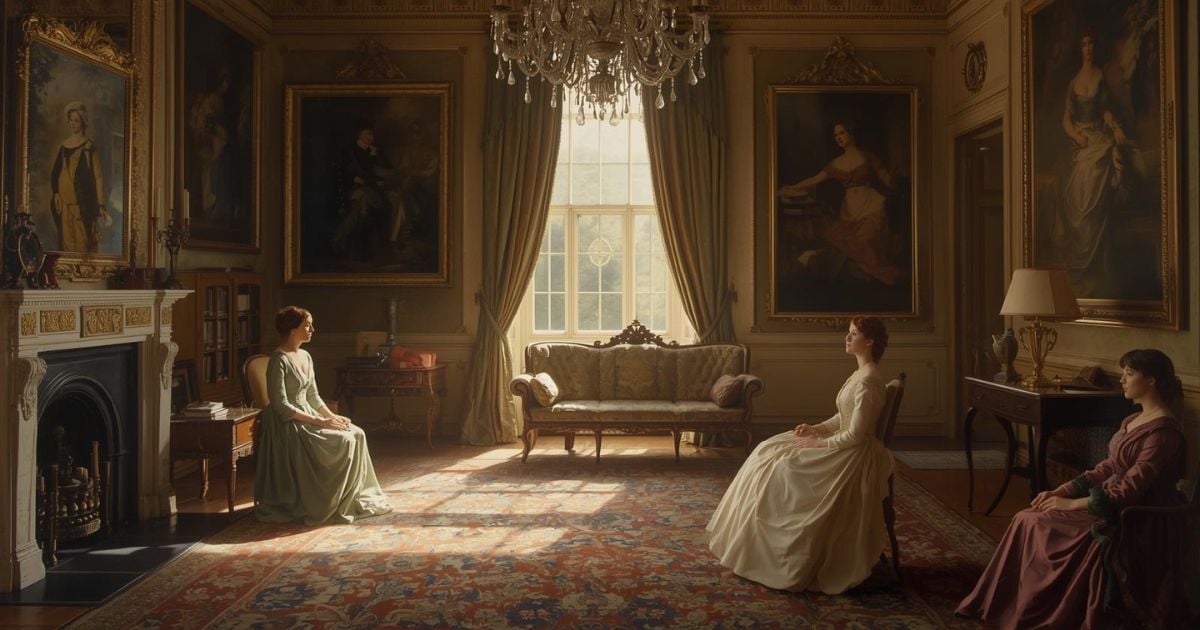
Mrs Jennings walks in without waiting. He is to be married very soon. She has it from Mrs Taylor, who had it from a particular friend of Miss Grey, else she would not have believed it. She wishes his wife may plague his heart out. If they meet, she will give him a dressing. Marianne's pretty face, she says, will never want admirers. Tonight the Parrys and the Sandersons will amuse her. Mrs Jennings leaves on tiptoe.
Marianne comes down to dinner, eats more than Elinor expected, and does not hear the kindness aimed at her, until sweetmeats, olives, and dried cherries force her to notice. She cries out in misery and leaves her wine unfinished. Miss Grey has fifty thousand pounds. Smart, they say, and not handsome. He is all to pieces, with his curricle and hunters. Why, Mrs Jennings asks, does he not sell the horses, let the house, and turn off the servants? The guardians, Mr and Mrs Ellison, would not be sorry to see Miss Grey married, for she and Mrs Ellison could never agree. She is of age, and may choose. Elinor asks that his name not be spoken before Marianne. Mrs Jennings agrees. She did not speak of it through dinner, and she will hint the same to Sir John and her daughters. Then Elinor adds what she thinks is due. He has broken no positive engagement. Mrs Jennings will not allow the defence. No positive engagement indeed, after he took Marianne all over Allenham and fixed the very rooms they were to live in hereafter. Elinor lets it stand. The stricter account could cost her sister much, and could gain him little.
An ill wind, Mrs Jennings says, will suit Colonel Brandon. They will be married by Midsummer. Two thousand a year, except the little love-child. Delaford has its mulberry, its fruit walls, and a yew arbour from which the carriages on the turnpike can be seen. One shoulder of mutton drives another down. If Willoughby can be put out of Marianne's head, Elinor says, they will do very well with or without the Colonel. Upstairs she is leaning over the remains of a fire, and will be left only if she goes to bed. She does. Mrs Jennings brings Constantia wine, her husband's remedy for a colicky gout. Elinor drinks the glass herself. At tea, Brandon already knows what Mrs Jennings is sure he does not. He heard the match that morning in a stationer's shop in Pall Mall, from Mrs Ellison, waiting for a carriage. It is no longer a secret. It will take place within a few weeks, and afterwards they go to Combe Magna. He stays serious the whole evening. Will the rooms at Allenham be set down beside "no positive engagement," or will the fifty thousand pounds be left to explain him alone?
Lucy Steele's calculated revelation to Elinor exposes a timeless truth: information is power, and threatened people weaponize it. In Austen's world, a woman's romantic prospects were her economic security, making Lucy's disclosure a form of financial warfare. She doesn't share her secret engagement out of friendship, she does it because she's detected competition and wants to eliminate it surgically. Today, this same pattern plays out everywhere. The coworker who suddenly shares news about layoffs right before your performance review. The family member who drops embarrassing stories about you at gatherings when they feel overshadowed. The friend who reveals your crush's dating history when they sense you're getting close. The mechanism is identical: strategic timing plus emotional precision equals maximum damage. What makes Lucy's approach particularly ruthless is her performance of concern. She watches Elinor's face, feeding on her pain while pretending to seek advice. This teaches us to examine not just what people tell us, but when they choose to tell us and how they deliver the information. The most dangerous revelations often come wrapped in fake friendship or manufactured concern. When someone suddenly becomes eager to share 'important' information with you, especially about relationships or opportunities, pause and ask: what do they gain from my knowing this? Their motivations matter more than their information.
Explore this chapter with AI to uncover deeper meaning and practical takeaways.
AI Discussion