
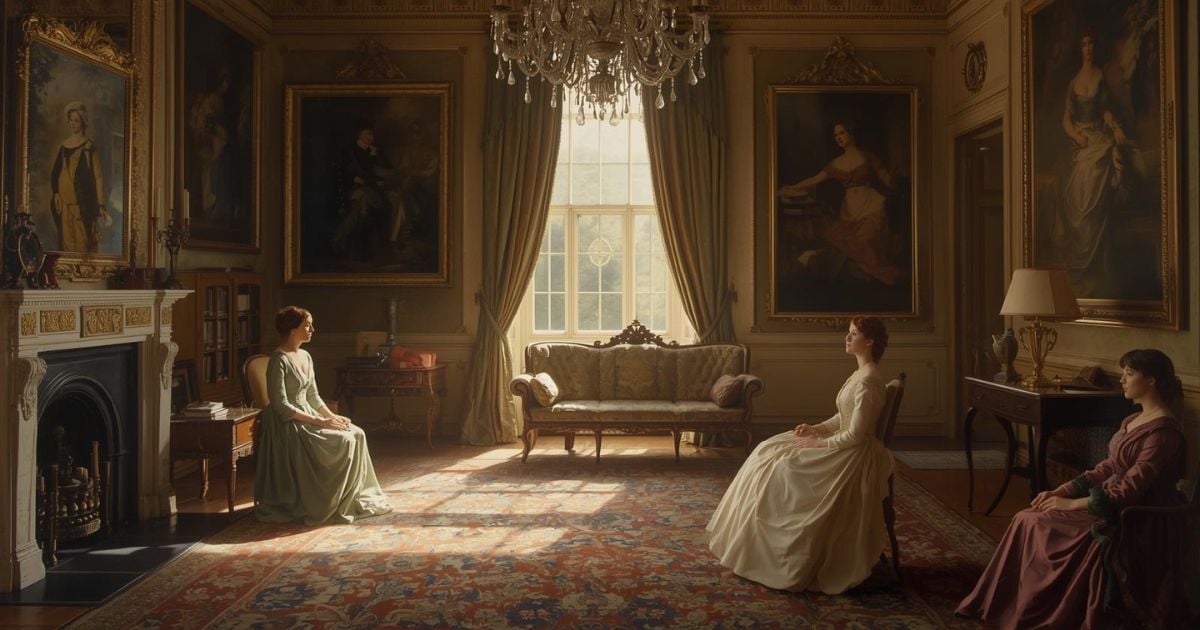
For three or four days he neither comes nor writes. Marianne goes to Lady Middleton's party with no look of hope, and starts when the carriage is at the door, as if she had forgotten it. The room is full and insufferably hot. Lady Middleton sits down to Cassino. Within a few yards, Willoughby is in earnest talk with a very fashionable young woman. He bows to Elinor and does not come nearer, though he cannot help but see Marianne. Her face glows. She would have gone to him if Elinor had not caught her arm. Why does he not look at her?
He turns. She says his name and holds out her hand. He speaks to Elinor instead. How is Mrs Dashwood, and how long have they been in town? Marianne's face is crimson. Has he not received her letters? Will he not shake hands? He cannot avoid the hand. The touch seems painful, and he holds it only a moment. Then he says he did himself the honour of calling in Berkeley Street last Tuesday, and hopes his card was not lost. Have the notes not reached him? There is some dreadful mistake. He must tell her what the matter is. He does not answer, until he catches the eye of the woman he had been speaking with. Yes, he received the information of their arrival, which she was so good as to send. He bows, and joins his friend.
Marianne goes white, and sinks into the chair. Lavender water, and Elinor between her and the room. Go to him, Marianne says. Force him to come back. This is not the place, Elinor answers. Wait until tomorrow. He leaves by the staircase door. Lady Middleton gives up a rubber without a word of objection. Almost nothing is said on the way to Berkeley Street. Hartshorn, then bed, and Marianne asks to be left alone. Elinor will not call the evening a mistake. Some attachment had subsisted, and he is weary of it. Only a thorough change of sentiment accounts for what he did. His embarrassment keeps her from thinking he had been sporting with her sister's affections from the first. Absence may have weakened the regard, and convenience may have decided him to put it aside. That the regard once existed, she cannot doubt. Will the question about the letters still be asked in the morning, or will last Tuesday's card be left as the answer?
Lucy Steele's manipulation of Elinor reveals something crucial about how emotional labor gets weaponized, especially by those with fewer resources. Lucy, with no inheritance or family wealth, sees Edward as her economic lifeline. But instead of being honest about her desperation, she transforms Elinor into unpaid emotional labor, forcing her to process Lucy's 'relationship doubts' while hiding her own heartbreak. This pattern persists today in workplaces where people share personal struggles to avoid accountability, or in families where one person's constant crises become everyone else's responsibility. The person providing emotional support rarely gets reciprocal care. They're expected to be endlessly understanding while their own needs go unmet. What makes Lucy's behavior particularly insidious is how she disguises exploitation as intimacy. She's not seeking genuine advice, she's creating a power dynamic where Elinor must either participate in her own emotional harm or risk appearing unsupportive. This mirrors modern situations where saying no to someone's emotional demands gets labeled as 'not being there for them.' The key insight is recognizing when vulnerability becomes a currency used to purchase compliance. True emotional intimacy doesn't come with immediate requests for favors, advice that benefits the asker at your expense, or obligations to manage someone else's choices.
Explore this chapter with AI to uncover deeper meaning and practical takeaways.
AI Discussion