
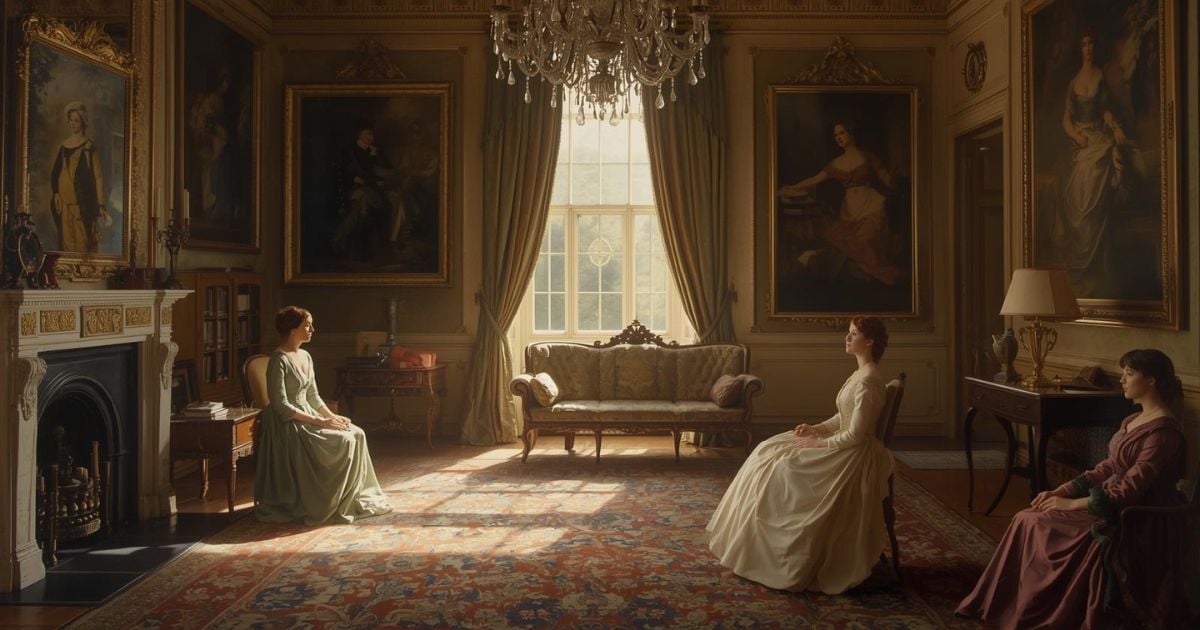
His low spirits make the visit only a partial satisfaction. A look one moment is contradicted by reserve the next. Next morning Marianne leaves them alone, and before she is halfway upstairs Edward comes out. He is going to the village to see his horses. He returns full of the valley. She begins on particulars. He stops her. He has no knowledge of the picturesque. He will call hills steep which ought to be bold, and distant objects out of sight which ought only to be indistinct. A fine country, for him, unites beauty with utility. He does not like crooked, blasted trees. He likes them tall, straight, and flourishing. A snug farm-house pleases him more than a watch-tower, and tidy villagers more than the finest banditti. Elinor says that to avoid one affectation he falls into another. Marianne looks at him with amazement, and at her sister with compassion. Elinor only laughs.
The subject stops. Then, as Edward takes his tea from Mrs. Dashwood, his hand passes so directly before Marianne that a ring becomes conspicuous, with a plait of hair in the centre. She has never seen him wear a ring. Is that Fanny's hair? She remembers Fanny promising to give him some. She would have thought her hair darker. She speaks what she feels, and when she sees how much she has pained him, her vexation cannot be surpassed by his. He colours very deeply, gives a momentary glance at Elinor, and says yes, it is his sister's hair. The setting always casts a different shade on it. Elinor meets his eye and looks conscious likewise. That the hair is her own, she feels as sure as Marianne does. The only difference in their conclusions is that Marianne considers it a free gift from the sister, and Elinor is conscious it must have been procured by some theft or contrivance unknown to herself. She is not in a humour to regard it as an affront. She talks of something else at once, and internally resolves to catch every opportunity of eyeing the hair until she is satisfied, beyond all doubt, that it is exactly the shade of her own. His embarrassment lasts, and ends in an absence of mind still more settled. He is particularly grave the whole morning. Marianne severely censures herself. Her forgiveness might have been speedier had she known how little offence it gave her sister.
Sir John discovers that Ferrars begins with an F, and the raillery is prepared, not yet sprung. They must drink tea tonight because the park will be alone, and dine tomorrow because it will be a large party. A dance will tempt Marianne. Did she think nobody could dance because a certain person is gone? Edward asks, low, who Willoughby is. Her face tells more than Elinor's reply. Later he whispers his guess. Mr. Willoughby hunts. She smiles, and is sure Edward will like him. He is astonished. He had thought it a joke, founded only on a something or a nothing. Will the next look at the ring settle the shade, or will the setting be left to keep changing it?
Edward's mysterious ring represents something every working person recognizes: the moment when reality crashes into our carefully constructed hopes. In Austen's time, a lock of hair in a ring was intimate as a wedding band, yet Elinor forces herself to question what she's seeing because accepting it means losing her future. Today's version might be spotting your crush's relationship status change on online networks, finding unfamiliar items in a partner's car, or watching a friend's spending habits when they claim to be broke. The pattern stays the same across centuries: we become detectives of our own denial. Modern psychology calls this 'motivated reasoning', we're literally motivated to find reasons why threatening evidence doesn't mean what it obviously means. The workplace version happens constantly: ignoring signs of layoffs because we need job security, overlooking a supervisor's favoritism because we can't afford conflict, dismissing a coworker's subtle undermining because we want to believe in team unity. Austen understood that intelligence isn't just about being smart, it's about being willing to see clearly even when clarity hurts. The most dangerous person to fool is yourself, especially when the stakes feel too high to face the truth.
Explore this chapter with AI to uncover deeper meaning and practical takeaways.
AI Discussion