
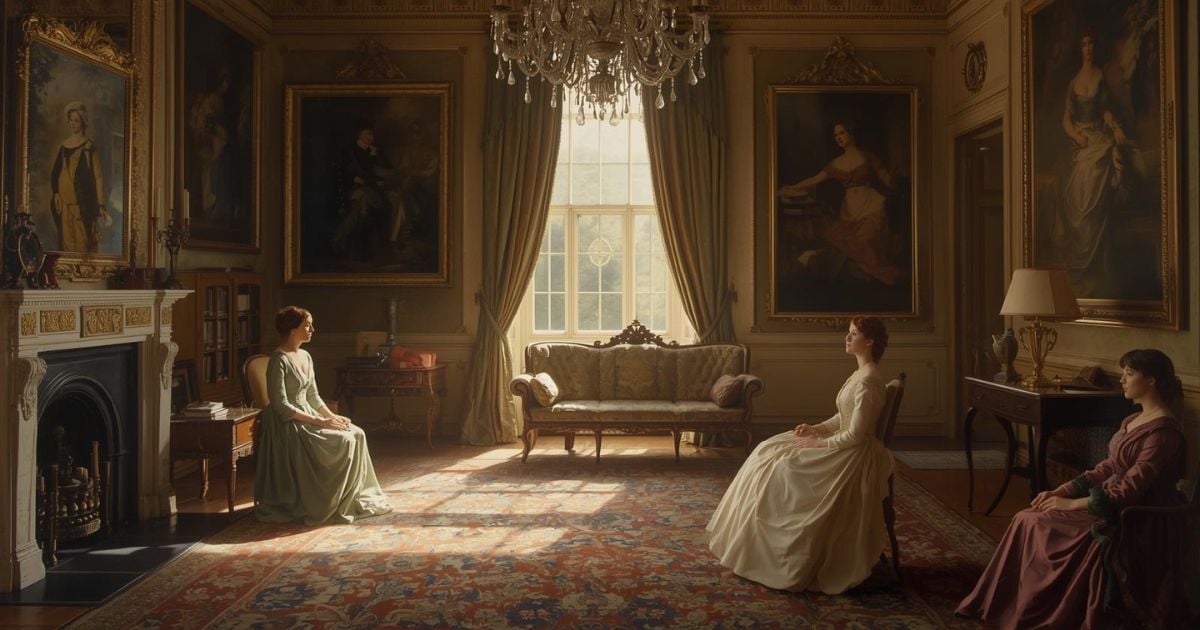
Mrs. Dashwood is surprised only for a moment. His coming is, in her opinion, the most natural thing in the world, and her welcome overcomes the coldness before he is well inside the house. He becomes more like himself. He is still not in spirits. She attributes it to his mother, and sits down indignant against selfish parents. He will not be a great orator in spite of himself. He has no wish to be distinguished, and greatness will not make him happy. Marianne asks what wealth or grandeur has to do with happiness. Elinor says grandeur has little, and wealth has much. Beyond a competence, Marianne says, money can afford no real satisfaction. What is her competence? About eighteen hundred or two thousand a year. Servants, a carriage, perhaps two, and hunters. Elinor laughs. Two thousand a year. One is her wealth. She hears Combe Magna in the list. Edward asks why hunters. Everybody does not hunt. Marianne colours. But most people do.
If they had a large fortune, Edward says, Marianne would buy every book about an old twisted tree, and every copy, to keep them from unworthy hands. She loves to be reminded of the past. Her opinion is unchanged. No one can be in love more than once, and at her time of life opinions are tolerably fixed. Elinor says she is not altered, only a little more grave. He is not very gay himself. Gaiety never was part of his character. Elinor hardly calls Marianne lively. She is earnest, and not often really merry. He has always set her down as a lively girl. Elinor has often caught herself in that mistake, guided by what people say of themselves, or by what others say of them, without time to judge. Marianne thought Elinor's doctrine was to follow the neighbours. No. Elinor has tried to influence behaviour, not understanding.
Edward's judgment is on Elinor's side. His practice is on Marianne's. He is so shy that he seems negligent, when he is only kept back by awkwardness. If his manners were easy, he would not be shy. Marianne says he would still be reserved, and that is worse. He starts, and colours. Reserved. What is he to tell them? What can she suppose? Elinor tries to laugh it off. Marianne calls everyone reserved who does not admire as rapturously as herself. He makes no answer, and sits silent and dull. Will anyone ask what the word made him suppose, or will the evening leave it as only her idea of shyness?
In Austen's world, a secret engagement could destroy reputations and financial security. The stakes were enormous because everyone's business was everyone else's business, but that same intimacy made secrets incredibly powerful weapons. Lucy Steele understands this perfectly. She's not just hiding an engagement; she's controlling the entire social dynamic around Edward by deciding who knows what and when. Today, we live in similar small communities, our workplaces, neighbourhoods, friend groups, where information travels fast and secrets carry weight. A coworker knows about layoffs but doesn't tell you. A neighbour sees your partner with someone else but stays quiet. A friend knows your ex is dating again but waits to mention it. The mechanics haven't changed: whoever controls information controls the situation. What's different now is how quickly secrets can explode across digital networks, making the stakes both higher and more unpredictable. We're still navigating the same fundamental question Elinor faces: when someone finally reveals what they've been hiding, we have to decide whether they're genuinely confiding in us or strategically positioning themselves for advantage. The intimacy of small communities, whether in 1811 or today, makes every secret a potential weapon, and every revelation a calculated move in a larger game of social chess.
Explore this chapter with AI to uncover deeper meaning and practical takeaways.
AI Discussion