
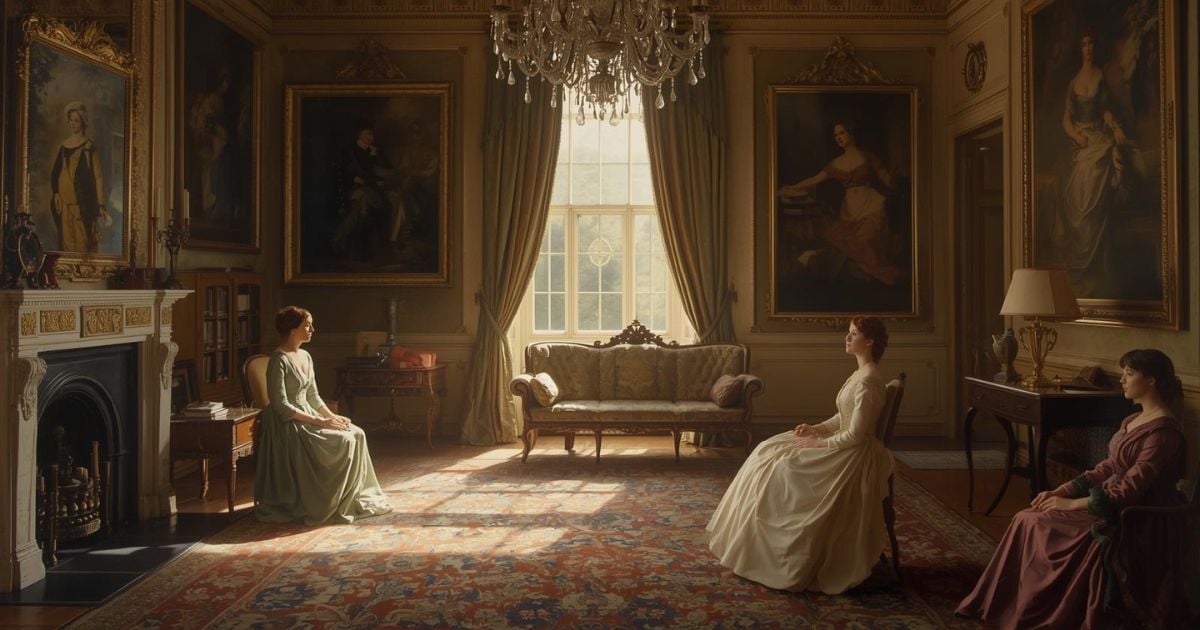
The curricle is waiting, and so is a farewell nobody foresaw. Marianne stays home from the visit to Lady Middleton, under a trifling pretext. Her mother is satisfied. She concludes Willoughby promised to call while they were out. They return to the curricle and the servant, and so far the conjecture holds. In the passage Marianne comes out of the parlour in violent affliction, handkerchief at her eyes, and runs upstairs without noticing them. Willoughby is leaning against the mantelpiece with his back towards them. He turns, tries to look cheerful, and says it is he who may expect to be ill. He cannot keep his engagement. Mrs. Smith has used the privilege of being rich, and sent a poor dependent cousin to London on business. By way of exhilaration he is come to take his farewell. Almost this moment. His visits to Mrs. Smith are never repeated within the year.
Mrs. Dashwood says he need not wait for an invitation here. His colour rises. His eyes stay on the ground. You are too good. She tells him Barton will always welcome him, and she will not press a return that only he can judge. He begins, confused, that his engagements are of such a nature that he dare not flatter himself, and he stops. Then he says it is folly to linger among friends whose society it is impossible for him now to enjoy. He steps into the carriage. In a minute it is out of sight. Elinor fears, in one moment, that no serious design was ever formed on his side, and in the next that a quarrel could account for the distress in which Marianne left the room. Marianne's love makes a quarrel seem almost impossible. The affliction itself is certain. Elinor thinks of a sorrow her sister is not merely giving way to as a relief, but feeding and encouraging as a duty.
Half an hour later Mrs. Dashwood returns, eyes red and countenance not uncheerful. She has a satisfactory account, and Elinor shall not talk her out of it. Mrs. Smith suspects the regard, disapproves, perhaps has other views, and invented the business to send him away. He dares not confess the engagement, so he must absent himself. Elinor's answer was already expected. It might or might not have happened. Her mother calls this taking evil upon credit, and declares him acquitted. Not entirely, Elinor says. Concealment from Mrs. Smith may be proper, if they are engaged. It is no excuse for concealing it from the family. She wants no proof of their affection. Of their engagement she does. Not a syllable has been said by either of them. Her mother has not wanted syllables where actions have spoken so plainly. Elinor confesses that every circumstance except one favours the engagement, and that one, the total silence of both, almost outweighs every other. If they correspond, her fears will be removed. At dinner Marianne cannot eat or speak. Her mother presses her hand, and she bursts into tears and leaves the room. The evening cannot keep clear of his name. If a letter comes, will it outweigh the silence, or will the silence still be the one fact?
Austen wrote this chapter in an era when women had few outlets for expressing agency, making dramatic emotional display one of the limited ways to command attention and resources. Marianne's theatrical grief serves multiple functions: it communicates the depth of her attachment, demands care from her family, and maintains connection to Willoughby through continued suffering. But Austen shows us the cost of making pain into performance. Modern parallels are everywhere in our online networks age, where personal struggles become content and trauma becomes brand. The person who posts every detail of their breakup, the coworker who makes their anxiety everyone else's problem, the family member whose crisis always needs to be the center of attention. There's often genuine pain underneath, but when suffering becomes the primary way someone gets their needs met, it creates a trap. The attention and care that flows toward dramatic displays of emotion can become addictive, making recovery less appealing than continued crisis. Meanwhile, people like Elinor - who process pain privately and maintain their responsibilities - often get overlooked precisely because they don't demand constant management. This dynamic shapes families, workplaces, and friendships, creating invisible hierarchies where the most functional people carry the most load. Understanding this pattern helps us distinguish between supporting someone through genuine difficulty and enabling a cycle where crisis becomes the only currency for care.
Explore this chapter with AI to uncover deeper meaning and practical takeaways.
AI Discussion