
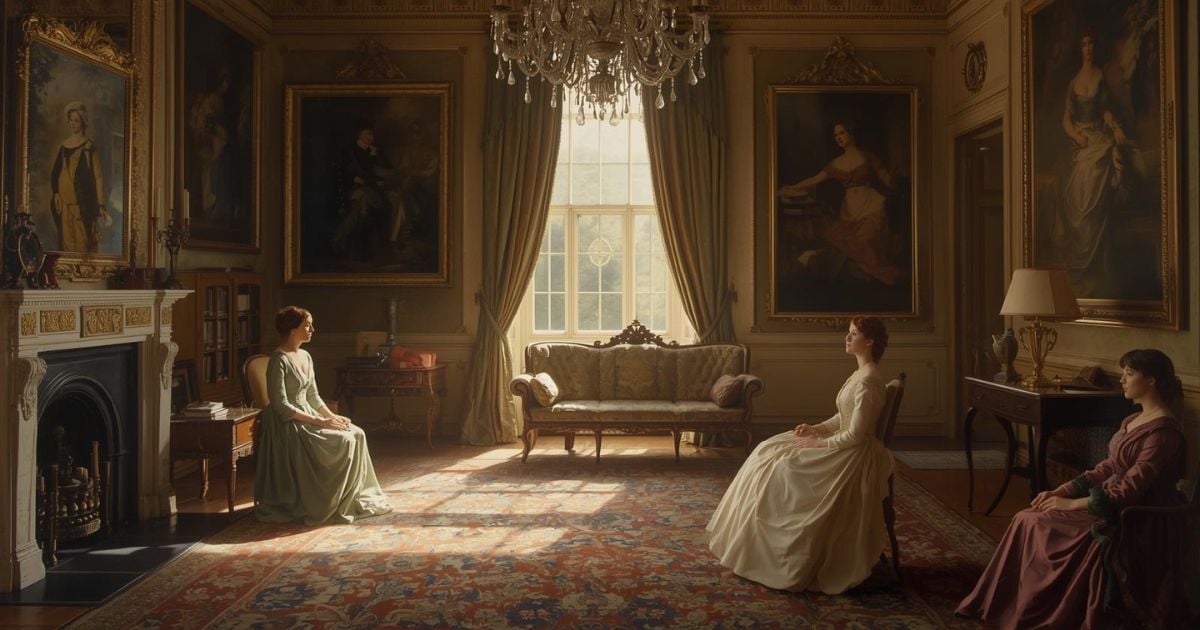
Mrs. Jennings will not let a departure have only one cause. For two or three days she wonders why Colonel Brandon left, and she is determined he shall not escape every distress she can invent. Perhaps money. Delaford was never reckoned more than two thousand a year, and his brother left everything sadly involved. Perhaps Miss Williams, because he looked conscious when she was mentioned, and Mrs. Jennings has a notion the young woman is always rather sickly. Perhaps his sister, worse at Avignon. Then she wishes him out of his trouble, and a good wife into the bargain. Each guess seems equally probable as it arises.
Elinor cannot give that leaving the amazement Mrs. Jennings wants. Her wonder is the silence. Marianne and Willoughby never acknowledge to her mother, or to her, what their constant behaviour declares. She can imagine that marriage is not immediately in their power. Sir John rates the estate at six or seven hundred a year, and Willoughby lives beyond it and complains of his poverty. What she cannot account for is a secrecy that conceals nothing at all, kept by two people whose whole practice is to despise concealment. A doubt sometimes enters. It is enough to stop her asking Marianne. His behaviour, meanwhile, is the affectionate attention of a son and a brother, and his hours at the cottage outnumber the hours at Allenham.
About a week after Brandon leaves, Mrs. Dashwood mentions improving the cottage in the spring. Willoughby will not consent. Not a stone must be added to its walls, not an inch to its size, if his feelings are regarded. Elinor says her mother will never have money enough. He is heartily glad. May she always be poor, if she can employ her riches no better. Were he rich enough he would pull Combe down and build it again in the exact plan of this cottage. Elinor names the dark narrow stairs and the kitchen that smokes. Yes, he says, with everything belonging to it. Then, and then only, he might be as happy at Combe as he has been at Barton. Elinor says that even with better rooms and a broader staircase he will find his own house as faultless as he now finds this. He asks Mrs. Dashwood to promise something further. Not only will the house remain the same, but he shall ever find her and hers as unchanged as the dwelling, and she will always consider him with the kindness that has made everything belonging to her so dear. The promise is readily given. He engages to be with them by four o'clock the next day. Will four o'clock find the parlour as unchanged as he asked, or will someone finally say the word their behaviour has been using all week?
Why do some people target those with good manners? Because they've learned that decent people make safe targets. The person who won't cause a scene, won't fight back publicly, won't stoop to their level, that person becomes a lightning rod for others' cruelty. It's a calculated strategy: hurt someone while looking innocent, knowing their character will protect you from consequences. This dynamic hasn't changed since Austen's time. The workplace bully who makes cutting remarks during meetings, the family member who brings up your failures at gatherings, the customer who berates service workers, they all rely on the same calculation. They're betting your professionalism, your desire to keep peace, your basic decency will shield them from accountability. The question becomes: how do you maintain your integrity without becoming a doormat? Austen shows us through Elinor that grace under pressure doesn't mean accepting abuse. There's a difference between choosing your battles and refusing to fight at all. Sometimes the most graceful response is refusing to play someone else's cruel game. The challenge is learning when politeness serves you and when it serves your tormentor.
Explore this chapter with AI to uncover deeper meaning and practical takeaways.
AI Discussion