
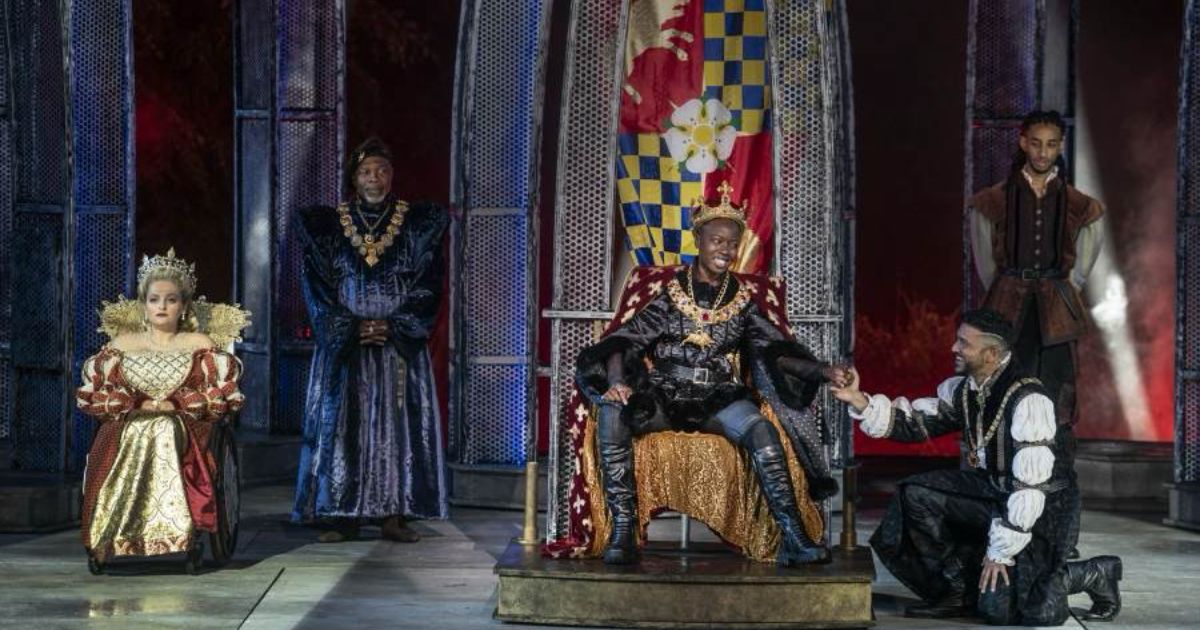
Richard opens alone and tells you exactly who he is before anyone else can. England has peace at last under his brother Edward IV, but Richard cannot enjoy it: he calls himself deformed, unfinished, unfit for courtship, and declares that since he cannot be a lover he is determined to prove a villain. He has already turned the King against their brother Clarence with a drunken prophecy tying the letter G to murder, and Clarence arrives that same day under armed guard, bound for the Tower because his name is George.
Richard performs sympathy on the spot. He pretends Clarence's arrest is the Queen's doing, names Elizabeth Grey and Anthony Woodville, and spins gossip about Mistress Shore and Lord Hastings to keep Clarence angry at the wrong people. When the guard Brakenbury tries to stop a private conversation, Richard covers with jokes and flattery, then promises Clarence he will go to the King and free him, calling the imprisonment a deep wound to brotherhood.
The moment Clarence leaves, Richard drops the mask. He vows Clarence will never return and plans to send his soul to heaven. Hastings enters with news that King Edward is gravely ill. Richard sends him ahead and stays to rehearse the next moves: push Edward's hatred further, make sure Clarence is dead before the King, marry Warwick's youngest daughter for a hidden purpose, and only then count what he has gained.
Richard III opens with something rare: a villain who tells you exactly who he is and what he plans to do before anyone on stage can stop him. He does not discover his evil nature. He chooses it, names it, and gets to work.
The pattern is **The Justified Corruption Loop**. When someone feels cheated by life, they can turn that grievance into permission to abandon morality. Richard acknowledges nature gave him a deformed body, then uses that fact as licence: since he cannot be a lover in peacetime, he will prove a villain and seize power instead.
Explore this chapter with AI to uncover deeper meaning and practical takeaways.
AI Discussion